


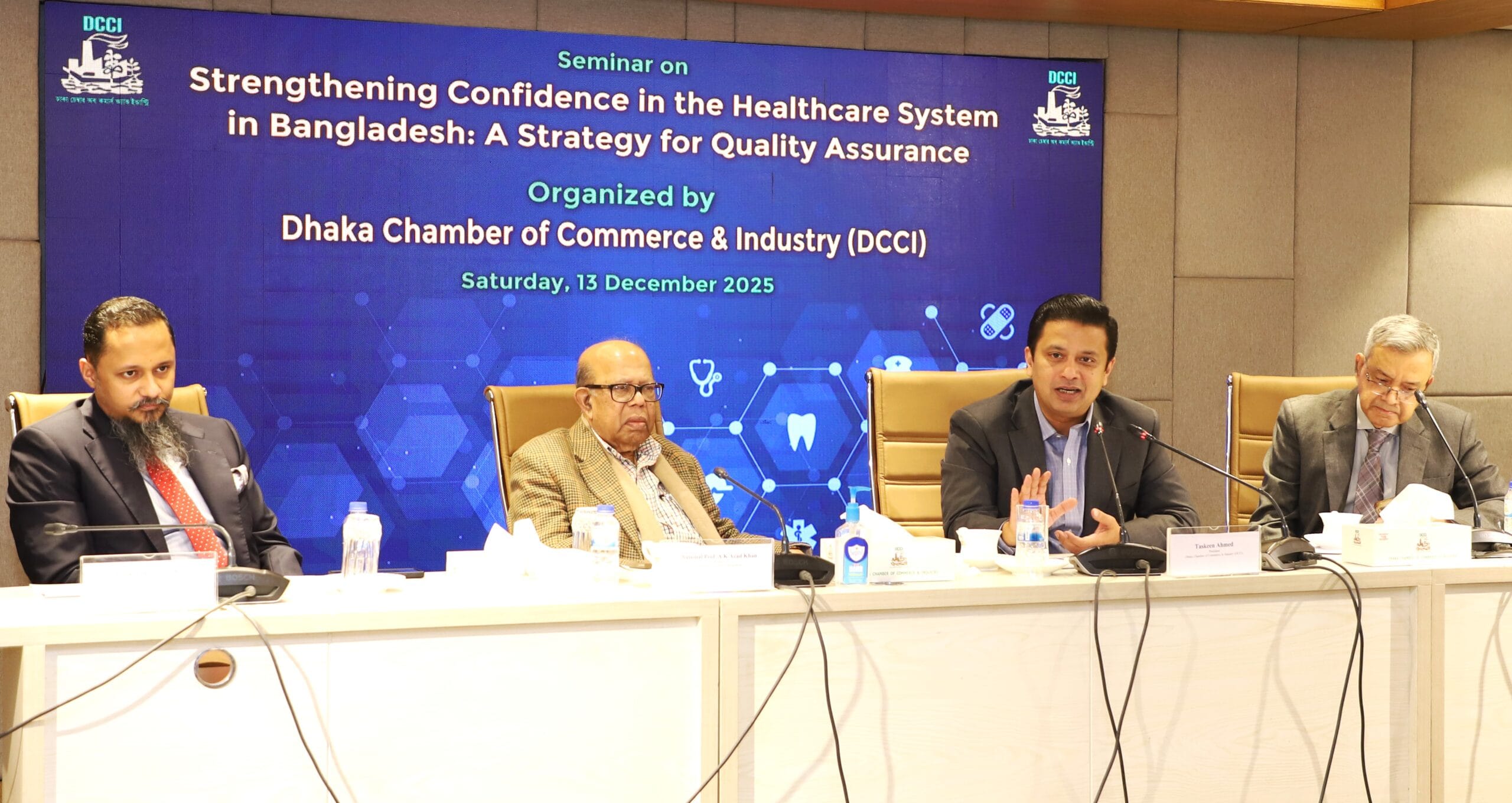
Bangladesh is losing nearly $5 billion annually to overseas medical treatment as patients continue to seek care abroad due to a lack of confidence in the country’s healthcare system, weak diagnostic capacity and inadequate service management, speakers said at a seminar in Dhaka on Saturday.
The concerns were highlighted in the keynote paper presented at a seminar titled “Building Trust in Bangladesh’s Healthcare Sector: Ensuring a Strategic Framework for Quality Control,” organised by the Dhaka Chamber of Commerce and Industry (DCCI) at its Motijheel auditorium.
The paper pointed out that public health spending remains below 1 percent of GDP, one of the lowest levels in South Asia, forcing patients to bear 73 percent of healthcare costs out of pocket.
Only 2.5 percent of the population is covered by health insurance, while nearly 80 percent of hospitals lack advanced diagnostic facilities.
Although the private sector delivers about 60 percent of healthcare services, the paper noted that high costs, uneven quality and poor regulation continue to undermine public trust.
Presenting the keynote, Malik Talha Ismail Bari, managing director of United Hospital and former senior vice-president of DCCI, said patients often doubt the accuracy of diagnoses, fear hidden costs and sudden bill hikes, and remain concerned about counterfeit medicines and substandard medical supplies.
According to the paper, India remains the top destination for Bangladeshi patients, who account for around 52 percent of India’s medical visas. In 2024, approximately 482,000 Bangladeshis travelled to India for treatment, followed by Thailand, Singapore and Malaysia.
The seminar was chaired by DCCI President Taskeen Ahmed, while National Professor AK Azad Khan, president of the Bangladesh Diabetic Association, attended as the chief guest.
Speakers highlighted shortages of specialist doctors, limited access to advanced treatment and weak post-treatment care for complex diseases as major drivers of medical tourism.
The paper noted that advanced healthcare services are available at only 15 centres nationwide, leaving many patients with no option but to seek treatment abroad. It also cited the absence of fixed treatment costs, lack of a unified health information system, and weaknesses in programme oversight and procurement as systemic challenges.
Bangladesh currently has 36 specialised hospitals, of which 19 are located in Dhaka and 17 outside the capital. The Dhaka division alone hosts 1,810 hospitals and clinics, compared to 3,651 across the remaining seven divisions, highlighting geographic disparities in access to quality care.
Despite the challenges, speakers expressed optimism about the sector’s growth prospects. The healthcare market is projected to reach $14 billion in 2025 and expand to nearly $23 billion by 2030–2033, nearly doubling in size.
The medical device market is also growing rapidly and is expected to exceed $820 million in 2025, up from $442 million in 2020, largely driven by rising import demand.
Speakers stressed that boosting public healthcare spending, strengthening regulation, improving service quality and encouraging greater private-sector investment are crucial to restoring confidence in domestic healthcare and reducing the outflow of patients and foreign currency.