


Bangladesh must treat carbon markets not just as a climate tool, but as an engine for investment, technology transfer and long-term mitigation, Environment, Forest and Climate Change Adviser Syeda Rizwana Hasan said on Sunday.
“Even with full adaptation financing, our coastal belt will not survive unless mitigation is strengthened. Adaptation has limits,” she warned, stressing that carbon trading must support both emissions reduction and climate resilience.
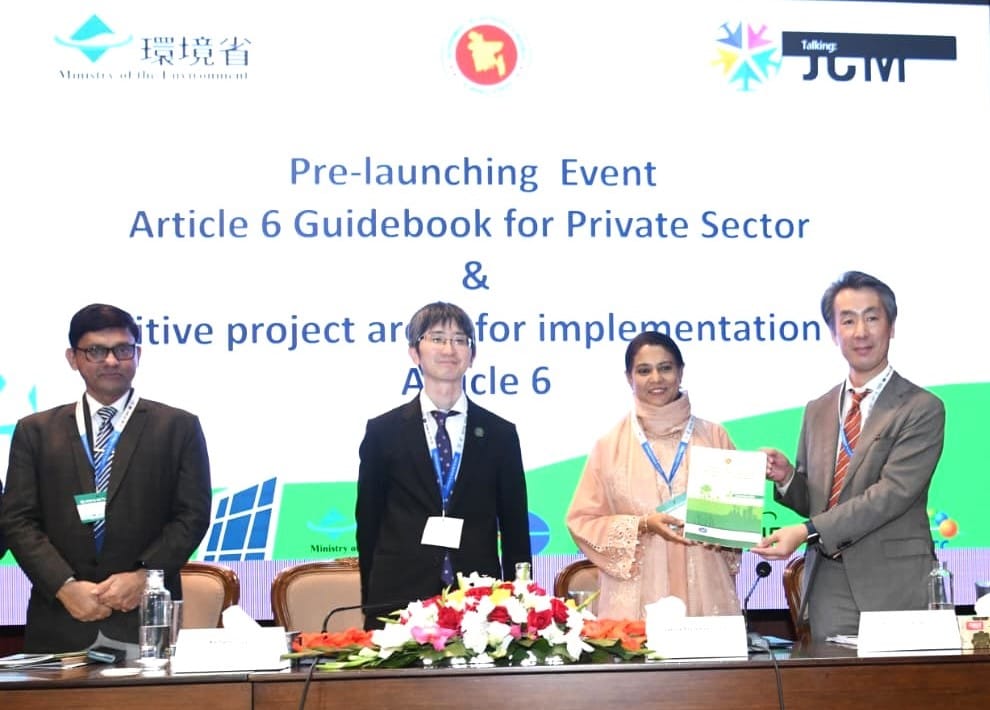
She made the remarks at a workshop titled “Business Forum on JCM Project Matchmaking and Advancing Article 6 Implementation in Bangladesh,” co-organised by the Department of Environment and Japan’s Ministry of the Environment at Agargaon.
Carbon Market Framework Pre-Launched Ahead of COP30
Welcoming Japan’s revised Joint Crediting Mechanism (JCM) rules aligned with Article 6 of the Paris Agreement, the Adviser highlighted Bangladesh’s pre-launch of its first-ever national carbon market framework during COP30 preparations.
The framework, she said, offers regulatory clarity, authorisation guidelines and a predictable platform for international climate investments. She called for more stakeholder engagement before final approval to ensure that vulnerable communities are not excluded.
NDC Targets Require Roadmap, Not Just Commitments
Referring to Bangladesh’s updated Nationally Determined Contributions—6.39% unconditional emission reduction and 13.92% additional conditional reduction by 2035—the Adviser urged the Department of Environment to develop a time-bound implementation roadmap.
“Submitting NDCs is not enough; we need an action plan,” she said, asking ministries to prepare sector-specific strategies for energy, industry, agriculture and waste.
Private Sector Must Lead Transformation
Hasan stressed that export-driven industries often move faster on sustainability when global buyers demand compliance. She urged companies to innovate beyond symbolic CSR tree-planting and invest in renewable energy, energy efficiency, climate-resilient agriculture and nature based solution.
He also cautioned against poorly managed waste-to-energy projects, citing the need for advanced technologies, third-party monitoring, compliance assurance, proper site selection and public disclosure of performance data.
Climate Negotiations Slow, But Japan Remains a Reliable Partner
Criticising the sluggish pace of global climate negotiations, the Adviser said Bangladesh cannot wait indefinitely while disasters intensify. She noted that lack of support from developed countries is constraining adaptation capacity in climate-vulnerable states.
She praised Japan as a consistent partner in climate action, technology support and capacity building. She also admired Japan’s urban design, cleanliness and community-friendly public spaces—elements she believes Bangladesh should adopt in its environmental transition.
Article 6 Guidebook Launched for Businesses
During the programme, Syeda Rizwana Hasan and Keitaro Tsuji, Director of the JCM Office (MOEJ), jointly launched the Article 6 Guidebook for the Private Sector, developed with support from IGES.
The guidebook will help Bangladeshi companies identify bankable mitigation projects and access carbon market opportunities.
New Memorandum of Cooperation Under Preparation
She announced that Bangladesh and Japan are preparing to sign a new Memorandum of Cooperation, which will expand Japan’s support for Bangladesh’s environmental programmes—a “milestone in long-term bilateral cooperation.”
Speakers included Additional Secretary Mohammad Navid Shafiullah, DoE Director General Dr Md Kamruzzaman, IGES representatives, JBCCI leadership and DoE climate officials.