


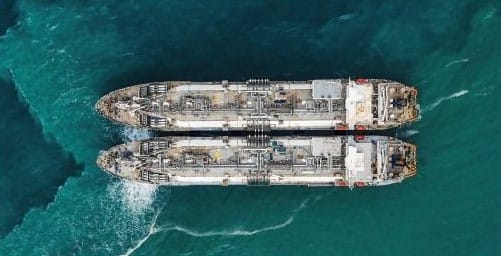
The Bangladesh government has approved the purchase of four cargoes of liquefied natural gas (LNG) to meet fuel demand in the power and industrial sectors, with the price of one cargo rising to more than $28 per million British thermal units (mmBtu).
The approval was given at a meeting of the Cabinet Committee on Government Purchase held at the Secretariat on Wednesday, chaired by Finance Minister Amir Khosru Mahmud Chowdhury.
Of the four cargoes, three will be purchased through international quotations from Aramco Trading Singapore, BP Singapore and Vitol Asia Pte Ltd, while the fourth will be procured from Aramco Trading Singapore under a short-term government-to-government arrangement with Petrobangla.
For the 49th cargo, scheduled for delivery on September 25–26, Aramco Trading Singapore quoted $27.54 per mmBtu. BP Singapore quoted $28.03 per mmBtu for the 50th cargo, scheduled for October 1–2, while Vitol Asia quoted $26.6688 per mmBtu for the 51st cargo, scheduled for October 5–6.
The additional cargo from Aramco Trading Singapore, scheduled for September 10, will cost $23.98 per mmBtu under the short-term LNG sales and purchase agreement between Aramco Trading Singapore and Petrobangla.
The latest approvals come amid a sharp rise in LNG prices in recent months. On August 24, the government approved the purchase of LNG at $24.63 per mmBtu, while the rate approved at a meeting on August 17 was $23.93 per mmBtu.
The increase is even more pronounced compared with late last year. In December 2025, the government was able to purchase LNG at less than $10.50 per mmBtu, meaning the price has risen to nearly three times that level within months.
The Energy and Mineral Resources Division said the three cargoes under the international procurement process were being purchased in accordance with the government’s public procurement rules.
The government has been increasing LNG imports as domestic gas shortages continue to disrupt electricity generation and industrial production. Industries, in particular, have been operating below capacity because of inadequate gas pressure and supply.
The situation has become more challenging amid the war in the Middle East, which has pushed up LNG prices while also making supplies more difficult to secure.
The Cabinet Committee recommended approval of both proposals placed by the Energy and Mineral Resources Division at Wednesday’s meeting.