


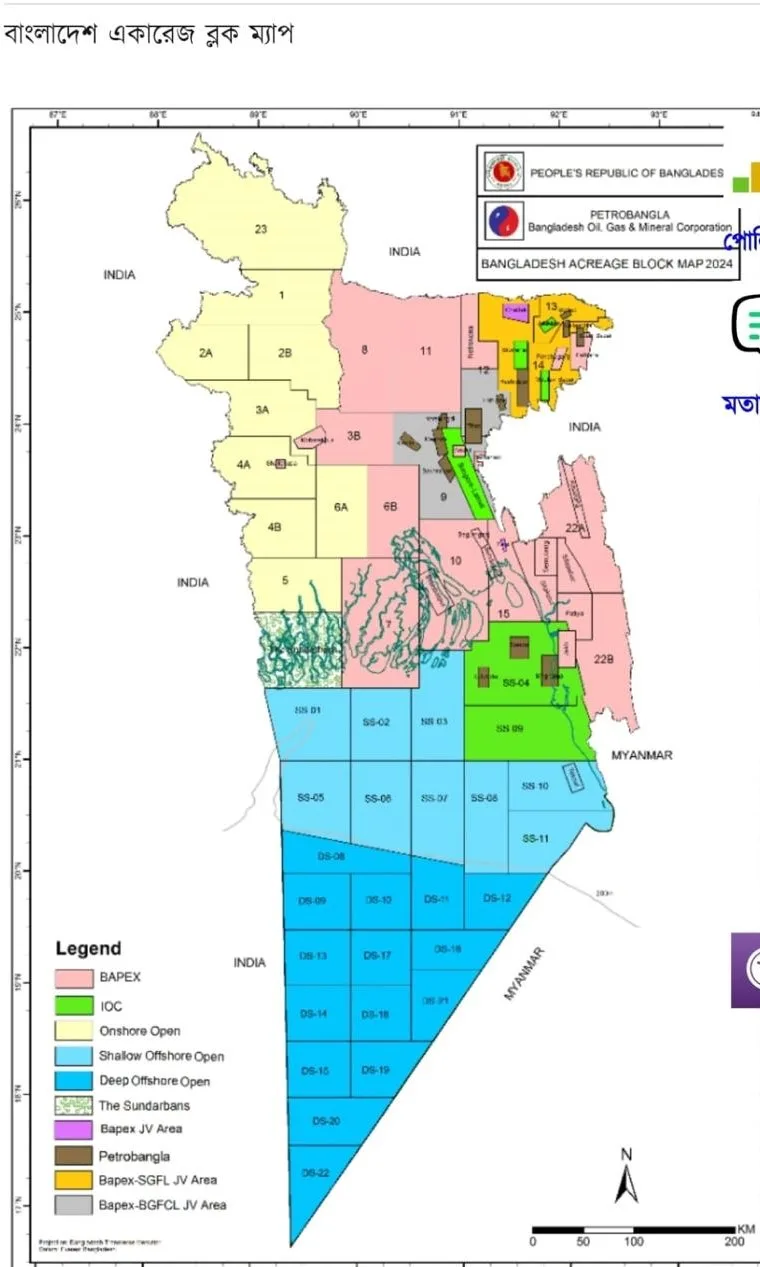
US energy giant Chevron may be granted exclusive exploration and development rights over 6,226 sq km of potentially gas-rich onshore acreage in Bangladesh, including the Chhatak and Sunetra prospects, without a competitive bidding process, according to officials familiar with the proposal.
The proposed acreage covers Onshore Blocks 8 and 11 in Sunamganj and Netrokona districts and forms part of the Surma Basin, which is believed to have significant remaining gas potential.
Government policymakers have agreed in principle to examine Chevron’s proposal, an official said.
Under its latest proposal, Chevron would receive a 90 per cent share of gas produced from any discoveries, while state-owned Bangladesh Petroleum Exploration and Production Company (Bapex) would retain 10 per cent. The proposed arrangement could run for 20 to 25 years, officials said.
Chevron has also proposed a gas pricing formula linked to Brent crude, with the company seeking a price equivalent to 8 per cent of the Brent crude price — a formula officials said could be considered in the government’s proposed framework for the latest onshore bidding round.
The proposal has raised questions because the acreage overlaps with areas where Bangladesh’s state-owned companies are planning extensive drilling.
Government data indicates that up to 150 wells could be drilled across the wider area in the coming years, potentially adding about 1,844 million cubic feet per day (mmcfd) to domestic gas production.
Chevron’s renewed proposal
Chevron first formally expressed interest in additional onshore acreage in December 2024, seeking rights outside the government’s Model Production Sharing Contract (PSC) framework.
The Energy and Mineral Resources Division (EMRD) acknowledged the proposal in January 2025 but said Bangladesh intended to pursue competitive bidding for new onshore exploration.
The proposal was subsequently rejected by officials and a review committee under the previous interim administration, with concerns over the legal basis for awarding acreage without bidding.
Chevron renewed its approach this month with a broader proposal for a new framework covering gas resource development, investment and pricing.
On 12 September, a high-level Chevron delegation led by Javier La Rosa, president of Base Assets and Emerging Countries, presented the proposal during a meeting with Prime Minister Tarique Rahman at the Bangladesh Secretariat.
Officials said Chevron has now specifically proposed developing potentially gas-rich acreage in the Surma Basin, with the government agreeing in principle to examine the request.
The government has formed a new six-member committee, led by Petrobangla’s director (finance), A K M Mizanur Rahman, to examine Chevron’s latest proposal.
Legal and pricing concerns
The proposal comes as Bangladesh faces a widening gas supply deficit and seeks to increase domestic production while reducing its dependence on imported liquefied natural gas (LNG).
However, officials remain divided over whether additional onshore acreage can legally be awarded without competitive bidding.
One official noted that the previous government had relied on the Special Powers Act when extending Chevron’s rights, but said that provision was no longer available.
The EMRD has previously maintained that new onshore acreage should be awarded through competitive bidding and that pricing mechanisms designed for offshore exploration should not automatically be applied to onshore fields.
Earlier, Energy expert and Consumers Association of Bangladesh (CAB) adviser Dr Shamsul Alam has criticised any move to award additional acreage without bidding, arguing that it could increase costs for Bangladesh.
Government reviews joint investment offers
The latest development coincides with a separate government initiative to examine proposals from companies seeking joint investment with Bapex in domestic gas fields.
An EMRD office order issued on 13 September said a six-member committee would assess proposals involving new well drilling, field development and increased gas production.
The committee is headed by Petrobangla’s director (finance), A K M Mizanur Rahman, and includes representatives from the EMRD, Petrobangla and Bapex.
It will review proposals submitted by companies interested in joint investment with Bapex and make recommendations following its assessment.
The move reflects the government’s growing focus on domestic exploration as Bangladesh struggles with persistent gas shortages and rising LNG import costs.
Chevron already dominates domestic gas production
Chevron is Bangladesh’s largest private-sector gas producer, operating the Bibiyana field under Block 12.
The company currently produces about 864 mmcfd, accounting for more than half of Bangladesh’s domestic gas output of around 1,617 mmcfd.
The production period for Bibiyana has been extended to 2034, with a further five-year extension approved. Any additional extension would have to comply with existing PSC provisions, according to the EMRD.
Chevron’s proposed expansion would represent a substantial increase in the company’s operational footprint, taking it well beyond the roughly 400 sq km area associated with its existing Bibiyana operations.
Chhatak legacy
The Chhatak area carries particular significance because of the controversial history of Niko Resources’ operations at the Tengratila gas field in Sunamganj.
Bangladesh allowed Canadian company Niko Resources to develop Tengratila through an unsolicited joint venture with Bapex in 2003.
Two major blowouts occurred in January and June 2005, resulting in the uncontrolled release and burning of large quantities of natural gas and causing extensive environmental and economic damage.
The International Centre for Settlement of Investment Disputes (ICSID) later found Niko liable in relation to operational failures and mismanagement.