


Bangladesh could attract $5–10 billion in foreign direct investment within the next few years if it can guarantee uninterrupted power, multiple international connectivity routes and adequate water resources, industry experts said on Tuesday.
They said global technology companies and hyperscalers are looking for locations where power, digital connectivity and other essential infrastructure can be secured reliably over the long term. Bangladesh’s ability to provide these services competitively could therefore determine whether it can emerge as a regional digital and technology hub.
The experts also warned that Bangladesh’s dependence on a single dominant international submarine cable operator is limiting competition, keeping connectivity costs higher and making the country less attractive to major technology investors.
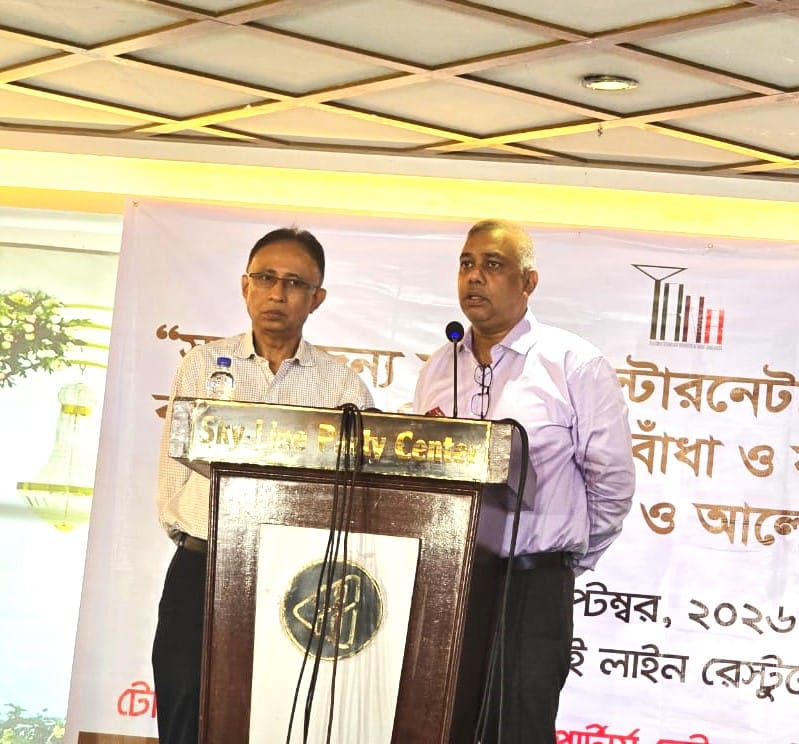
The observations came at a seminar titled “Affordable Internet for All and Investment by Tech Giants in Bangladesh: Current Challenges and the Way Forward”, organised by the Telecom and Technology Reporters Network Bangladesh (TRNB) at the Rawa Convention Hall in Dhaka on Tuesday.
Speakers said Bangladesh currently uses around 13,500 Gbps of international bandwidth, with global technology companies such as Google, Meta, Akamai and Cloudflare increasingly dependent on reliable international connectivity and domestic digital infrastructure.
Competition needed
The seminar was told that Bangladesh Submarine Cables PLC (BSCPLC), the state-controlled operator, has invested Tk819.5 crore in the SEA-ME-WE-4 and SEA-ME-WE-5 submarine cable systems.
From 2008 to 2026, the company generated more than Tk3,000 crore in revenue and over Tk1,362 crore in net profit, according to a presentation.
Speakers argued that the investment and returns demonstrate the commercial potential of international bandwidth, but the present market structure has not created sufficient competition for consumers and businesses.
In 2006, BTCL sold 1 Mbps of bandwidth for Tk75,000. The price fell to Tk500 in 2016 and stands at about Tk120 this year. Analysts at the seminar said competition from private submarine cable operators could bring the price down to Tk60–70 per Mbps by 2027.
They said such reductions would be difficult to achieve without allowing more private investment and alternative international routes.
Moin Uddin Ahmed, treasurer of the Internet Service Providers Association of Bangladesh (ISPAB), called for easier approval of private submarine cables and open, carrier-neutral and non-discriminatory access to cable landing stations.
The recommendations also included expanding the number of submarine cables and landing stations, promoting domestic fibre sharing, expanding internet exchange points and local peering, and rationalising taxes on broadband infrastructure and equipment.
FDI depends on infrastructure
Aminul Hakim, director and chief executive officer of Metacore Subcom Ltd, said Bangladesh could not simultaneously maintain a monopoly in international connectivity and expect affordable, high-quality internet services.
He said private investment should be allowed to create competition in the international connectivity market.
“Uninterrupted power supply and reliable connectivity are fundamental requirements for large technology investments,” speakers said, stressing that water availability is also critical for data centres and other technology-intensive facilities.
With these three infrastructure pillars—power, connectivity and water—in place, Bangladesh could position itself to attract $5–10 billion in FDI within a few years, they said.
Hakim also questioned how Bangladesh could ensure affordable and secure connectivity if the country became overly dependent on foreign companies for international connectivity.
Speakers warned that without new submarine cables and alternative routes, foreign-controlled capacity could increase, potentially creating concerns over data sovereignty, resilience and national digital security.
A private submarine cable is expected to become operational around the end of the year or early next year, according to the seminar.
Digital access remains limited
The speakers also highlighted the gap between Bangladesh’s existing internet users and its potential digital market.
At present, around 1.5 crore people are connected to the internet, while the potential target is about 4 crore people, underscoring the need for affordable and reliable broadband infrastructure.
The seminar was chaired by TRNB president Masuduzzaman Robin and moderated by former president Samir Kumar Dey. Mahmood Shahed, project head of Metacore Subcom Ltd, and Moin Uddin Ahmed presented the keynote paper.
Other speakers included Mashiur Rahman, chief executive officer of Cidenet Communications, and AHM Bazlur Rahman, chief executive officer of Bangladesh NGOs Network for Radio and Communication.
Speakers said Bangladesh would need a stable, predictable and technology-neutral regulatory framework, alongside competitive international connectivity, reliable electricity and adequate water resources, if it is to become a genuine regional digital infrastructure hub.