


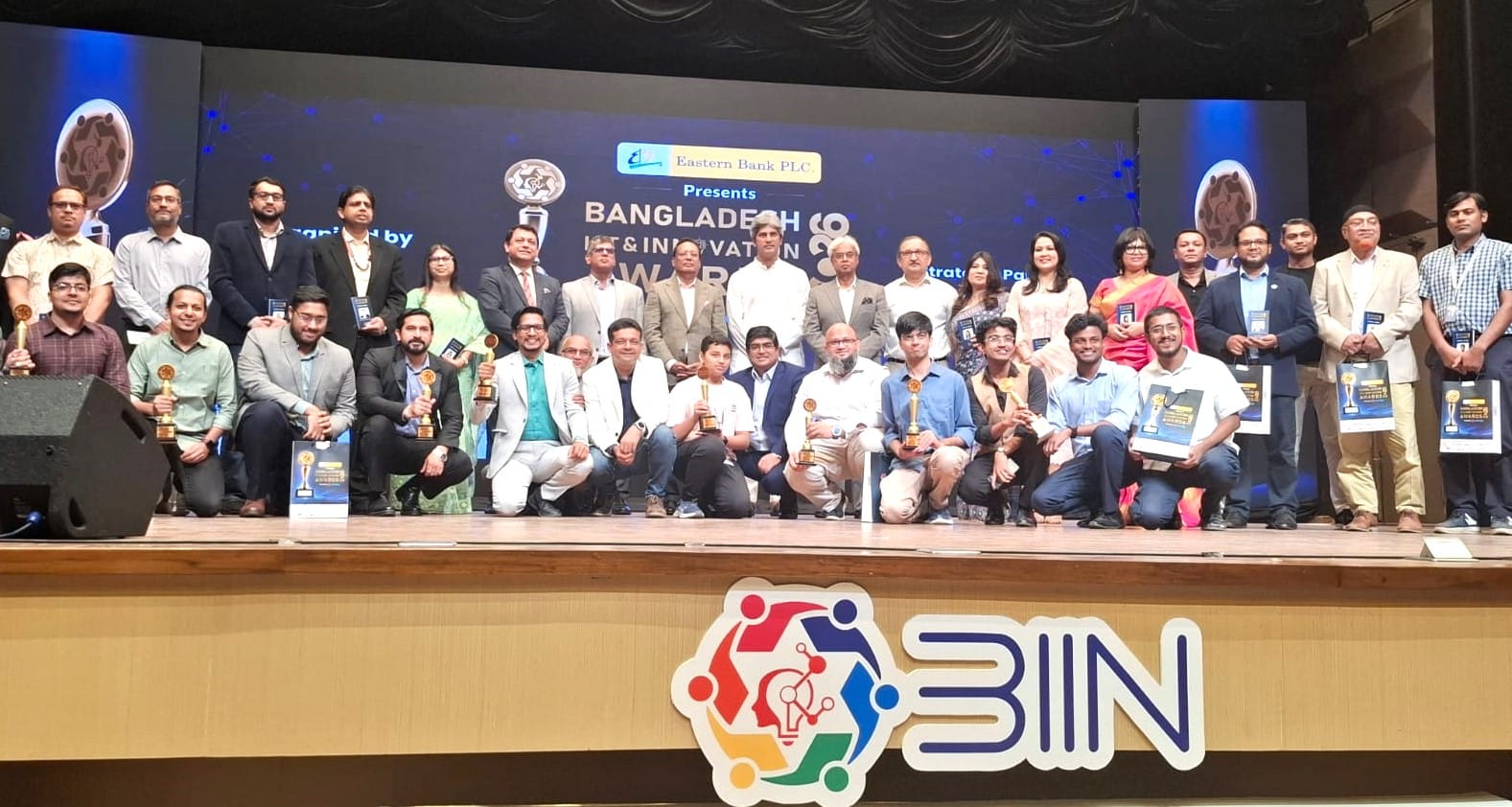
Bangladesh must move beyond being a consumer of foreign technology and become a producer and exporter of home-grown innovations, Science and Technology Minister Faqir Mahbub Anam has said.
The government is working to establish a global “Made in Bangladesh” brand in artificial intelligence (AI), semiconductor design, software, data centres and digital services, he said.
The minister was speaking as chief guest at the Bangladesh ICT and Innovation Awards 2026 at the BRAC University Auditorium in Dhaka on Saturday.
Under the leadership of Prime Minister Tarique Rahman, Bangladesh is seeking to transform its labour-intensive economy into a knowledge-based one and strengthen its position among the world’s leading digital economies over the next five years, Mr Anam said.
He stressed the need to develop innovation, technological skills and research among young people to achieve that ambition.
“Instead of complaining when faced with problems, they have used their talent to develop practical solutions,” he said, praising the young innovators recognised at the event.
A total of 355 projects were submitted for this year’s awards, with 44 innovations selected after two days of evaluation by 40 judges from industry, academia, banking, public administration and the start-up sector.
Nine projects received Champion awards, 10 were named Winners and 25 received Merit awards.
The minister said the number of submissions demonstrated the strength of Bangladesh’s young talent and its potential to develop home-grown technology.
Bangladesh’s large working-age population and expanding mobile and internet networks provide a strong foundation for a technology-driven economy, he said. The next priority should be to build a stronger ecosystem around domestic research, innovation and skills.
The minister also highlighted Bangladesh’s emphasis on capacity-building, knowledge-sharing, affordable connectivity and digital public goods at the recent World AI Conference in Shanghai.
He said the innovations recognised at the awards were designed to address real-world problems and were not simply copies of foreign technologies.
However, turning prototypes into commercially viable products and eventually building industries around them would require research, investment and policy support, Mr Anam said.
He urged private-sector companies and investors to become early customers of young innovators, provide opportunities for pilot projects and invest in promising technologies.
Universities, he added, should establish stronger links between their research laboratories and industry.
“We are with you; the government is with you,” he told the innovators.
State Minister for Planning Md Jonaid Abdur Rahim Saki said Bangladesh’s young talent must be harnessed to build an inclusive and prosperous economy.
He said economic growth and wealth creation would depend increasingly on science, information technology, research and innovation.
To achieve the government’s ambition of building a trillion-dollar economy, innovation, research and business must be brought together rather than treated as separate activities, Mr Saki said.
He called for an integrated “trinity” involving government, business and academia.
Science and Technology Secretary Md Anwar Hossain said Bangladesh still faced significant challenges in taking innovations from ideas and research to the market, particularly in areas such as incubation, market development and commercialisation.
The government was working to create an innovation-friendly ecosystem, including stronger intellectual property protection, access to finance and tax support for research and development, he said.
Bangladesh Bank, the Department of Patents, Designs and Trademarks, the National Board of Revenue and UNDP are working with the government in different areas of the initiative.
Mr Hossain said technology and green financing for start-ups was being developed through Bangladesh Bank, while measures were being taken to strengthen intellectual property protection and provide tax incentives for R&D investment.
He said Bangladesh’s ambition of becoming a trillion-dollar economy by 2034 would require greater emphasis on research, innovation and a knowledge-based economy, alongside traditional production-driven growth.
Four priorities have been identified for the science, technology and innovation sector: STEM and human-resource development, research-to-market, innovation-to-market and frontier technologies.
These include building capabilities in semiconductors, AI, nanotechnology, biotechnology and space research.
BTRC Chairman Major General Md Emdad Ul Bari (Retd) said connectivity alone was not sufficient to drive digital development.
“What is needed is quality internet, appropriate devices and affordable prices,” he said, adding that regulation should enable rather than obstruct innovation.
The Bangladesh ICT and Innovation Network organised the awards, with Eastern Bank PLC as presenting sponsor and Cartup as the Powered By Partner. The Ministry of Science and Technology was the strategic partner.
The Champion and Winner innovations will be nominated to represent Bangladesh at the Asia Pacific ICT Alliance (APICTA) Awards 2026.