


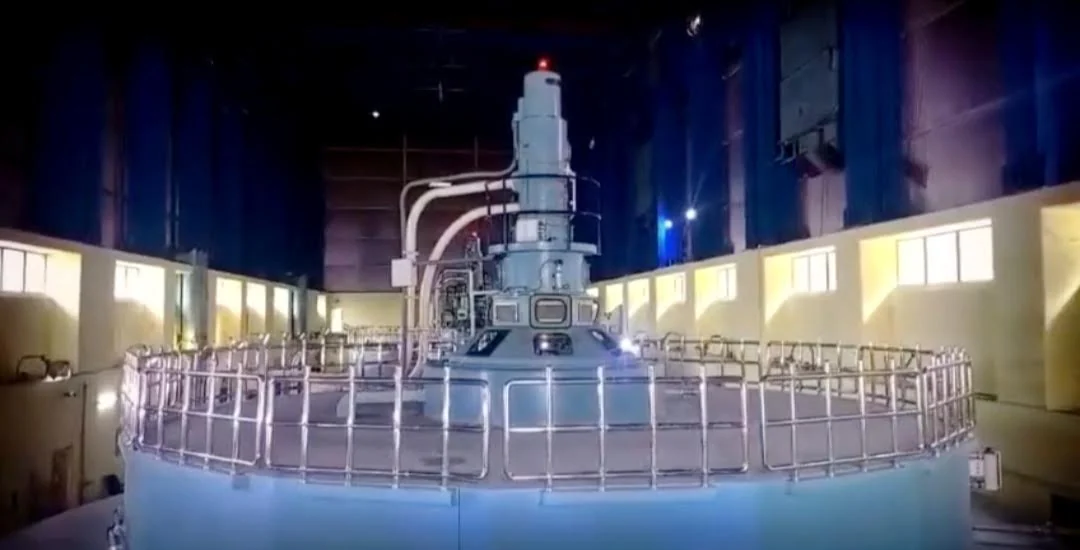
The Bangladesh Power Development Board (BPDB) has proposed a Tk870 crore project to rehabilitate two ageing units of the country’s only hydropower plant, aiming to restore up to 30 megawatts (MW) of lost generation capacity and extend their operational life by another 20 years.
The proposed overhaul of Units 4 and 5 of the Karnafuli Hydropower Station in Kaptai, Rangamati, comes amid growing concerns over structural cracks, excessive vibration and obsolete equipment that have reduced electricity generation and increased the risk of major mechanical failure.
Each unit has an installed capacity of 50MW but can now generate only 35-40MW, leaving a combined capacity shortfall of 20-30MW, according to a BPDB feasibility study.
The three-year project, scheduled for implementation from January 2027 to December 2029, would replace damaged turbine and generator components, modernise control systems and upgrade electrical and safety equipment.
However, the proposal has come under scrutiny from the Planning Commission over its sharply increased cost, repeated tender failures and the lack of a clear assessment of the underlying causes of the damage.
The commission noted that Toshiba, the original equipment manufacturer, had offered to rehabilitate the units for $11.92 million in 2018, compared with the current estimated project cost of $71.13 million — nearly six times higher.
The commission’s Industry and Energy Division reviewed the proposal at a meeting in mid-October, chaired by Nurunnahar Chowdhury, former member of the division, to assess its justification, cost and financing arrangements.
“The need for rehabilitation is underscored by the condition of the two units, which were commissioned in 1988 and have operated for about 37 years,” Nurunnahar said.
According to the feasibility study, cracks have developed in seven of the 10 rotor-rim supporting ledges in Unit 5 and six of the 10 in Unit 4, with Unit 5 in a more critical condition.
Repeated welding repairs have hardened the affected metal, making it increasingly brittle and raising the risk of catastrophic mechanical failure and potentially irreversible damage.
The study attributed the deterioration to excessive turbine vibration and age-related deformation of the foundations, which distorted the stators and created imbalanced magnetic forces.
The units were last rehabilitated in 2010-11, although manufacturer guidelines recommend major overhauls every eight to 10 years.
Their control and protection systems have also become obsolete, while spare parts are increasingly difficult to obtain, making further piecemeal repairs technically and economically unsustainable, the study said.
Under the proposed rehabilitation, the BPDB would replace major generator components, including stator coils, rotor poles, spokes and rim-support systems, alongside turbine runners, discharge rings and bearings.
The project would also install digital governors, modern control systems and static excitation equipment.
Additional upgrades would cover the 132-kilovolt and 11-kilovolt switchyards, transformers, cooling systems and fire-fighting facilities.
All work would be carried out within the existing power station, requiring no additional land.
Of the estimated Tk869.97 crore project cost, Tk656.99 crore would come from a project loan, Tk200.58 crore from the government and Tk12.41 crore from the BPDB’s own resources.
The turnkey supply and works package accounts for Tk647.85 crore, including Tk221.97 crore for hydraulic turbines and Tk205.17 crore for generator and excitation systems. Customs duties, taxes and VAT are estimated at Tk148.47 crore.
Repeated tender failures raise concerns
The Planning Commission has also questioned the BPDB’s procurement strategy following several unsuccessful attempts to appoint a contractor between 2018 and 2022.
Toshiba declined to serve as the prime contractor in 2019, prompting the BPDB to invite international tenders.
The first tender attracted only one bidder and was cancelled. A second tender in May 2021 also received a single proposal, with the evaluation committee finding that a restrictive technical condition had limited competition.
Another procurement attempt in 2022 was cancelled after all bidders were declared non-responsive.
Against this backdrop, the commission has sought an explanation of how the BPDB intends to avoid similar setbacks.
It has also requested an update on an independent reviewer’s recommendation to conduct a root-cause analysis of the equipment failures.
Other concerns include the proposed appointment of 11 consultants, the availability of foreign financing and whether a smaller-scale rehabilitation could be undertaken entirely with government funding.
The commission has further asked the BPDB to examine whether investment in solar power could replace the lost 20–30MW of generation capacity at a comparable cost.
It also sought information on wind power potential in the Chattogram Hill Tracts, the cost and scope of the 2010–11 rehabilitation, and future plans for the plant’s other units.
The proposed project is not included in the revised Annual Development Programme for fiscal year 2026-27.
The BPDB maintains that rehabilitating the units is necessary to preserve an existing national asset, improve generation reliability and support cleaner electricity production.
The Integrated Energy and Power Master Plan 2023 projects Bangladesh’s electricity demand to reach 27,087MW by 2030 and 50,364MW by 2041.
However, the project must address the Planning Commission’s concerns over costs, procurement and financing before it can move towards approval and implementation.