


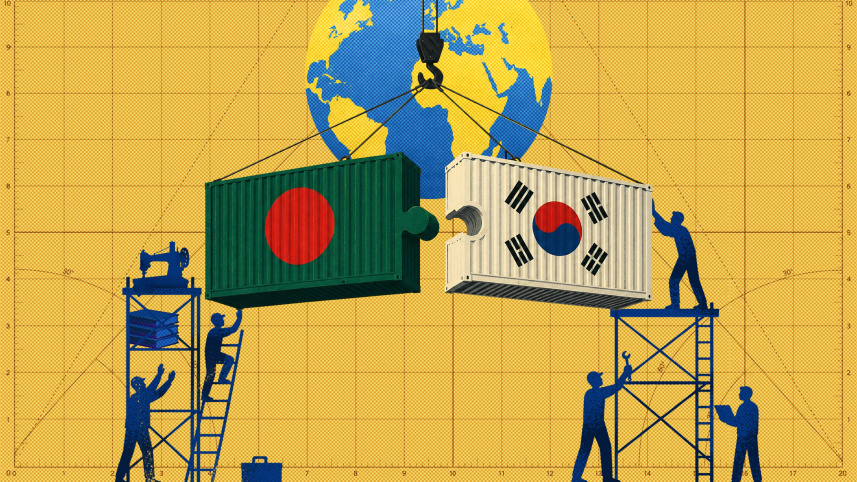
Bangladesh and the Republic of Korea have agreed to deepen their economic partnership following the conclusion of negotiations on the Comprehensive Economic Partnership Agreement (CEPA), with a renewed focus on trade, investment, technology and private-sector cooperation, says BSS report.
The two sides agreed to establish a government-private sector working group to identify priority areas for cooperation and facilitate business engagement, including through public-private partnerships (PPPs).
The understanding was reached at a bilateral meeting between Bangladesh Finance and Planning Minister Amir Khosru Mahmud Chowdhury and Korean Trade Minister Jung-sung Park in Seoul on Monday.
Adviser to the Prime Minister on Posts, Telecommunications and Information Technology Rehan Asif Asad, Prime Minister’s Special Assistant for Investment and Capital Market Affairs Tanvir Shahriar Ghani, Economic Relations Division (ERD) Secretary Md Shahriar Kader Siddiky and senior officials of the division and Invest Bangladesh were present at the meeting, said a press release received here today.
The proposed government-private sector working group, involving relevant government agencies and chambers of commerce, will focus on identifying priority reforms, investment opportunities, business facilitation measures and mechanisms for stronger private-sector engagement, including PPPs.
The Finance and Planning Minister said the conclusion of CEPA negotiations provides an important opportunity to take Bangladesh-Korea economic relations into a broader and more dynamic phase.
“We now have an opportunity to move beyond the traditional textile and garments-based partnership and build a broader, technology-driven economic relationship with Korea.”
He highlighted electronics and semiconductors, shipbuilding and maritime industries, renewable energy, artificial intelligence, digital and creative industries as emerging areas of cooperation, alongside energy, pharmaceuticals, medical devices, agro-processing, logistics, advanced manufacturing and infrastructure.
The minister also briefed the Korean side on Bangladesh’s ongoing efforts to improve the investment climate, including digitalisation and automation of capital repatriation, reduction of customs duties on raw materials for electronics from 26 percent to zero, and measures to streamline customs and port procedures.
He encouraged greater use of G2G and PPP models to accelerate strategic infrastructure, energy and other priority investment projects.
Minister Jung-sung Park reaffirmed Korea’s strong commitment to its long-standing partnership with Bangladesh and referred to various matters of interest raised by Korean businesses operating in Bangladesh, with a view to further facilitating their operations and future investments. The Korean side agreed to share a consolidated list of these matters with the Bangladesh side for consideration and follow-up.
As part of the visit, the Bangladesh delegation also held high-level meetings with leading Korean companies to explore concrete investment, technology and business opportunities in Bangladesh.
At Hyundai Glovis, discussions with President Lee Kyu-bok and senior officials focused on logistics, port development and the automotive sector. The Bangladesh side highlighted opportunities in logistics hubs, ports, economic and free trade zones, automotive supply chains and smart logistics. Hyundai Glovis expressed strong interest in exploring opportunities in Bangladesh, and both sides agreed to establish working-level teams to advance potential areas of cooperation.
At Hanwha Ocean, discussions covered shipbuilding, ship repair and dry-docking, maritime infrastructure and Floating Storage and Regasification Unit (FSRU) projects. Hanwha Ocean proposed a phased approach beginning with ship repair, maintenance and retrofitting, followed by higher-value shipbuilding and other maritime activities. Both sides agreed to pursue further technical discussions and follow-up visits.
The delegation also met President Kim Woo-june and senior officials of Samsung Electronics to explore expanded cooperation in electronics manufacturing, artificial intelligence, digital connectivity, and workforce development. The Finance and Planning Minister encouraged Samsung to explore opportunities to expand its operations and introduce advanced technology solutions in Bangladesh. President Kim expressed Samsung’s interest in exploring greater future cooperation with Bangladesh.
The Finance and Planning Minister said Bangladesh looks forward to working closely with the Korean government and Korean businesses to translate the post-CEPA opportunity into tangible economic outcomes.
He emphasised that the next phase of Bangladesh-Korea economic relations should focus on higher trade and investment, technology transfer, industrial diversification, quality employment and deeper integration into global value chains, creating new opportunities for shared growth and prosperity.