


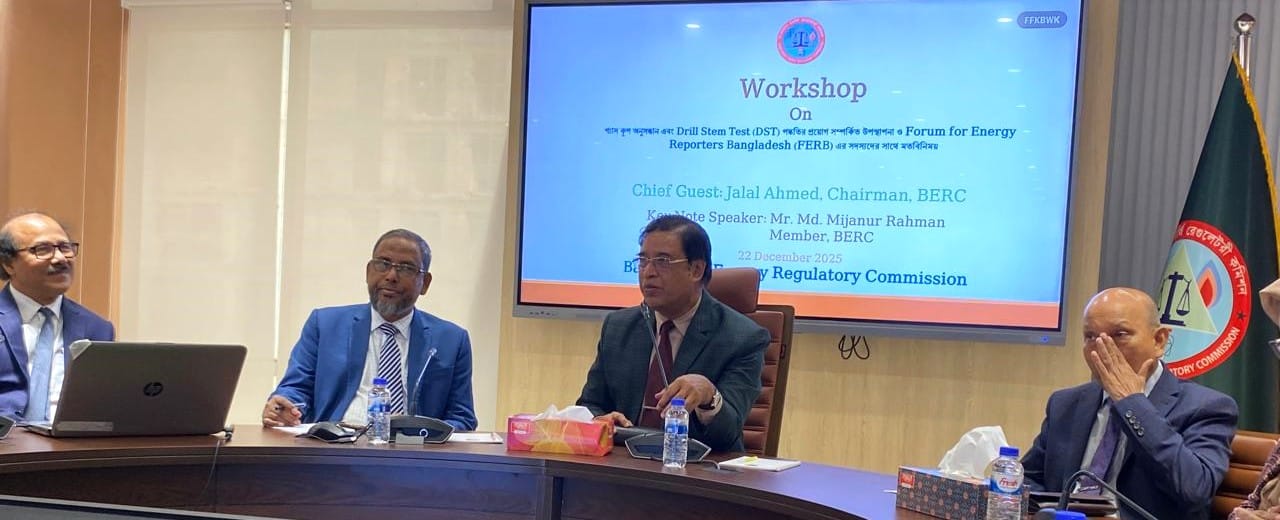
Bangladesh has long suffered from inadequate investment and risk-taking in gas and oil exploration, Bangladesh Energy Regulatory Commission (BERC) Chairman Jalal Ahmed said on Monday.
“Successive governments have been reluctant to take risks in exploration, which is why the level of investment and exploration required over the last 30 to 40 years did not take place,” he said.
Jalal Ahmed made the remarks at a workshop on Drill Stem Test (DST) at BERC’s conference room in the IEB building in the capital today.
The workshop was organised by BERC for members of the Forum for Energy Reporters Bangladesh (FERB).
He said the absence of extensive seismic surveys has been a major shortcoming in exploration efforts. “Had we conducted large-scale seismic surveys, we could have undertaken planned exploration based on those findings.
But we have remained weak in this area,” he said, adding that oil and gas exploration and development activities now need to be significantly intensified.
Describing field-level realities, the BERC chairman said flaring is often visible in gas fields, with flames and loud noise coming from pipes, which is an important part of exploration and testing.
Once the presence of gas is confirmed after drilling, pressure and flow rates are tested for 24 to 48 hours to determine commercial viability, he explained.
He proposed to conduct the reservoir management study to find out prospect of gas resources here in different gas fields.
BERC member (gas) Md Mizanur Rahman provided a detailed technical explanation at the workshop. He said determining whether a well contains gas and whether it is commercially viable requires several stages and is a time-consuming process.
Before drilling, seismic surveys are conducted to identify prospective geological structures and determine the precise well location.
During drilling, he said, gas or oil presence is identified mainly through two types of logging—mud logging and wireline logging. Mud logging units collect data round the clock during drilling, analysing parameters such as drilling rate, pressure, mud density and gas cuttings. On-site geologists and data engineers use this information to identify gas shows or formation changes.
After gas is found, DST or phased testing is carried out to assess volume and production potential, Rahman said, noting that the same procedure applies to both oil and gas.
Although oil and gas were found in several wells in the past, sustained long-term production was not always possible, he added, but such data provide valuable guidance for future exploration.
Referring to the Sylhet Belt, Rahman said there is strong potential for condensate along with gas, which can be used to produce valuable products such as LPG.
“With proper planning, modern technology and phased testing, assessing gas and oil potential within a short time should now be the key objective,” he said.
Among others, BERC members Md Abdur Razzak (finance, administration and law), Dr Syeda Sultana Rajia (petroleum) and Brigadier General Mohammad Shahid Sarwar (retd) (electricity), FERB Chairman Md Shamim Jahangir, FERB Executive Director Serajul Islam Siraj, and senior BERC officials were present at the workshop.