


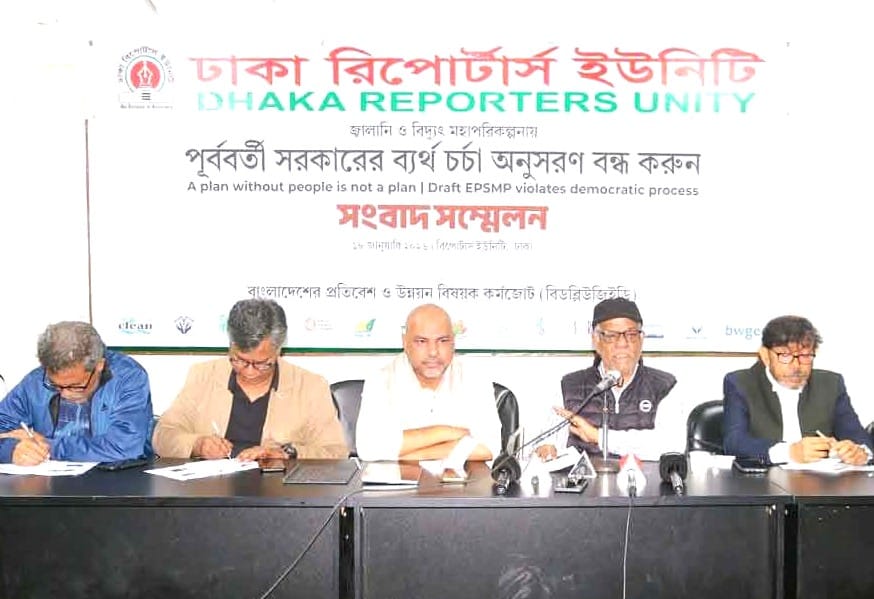
Civil society groups on Sunday strongly demanded the cancellation of the draft Energy and Power Sector Master Plan (2026–2050), calling for a new, transparent and participatory plan that adequately addresses environmental and social impacts.
They alleged that the draft master plan prepared by the interim government was formulated without following democratic processes and in disregard of environmental and social considerations.
The demand came at a press conference organised by the Bangladesh Working Group on Ecology and Development (BWGED) at the Dhaka Reporters Unity auditorium in the capital.
Representatives from several civil society organisations, including CLEAN, BELA, CEPR, ETI Bangladesh, JET-NET BD, LEAD and the Manusher Jonno Foundation, attended the event.
Presenting the keynote statement, CLEAN Network Adviser Manowar Mostafa said that the interim government was constitutionally mandated to oversee routine state affairs, yet it was attempting to impose a long-term, high-risk energy plan.
He claimed the draft had been prepared without any meaningful public consultation, despite a directive from the High Court.
He further alleged that while the draft plan claims a 44 percent share of renewable energy, the realistic contribution would be only about 17 per cent.
The proposal to expand gas-based power generation and to remain nearly 50 percent dependent on LNG, coal and oil even after 25 years was described as a serious threat to the country’s energy security and economic stability.
BWGED Member Secretary Hasan Mehdi said the attempt to finalise such a nationally important plan without public hearings or open discussions reflected a continuation of the opaque policymaking practices of previous governments.
Speakers warned that implementation of the draft plan would lead to unnecessary excess generation capacity, rising capacity charges, increased import bills and higher carbon emissions.
From the press conference, civil society groups called for the immediate suspension and cancellation of the draft EPSMP 2025, the launch of a fresh consultation process involving citizens and experts, and the formulation of a realistic roadmap towards a 100 per cent renewable energy–based system.
They cautioned that if the current draft plan is implemented, the public would bear the burden of higher electricity prices, increased taxes and subsidies, and irreversible environmental damage for decades to come.