


Bangladesh’s two largest garment exporters’ associations have urged the government to withdraw its decision to scrap the bonded warehouse facility for importing cotton yarn from India, warning that the move could push the apparel sector into deeper crisis at a time of falling exports and rising global uncertainty.
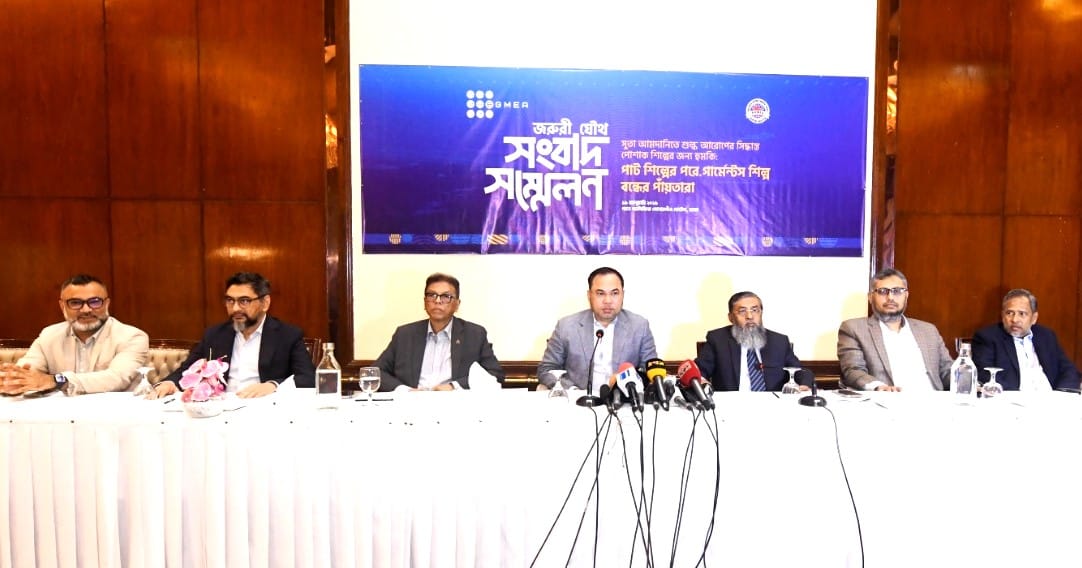
Leaders of the Bangladesh Garment Manufacturers and Exporters Association (BGMEA) and the Bangladesh Knitwear Manufacturers and Exporters Association (BKMEA) made the call at a joint press conference at a city hotel on Monday.
Bangladesh’s commerce ministry has recently moved to end the long-standing duty-free import facility in an effort to protect domestic spinning mills.
BGMEA Acting President Salim Rahman said the decision was taken unilaterally, ignoring the concerns of garment exporters who are the primary buyers of yarn produced by local spinning mills.
“It is surprising that the interests of the garment industry have been completely ignored in making such a sensitive and far-reaching decision,” he said, adding that discussions with exporters were still ongoing when the Trade and Tariff Commission recommended withdrawal of the facility.
Rahman warned that removing the bonded facility would raise total import taxes on yarn to around 37%, significantly increasing production costs for exporters.
Industry leaders estimate that restricted imports could force exporters to pay an additional $0.30 to $0.60 per kilogram of yarn, an increase they say the sector cannot absorb in the current competitive global market.
“If this illogical decision is not withdrawn, we will be forced to take strict measures to protect the existence of our industry,” Rahman said, without specifying what actions might follow.
He described the policy shift as “suicidal”, arguing that while it may be intended to support local spinners, it risks undermining the garment and knitwear sectors that earn the bulk of the country’s export revenue.
BKMEA leaders echoed the concern, saying international buyers had already expressed alarm over the proposed change. “Buyers are frightened due to the imposition of the new duty,” said BKMEA Executive President Fazlee Shamim Ehsan, noting that higher raw material costs could lead to reduced orders.
The associations also questioned the legal basis of the move, claiming it violates provisions of the World Trade Organisation’s Safeguard Agreement, which require transparent and impartial investigations to prove serious injury to local industry before imposing such restrictions. Rahman said no such investigation had been conducted.
The government has provided duty-free yarn imports under the bonded warehouse system since the 1980s to keep export-oriented garment manufacturing competitive.
Textile mill owners, however, have long argued that cheap yarn imports—particularly from neighbouring countries—threaten the survival of domestic spinning mills.
The Bangladesh Trade and Tariff Commission has supported this view, prompting the commerce ministry to ask the National Board of Revenue on 12 January to suspend the facility for Indian cotton yarn.
Garment exporters counter that the problem lies not in imports but in structural inefficiencies within the spinning sector. Rahman said local mills are operating at around 60% capacity and struggling with high production costs, energy shortages and lack of modernisation.
“What the spinning mills need is not artificial protection through duties, but capacity building and productivity upgrades,” he said, suggesting direct incentives, reliable gas and power supply, tax relief and easier access to low-interest loans as alternatives.
He also warned of the broader economic impact, noting that apparel exports fell 2.63% year-on-year in the July–December period of the current fiscal year, with a sharp 14.23% decline in December alone.
Higher yarn prices, he said, would further erode competitiveness, prompting buyers to cut orders and hurting both direct and deemed exporters.
At the press conference, BGMEA and BKMEA jointly demanded immediate withdrawal of the decision to impose duty on yarn imports, direct cash assistance or special incentives for the spinning sector instead of import barriers, and urgent steps to lower production costs across the textile value chain.
Senior leaders of both organisations, including BKMEA President Mohammad Hatem and BGMEA Vice Presidents Inamul Haque Khan and Shihab Uddouza Chowdhury, were present at the briefing.