


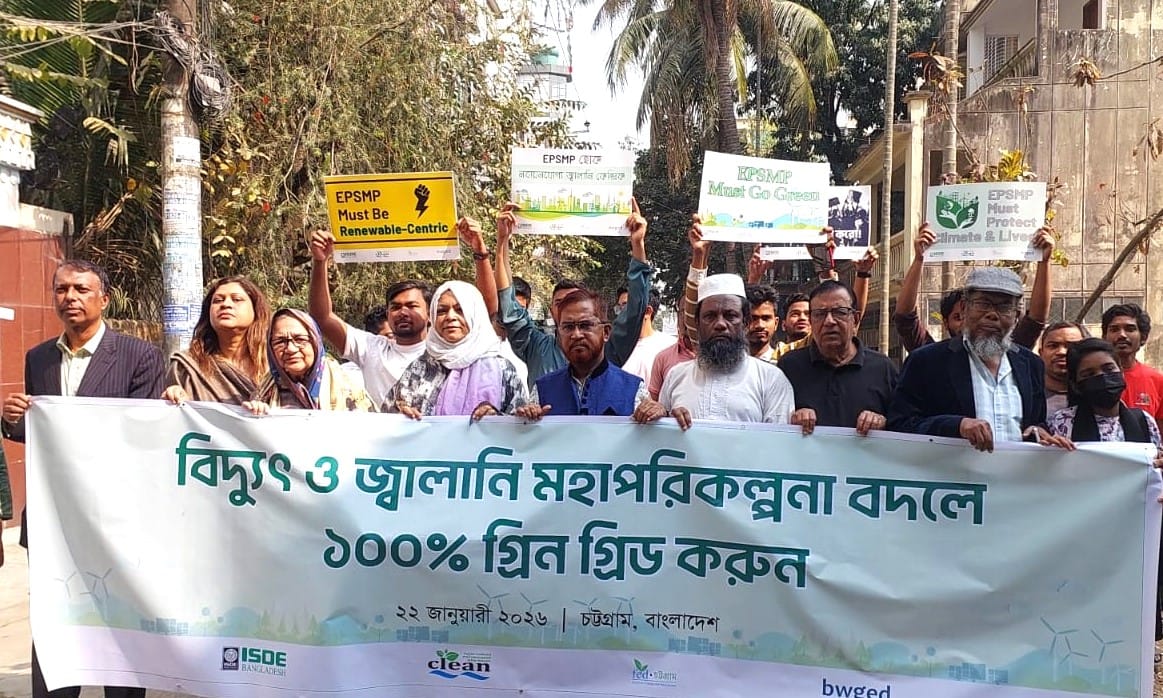
Civil society groups in Bangladesh have protested against the interim government’s move to approve a 25-year Energy and Power Sector Master Plan (EPSMP 2025) without holding any public consultations or discussions with citizens, independent experts or key stakeholders.
The protest took place in Chattogram, where demonstrators accused the interim administration of advancing the draft master plan for 2026–2050 in a manner that undermines democratic process, transparency and public participation. Civil society representatives claimed that the plan was prepared without adequately assessing environmental and social impacts and ignored meaningful public engagement.
The protest was organised by the Bangladesh Working Group on Ecology and Development (BWGED), with ISDE Bangladesh, the Environment and Development Forum–Chattogram, and the Coastal Livelihood and Environment Action Network (CLEAN) acting as co-organisers.
SM Nazer Hossain, vice-president of the central committee of the Consumers Association of Bangladesh (CAB) and executive director of ISDE Bangladesh, said the interim government had completely excluded the public, civil society and independent experts from the formulation of the draft energy and power master plan.
“This attempt to finalise such a critical national policy without dialogue or open consultation mirrors the opaque and unaccountable policymaking practices of the previous authoritarian government,” he said.
Speakers at the protest argued that the interim government’s mandate was limited to ensuring routine state administration, not imposing a long-term, high-risk energy strategy with far-reaching economic, social and environmental consequences. They alleged that, despite a High Court directive, no meaningful participatory consultation process had been followed.
Activists also warned that the EPSMP 2025 risks legitimising continued fossil fuel dependence, similar to the controversial use of the Quick Enhancement of Electricity and Energy Supply (Special Provisions) Act in the past. Although the plan promotes “energy transition” rhetorically, critics said that in practice only 17 per cent of energy would come from genuine renewable sources, despite claims of a 44 per cent share on paper.
The draft plan proposes increasing gas-based power generation capacity from 15.8 gigawatts to 25.2 gigawatts and projects that Bangladesh will remain 50 per cent dependent on liquefied natural gas (LNG), coal and oil even after 25 years. Protesters warned that such reliance poses serious risks to the country’s energy security and economic stability.
Civil society groups also criticised the plan’s reliance on costly and experimental technologies such as hydrogen, ammonia co-firing and carbon capture and storage (CCS), arguing these could push Bangladesh into further debt, subsidies and environmental crises. According to the plan, Bangladesh’s carbon emissions would reach 186.3 million tonnes of CO₂ equivalent by 2050—contradicting the country’s Nationally Determined Contributions (NDCs) and the vision of “zero poverty, zero unemployment and zero carbon” articulated by Nobel laureate Professor Muhammad Yunus.
Speakers further noted that key issues such as worker rehabilitation, gender equity, agriculture, public health, education and greening of the garment sector were largely neglected in the proposed plan.
They demanded immediate suspension and cancellation of the Energy and Power Sector Master Plan 2025. They also demanded rapid reduction of fossil fuel dependence and formulation of a realistic roadmap towards 100 per cent renewable energy.
Protesters warned that failure to address these demands would see EPSMP 2025 become another “anti-people, opaque and unaccountable” policy document in Bangladesh’s history, with severe consequences for current and future generations.
Several prominent figures expressed solidarity at the event, including former Chattogram Journalists Union president M Nasirul Haque, women’s rights leader Jasmine Sultana Paru, BNP Chattogram metropolitan women’s affairs secretary Dr Lucy Khan, business leader Mohammad Selim Jahangir, environmental activists, educators, journalists and youth leaders.