


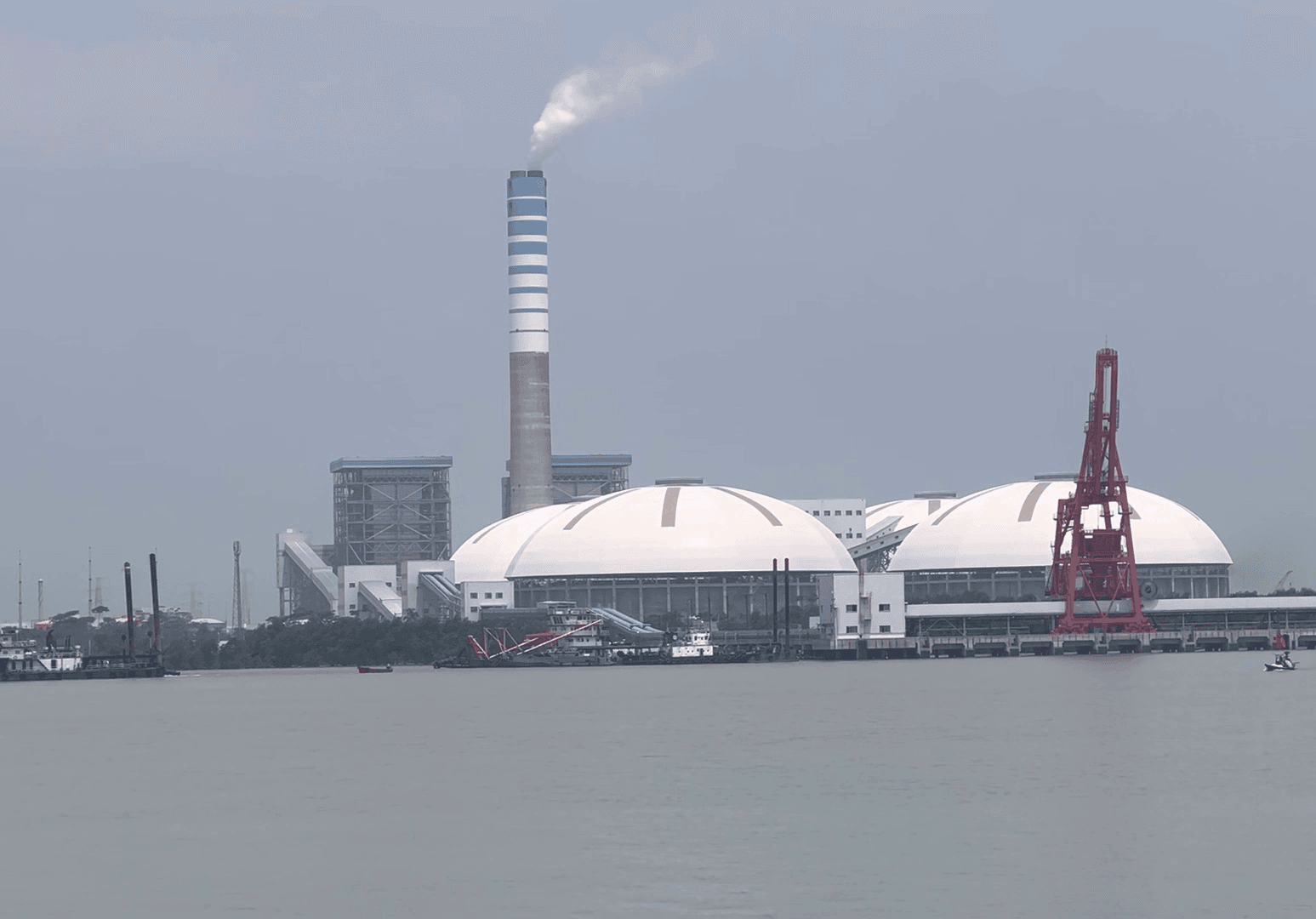
A forensic audit of Bangladesh’s SS Power I Limited (SSPIL) coal-fired power project has found that the plant’s contractual design heavily favours its private sponsor while transferring substantial financial and operational risk to the state, raising fresh questions over the country’s power-sector governance.
The National Review Committee (NRC) examined the legal, financial and operational framework of the 1,224-megawatt net facility at Banshkhali in Chattogram, owned by SS Power I Limited, a joint venture led by the S Alam Group.
Auditors analysed the Power Purchase Agreement (PPA), Implementation Agreement, subsequent amendments and side letters, alongside provisional billing records for June 2024.
According to the findings, the project operates less like a conventional infrastructure asset and more like a state-backed financial instrument, offering the investor near-complete insulation from market risks such as fuel price volatility, currency depreciation and operational shortfalls.
Those risks, the audit says, are instead borne by the Government of Bangladesh and the Bangladesh Power Development Board (BPDB) through a dense network of “pass-through”, “true-up” and sovereign guarantee clauses.
The government currently holds significant leverage in the form of outstanding arrears, amounting to Tk 55.24 billion owed to SS Power.
The clearance of these dues should be made conditional on the execution of Supplemental Agreements that implement the ‘Year 13 Correction’ and impose a cap on foreign-currency indexation.
Capacity payments dominate costs
The most immediate fiscal impact comes from fixed capacity payments — fees paid to the operator regardless of whether electricity is generated. A provisional invoice for June 2024 shows a single-month capacity charge of Tk 3.93 billion. On an annual basis, this implies a liability running into hundreds of millions of dollars, even if the plant operates below capacity or remains idle.
Analysts involved in the audit argue that such rigid payment obligations significantly constrain public finances at a time when Bangladesh is grappling with fuel shortages, foreign exchange pressure and rising power-sector subsidies.
From diversified tender to concentrated risk
The project’s origins trace back to an international tender launched in 2011 for five coal-fired power plants of varying sizes and locations. The original design — two large plants of 600–800MW and three smaller plants of 100–300MW across Dhaka, Chattogram and Barishal — was intended to spread risk and ease grid integration.
After a re-tender in September 2012, the Cabinet Committee on Government Purchase approved the lowest bidder in September 2013: a consortium comprising S Alam Steels, S Alam Super Edible Oil, S Alam Cement and China-based HTG Development Group.
Crucially, the award was split into two separate projects under a 25-year Build, Own and Operate (BOO) model: a 612MW plant in Chattogram and a 276MW plant in Barishal. Letters of intent were issued in October 2013. At that stage, risk was geographically and operationally diversified; delays or failures at the smaller Barishal plant would not have jeopardised the larger Chattogram facility.
Subsequent restructuring, however, consolidated exposure around the Chattogram plant while embedding extensive payment guarantees, the audit notes.
Wider implications
Energy economists say the SSPIL case reflects a broader pattern in Bangladesh’s power expansion over the past decade, where emergency procurement and generous contractual terms have locked the state into long-term liabilities. With demand growth slowing and renewable energy gaining traction, critics warn that such contracts could become an increasing fiscal burden.
The government has not publicly responded to the audit’s findings. BPDB officials have previously defended capacity payments as necessary to attract private investment, but the latest analysis is likely to intensify calls for contract renegotiation and greater transparency in future power deals.