


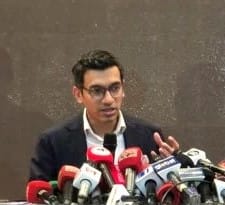
The United States may announce a reduction in the reciprocal tariffs imposed on Bangladesh by the end of this week or early next week, Chief Adviser’s Special Envoy on International Affairs Lutfey Siddiqi said on Tuesday, expressing optimism about an early easing of trade barriers.
Speaking at a press conference at the Foreign Service Academy while briefing the media on Bangladesh’s engagements at the World Economic Forum (WEF) in Davos, Lutfey said Washington has shown sincerity in lowering tariffs on Bangladesh, although the extent of the reduction from the current 20 percent rate is yet to be known.
He said the issue was discussed with US Treasury Secretary Scott Bessent, a member of President Donald Trump’s Cabinet, on the sidelines of the Davos meeting.
“Several elements of the US non-tariff policy agenda align with the reform programme of Bangladesh’s interim government. At the same time, Bangladesh’s trade deficit with the US—around $6 billion earlier—has declined significantly. Considering these factors, the US is showing willingness to reduce trade barriers. A positive decision is expected soon,” Lutfey said.
On Bangladesh’s trade relations with the European Union, he said discussions were held with EU Commissioners Roxana Mînzatu and Jozef Síkela regarding the possibility of a Free Trade Agreement (FTA). Bangladesh has clearly expressed its interest in an FTA, he said, though the EU’s decision-making process remains slow.
He noted that the EU is currently prioritising FTAs with India and may move on to Vietnam next, which could pose challenges for Bangladesh. “There is, however, no reason to panic. Engagement must continue, and I will leave detailed notes for the next government,” he added.
Lutfey cautioned that securing GSP Plus facilities in the EU market after Bangladesh’s graduation from least developed country (LDC) status will be difficult, particularly given the country’s heavy export concentration in garments. Excessive dependence on a single product could create vulnerabilities and affect eligibility for preferential access, he warned.
Referring to talks with World Trade Organization (WTO) Director-General Ngozi Okonjo-Iweala, Lutfey said future trade policy issues were discussed, during which the WTO chief advised Bangladesh to gradually reduce overreliance on multilateral trade arrangements and place greater emphasis on bilateral agreements.
In this context, he said Bangladesh held productive discussions with Japan on an Economic Partnership Agreement (EPA). Japanese Minister of Economy, Trade and Industry Akazawa Ryosei informed that a formal agreement could be signed within the next one or two weeks. Bangladesh will also enjoy duty-free transit facilities in Japan for three years after LDC graduation, he added.
“FTA talks are ongoing with South Korea, while negotiations with Singapore are at an advanced stage. In the evolving global trade environment, it will be increasingly difficult to remain competitive without FTAs or EPAs,” Lutfey said.
He said discussions with Thai Foreign Minister Sihasak Phuangketkewo focused on potential Thai investment in Bangladesh’s food processing sector and the use of Thai ports to enhance bilateral trade.
On the Rohingya issue, Lutfey said he discussed repatriation prospects with UN Special Envoy on Myanmar Julie Bishop in Davos. “The geopolitical situation surrounding Myanmar is becoming more complex by the day, but Bangladesh must remain firm and focused on its legitimate demands,” he said.
Highlighting talks with International Organization for Migration (IOM) Director General Amy Pope, he said discussions centred on promoting legal migration from Bangladesh. “There is an international perception that Bangladesh is not sufficiently serious about curbing irregular migration. We are working to change that perception,” he said.
He noted that 600 holders of fake passports were deported from Singapore last month, adding that legal action would be taken against all of them with the support of the Criminal Investigation Department (CID).
Stressing the need for a shift in diplomatic approach, Lutfey said symbolic gestures such as signing memorandums of understanding, handshakes and photo opportunities are no longer enough. “Bangladesh must make itself more relevant globally through corridor diplomacy and issue-based negotiations,” he said.