


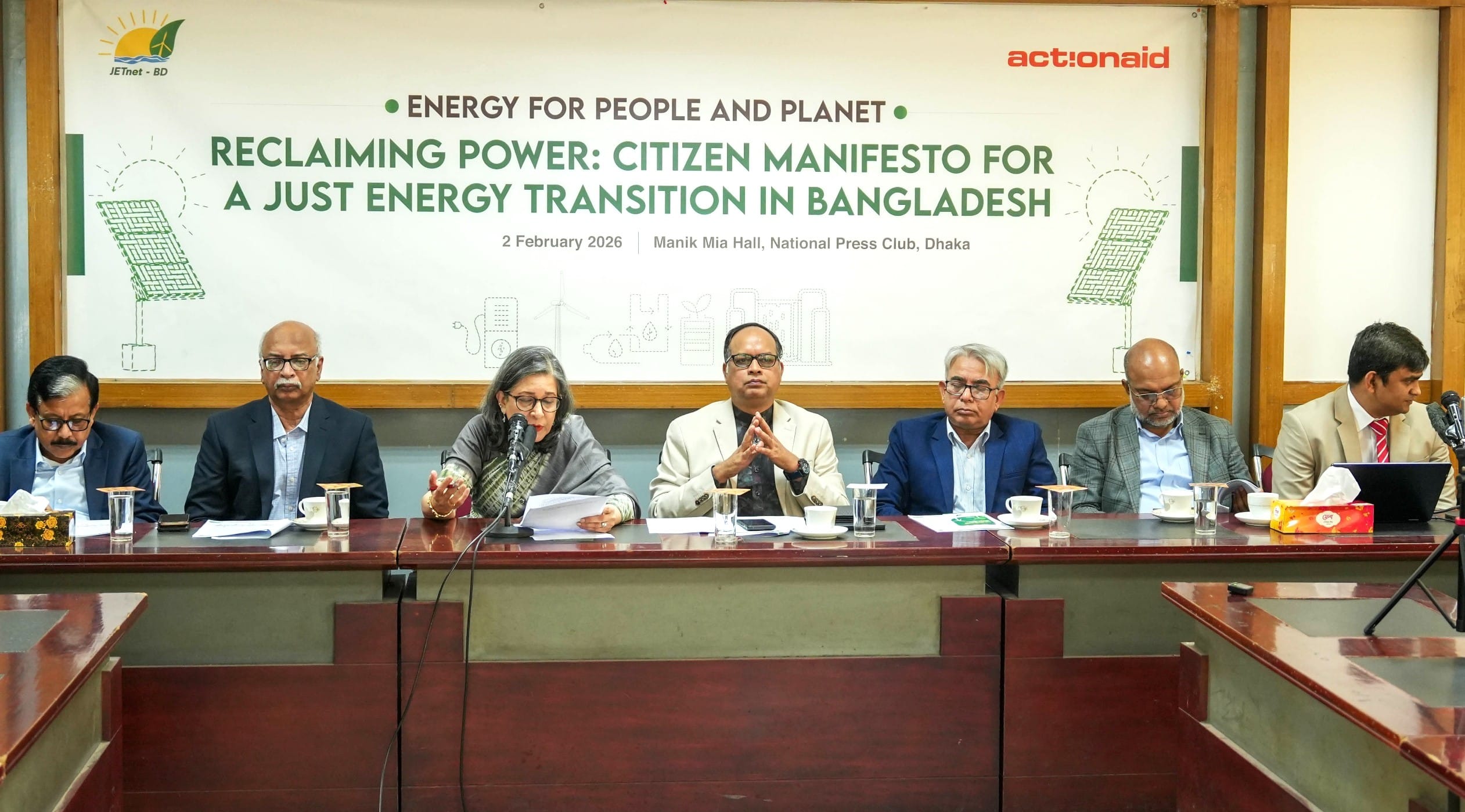
Bangladesh risks sliding into a major economic and social crisis if its worsening gas shortage is not addressed urgently, a leading academic has warned, as civil society groups called for a decisive shift away from fossil fuel dependence towards renewable energy.
Prof M Tamim, vice-chancellor of Independent University, Bangladesh (IUB), said a deepening gas deficit would be “extremely difficult to manage” and “painful for all sections of society”.
He was speaking on Monday at a press conference at the National Press Club titled “Reclaiming Power: A Just Energy Transition for Bangladesh”, organised by the Just Energy Transition Network Bangladesh (JETnet-BD), a platform representing 155 civil society organisations, with ActionAid Bangladesh as its secretariat.
As an immediate demand-management measure, Prof Tamim proposed revising office hours to reduce pressure on the power system. He argued that earlier working hours would allow people to return home sooner and reduce evening peak electricity demand, which typically strains the grid.
Beyond short-term fixes, Prof Tamim stressed the need for a coherent and credible national energy transition policy.
He backed JETnet-BD’s 14-point Citizens’ Manifesto, saying Bangladesh lacked a genuinely integrated strategy to guide the shift to clean energy. Government engagement in renewables, he added, had fallen short of what was required, particularly during the interim period, and without strong state backing in the early stages, ambitious targets would be difficult to achieve.
He also pointed to inconsistencies across policy documents, noting that renewable energy targets set out in the 2008 Renewable Energy Policy, the Eighth Five-Year Plan and the draft Renewable Energy Policy 2025 do not align. “This reflects a serious lack of coordination,” he said.
Energy expert Dr Ijaz Hossain, a former professor at Bangladesh University of Engineering and Technology (BUET), echoed these concerns, saying he was not optimistic about the country’s current renewable energy trajectory.
He warned that even targets set for 2060 could remain unmet by the end of the century without proper planning. Dr Hossain also criticised the lack of transparency in policy making, claiming that despite being a member of a relevant committee, he had little insight into newly announced plans. He urged citizens to maintain pressure on policymakers.
The press conference also highlighted the heavy economic cost of Bangladesh’s reliance on imported fossil fuels. Speakers said about 97 per cent of the country’s energy demand is met by fossil fuels, nearly 70 per cent of which are imported, costing an estimated Tk 1.5 trillion annually and exposing the economy to global price volatility.
Shafiqul Alam, chief analyst at the Institute for Energy Economics and Financial Analysis (IEEFA), said the average cost of electricity generation in fiscal year 2024–25 had risen to Tk 12.10 per unit.
Oil-fired plants accounted for 10.7 per cent of generation, he said, adding that replacing just five percentage points of oil-based generation with renewable energy could reduce average costs to around Tk 11 per unit.
M Zakir Hossain Khan, executive director of Change Initiative, criticised the interim government for deferring decisions on controversial power contracts involving companies such as Adani and Summit, despite allegations of irregularities. He called for the immediate cancellation of risky and costly agreements.
At the event, ActionAid Bangladesh presented a 14-point Citizens’ Manifesto calling for a just energy transition, including a target of net-zero carbon emissions by 2050.
The manifesto proposes achieving at least 20 per cent renewable energy by 2030 and 50 per cent by 2040, alongside the phased closure of import-dependent fossil fuel power plants.
Other key demands include the formulation of a comprehensive National Energy Transition Policy, strengthening the Bangladesh Energy Regulatory Commission as an independent regulator, zero import duty on renewable energy equipment for five years, and greater reliance on domestic expertise in energy planning.
Farah Kabir, country director of ActionAid Bangladesh, said the manifesto would be formally submitted to political parties and candidates contesting the next national election.
“Bangladesh does not seek energy deficiency,” she said. “What the country needs is a sustainable, efficient and people-centred energy sector that ensures affordability, security and climate justice.”