


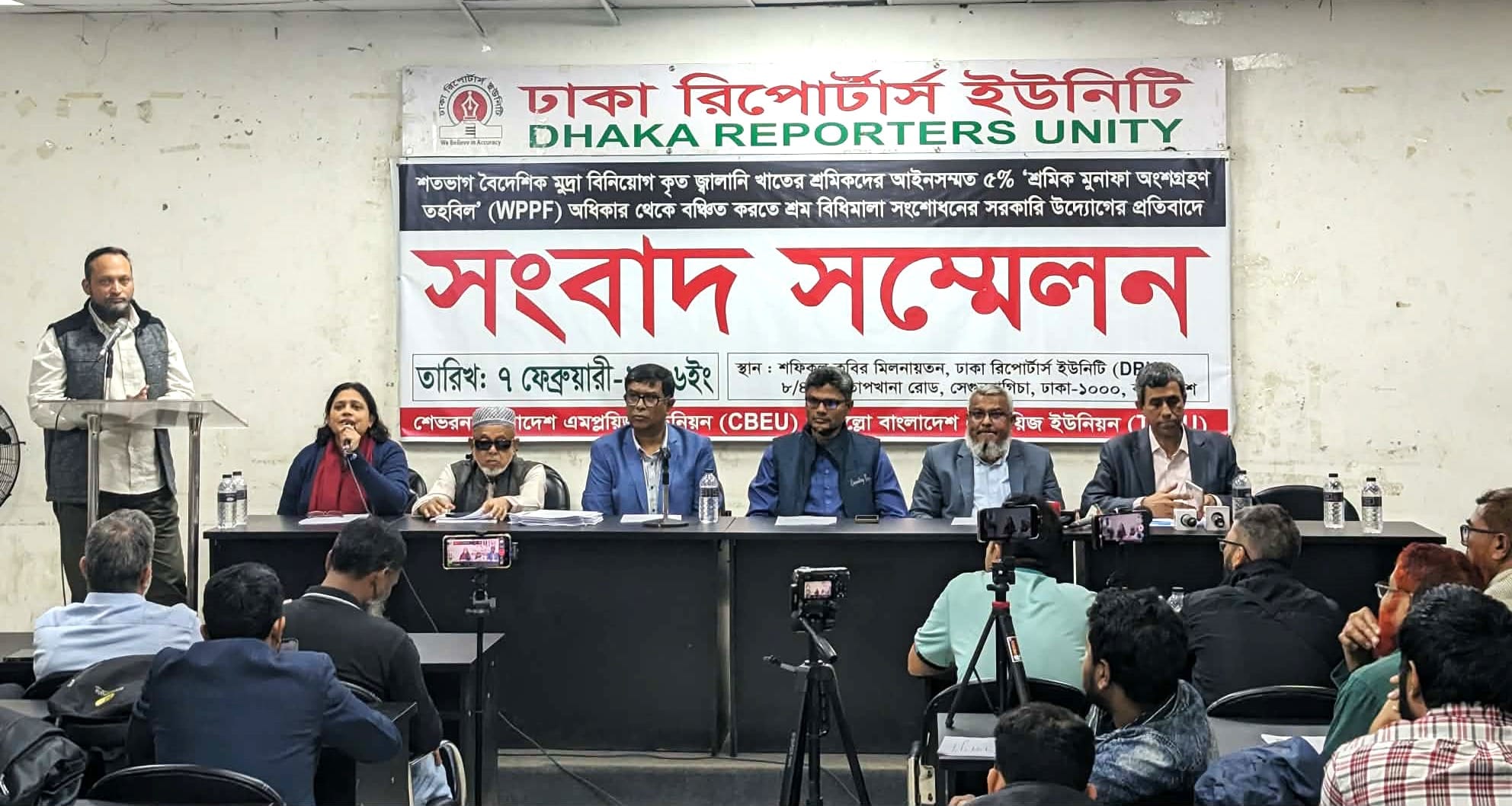
The Chevron Bangladesh Employees’ Union has called on the government to withdraw all initiatives to amend the labour law that would exempt foreign-invested energy companies from their statutory obligation to contribute five per cent of net profits to workers’ welfare and profit participation funds.
The union also demanded an immediate halt to any changes to the labour law while related cases remain sub judice, arguing that taking such decisions ahead of a national election is unjustified and inappropriate.
The demands were made at a press conference at the Dhaka Reporters’ Unity on Saturday. Union president Mostafa Sohel Iqbal, vice-president SM Shahriar Abedin, and Tullow Bangladesh Employees’ Union general secretary Md Harun Al Rashid were among those present.
In a written statement, the general secretary of the Chevron Bangladesh Employees’ Union, Mohammad Nure Alam Siddiqui, said Chevron-operated gas fields at Jalalabad, Bibiyana and Moulvibazar, along with the Bangura gas field operated by Tullow (now KrisEnergy), account for a major share of Bangladesh’s gas supply and play a critical role in national energy security and the wider economy.
He said the Chevron and Tullow employees’ unions “strongly condemn and protest” what they described as a recent move by the interim government to amend the labour law in a way that would deprive national employees in foreign-invested energy companies of their legally mandated five per cent Workers’ Profit Participation Fund (WPPF).
Pushing through changes to such a sensitive, worker-related issue while public attention is focused elsewhere ahead of an election is not only inappropriate, he argued, but “suggests a clear conspiracy against the national interest”.
According to the union, Chevron workers filed a writ petition in the High Court in 2022 after the company repeatedly failed to pay WPPF dividends due from 2013 onwards. Following hearings, the High Court ruled in favour of the workers on 10 December 2024, directing Chevron Bangladesh to form the required fund and pay five per cent of its net profits to the WPPF within three months of receiving the verdict.
The court also instructed the Ministry of Labour to take necessary steps to implement the ruling.
Chevron later appealed to the Appellate Division of the Supreme Court. On 28 October last year, after a preliminary hearing, the chamber court of the Appellate Division referred the appeal for regular hearing without issuing any stay on the High Court verdict.
As the matter is currently pending before the Appellate Division, the union said any attempt to amend labour rules at this stage would amount to interference in a sub judice matter and could constitute contempt of court.
The union also referred to a 2022 amendment to labour rules that excluded workers in 100 per cent export-oriented sectors from WPPF benefits, a move widely criticised as one-sided and unjust. They said the High Court has since issued a rule asking why that amendment should not be declared unlawful.
Siddiqui said union leaders met the labour and employment adviser, Brigadier General (retd) Dr M Sakhawat Hossain, on 6 January to formally express concern over the latest amendment initiative.
He claimed it later became clear that the process was being pushed forward at unusual speed due to pressure from unnamed vested interests, accompanied by what he described as misleading and false information about employees’ pay structures.
He further alleged that a subsequent meeting convened by Petrobangla on 12 January, without prior notice of the agenda, raised questions about transparency after representatives of foreign-invested companies were present alongside national workers’ unions during discussions on labour law amendments.
The union warned that, given the sensitivity and fragility of the energy sector, it would be forced to consider tougher action if the government fails to meet its demands promptly.