


The interim government’s most significant achievement has been the dismantling of what it describes as a long-standing, institutionalised system of corruption in Bangladesh’s power and energy sector and the restoration of transparency and accountability, the energy adviser has said.
Muhammad Fouzul Kabir Khan, adviser to the Ministry of Power, Energy and Mineral Resources, said corruption in the sector had not been limited to individual wrongdoing but had evolved over years into a “legal and administrative architecture”.
“Our first task was to break that architecture,” he told a press conference at the Power Building in Dhaka on Tuesday, outlining the interim administration’s actions and achievements.
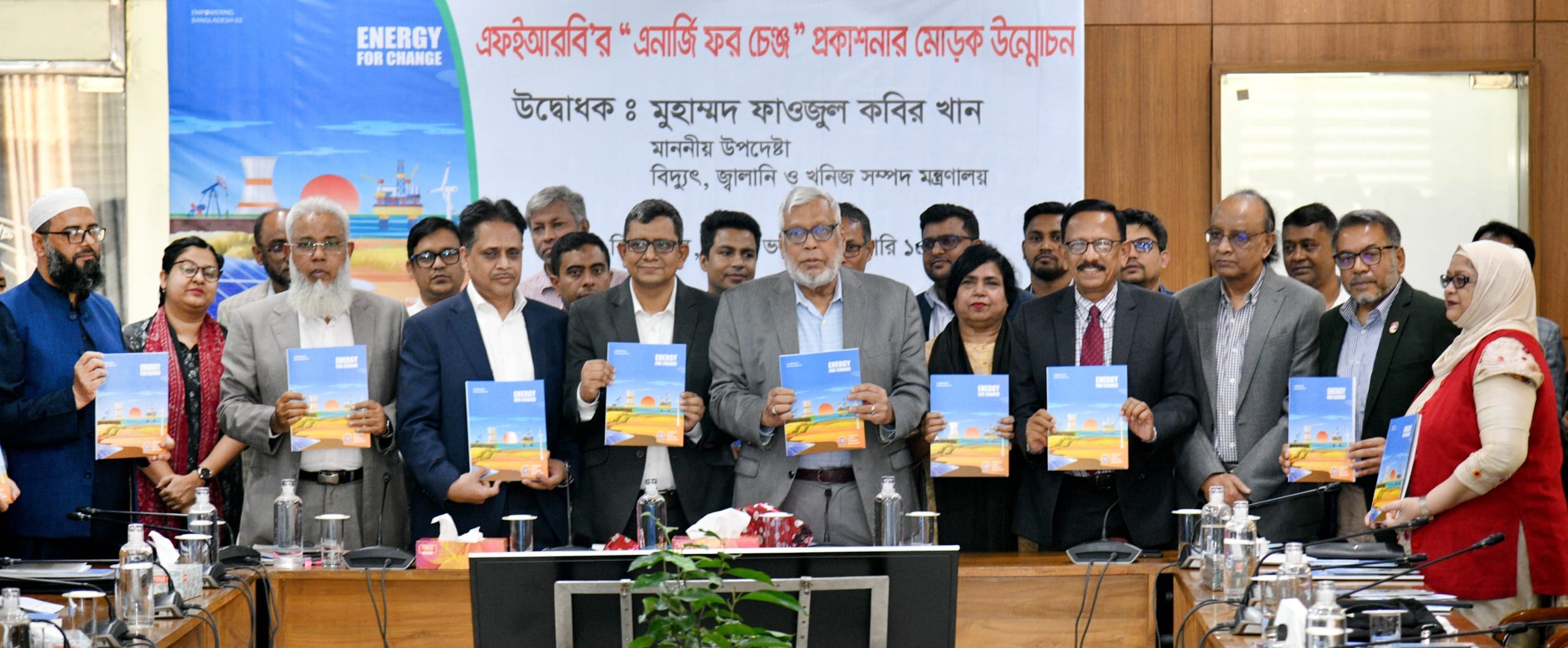
At the event, Khan also unveiled Energy for Change, a new publication by the Forum for Energy Reporters Bangladesh (FERB) with the attendance of secretaries of the ministry of power, energy and mineral resources, roads and highways and rail. FERB Chairman Md Shamim Jahangir and its Executive Director Sherajul Islam Shiraj and other members also attended at the event.
Muhammad Fouzul Kabir Khan said the government had repealed a controversial special law enacted in 2010, which he claimed had provided a legal basis for corruption. At the same time, authority over electricity and energy price setting was returned to the Bangladesh Energy Regulatory Commission (BERC), reversing earlier arrangements that had shifted pricing power to the government.
“As a result, electricity tariffs have not been increased over the past 17 months,” he said.
Khan added that key reforms had been introduced to address conflicts of interest. Previously, senior ministry secretaries had simultaneously served as chairpersons of companies under their own ministries. “That practice has been completely abolished,” he said, noting that no secretary now chairs a company under their respective division.
According to the adviser, the interim government has adopted a Renewable Energy Policy 2025 and a Merchant Power Policy 2025. It has also drafted new regulations to rebalance authority between the Rural Electrification Board and rural electricity cooperatives, aiming to end years of instability in the sector. The rules are currently undergoing the legislative process.
To identify corruption patterns, the government formed two committees: a national committee led by former justice Moinul Islam Chowdhury, and an independent body comprising lawyers, economists and engineering experts. Khan said the committees conducted project-based analyses to pinpoint irregularities and governance failures.
“These reports have been preserved for the next elected government so that appropriate legal action can be taken,” he said. A separate committee led by former BUET professor Dr Kamal Hossain has documented cases of excessive tariffs, detailing how much additional cost was assigned to individual projects.
Khan said an Energy and Power Sector Master Plan had also been prepared, alongside a detailed publication on cost-saving measures implemented within the power division. He added that he would leave behind a written “statement for the successor”, outlining the sector’s current condition, steps taken and priorities for the future.
On renewable energy, the adviser said rooftop solar installations and net metering had been rolled out across government offices. Solar power projects are now being awarded exclusively through open tendering, with no projects allocated through direct negotiation.
He also highlighted savings in fuel imports, saying the sector had faced a major challenge from large unpaid foreign bills, which previously resulted in late payment penalties and higher premiums. The interim government cleared the arrears, restoring confidence among suppliers.
“This has increased competition in oil and LNG imports,” he said, adding that import premiums had fallen by an average of up to 35 per cent, saving around Tk 15 billion (about £110 million) in just six months.
Khan said the modernisation project of the 58-year-old Eastern Refinery had been brought back under normal government oversight by removing it from fast-track energy supply legislation. However, uncertainty over the interim government’s tenure had limited the inflow of large-scale foreign investment.
He noted that preliminary preparations had been made to advance onshore and offshore gas exploration, including steps to procure new drilling rigs for Petrobangla. Offshore bidding documents have also been revised and left ready for the next government.
Calling for patience, Khan said no government could deliver “magic solutions” overnight.
“A stable, full-term government is essential for lasting solutions in the power and energy sector,” he said. “The next administration will need time and cooperation. The foundations we are leaving behind are what future governments must build on.”