


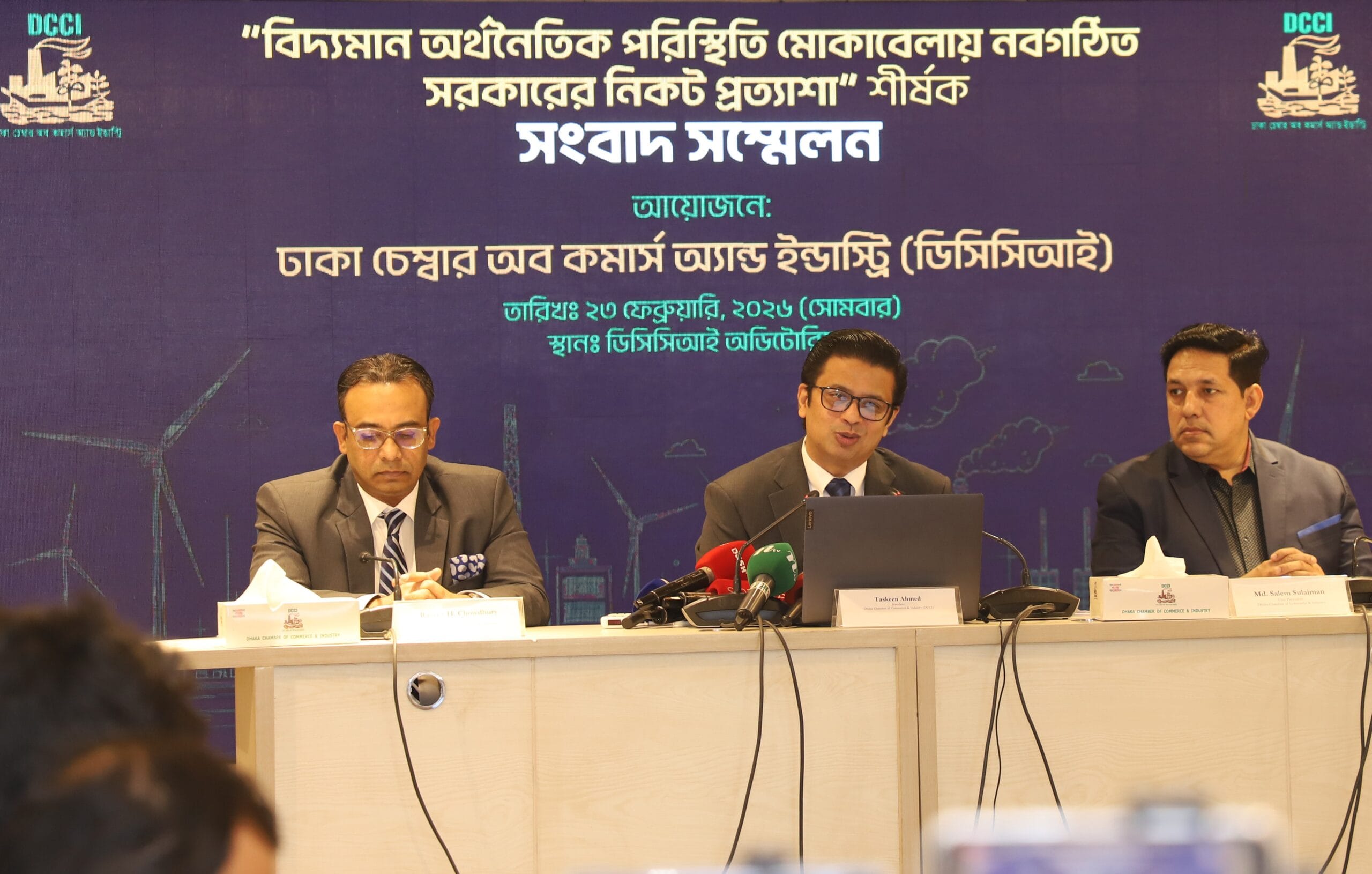
Bangladesh’s business environment is nearing a tipping point, with high borrowing costs, worsening law and order, extortion and policy inefficiencies posing “suicidal” risks to the economy, the president of the Dhaka Chamber of Commerce & Industry said on Monday.
Speaking at a press conference, DCCI President Taskeen Ahmed urged the new government to act swiftly to stabilise the economy and restore investor confidence.
He said businesses are being forced to borrow at steep interest rates of 16–17% due to an unchanged policy rate, squeezing private sector activity. Rising non-performing loans and tighter loan classification rules have further strained the financial sector, spilling over into industrial instability.
Energy supply constraints are adding to the pressure. Inadequate gas supply, coupled with sharp tariff hikes for new industries and captive power, has disrupted production and weakened both domestic demand and export performance.
Ahmed warned that inconsistent industrial policies, alongside a deteriorating law and order situation—particularly widespread extortion—are discouraging investment and undermining business operations.
He also criticised the lack of automation in revenue management, saying it exposes taxpayers to harassment while allowing many to remain outside the tax net. This weakens revenue mobilisation and slows overall economic momentum.
Rising business costs are being driven by structural bottlenecks, including delays in land acquisition, high land prices, increased port service charges and the underuse of inland waterways. These factors are fuelling inflation by raising production and distribution costs.
On the looming LDC graduation, he cited estimates from UNCTAD suggesting exports could fall by up to 7%, or about $2.7 billion. Given current global and domestic uncertainties, he called for a three-year deferral of the transition.
Ahmed also expressed concern over a recent agreement with the United States, noting it does not ensure duty-free access for garments and could raise import costs, particularly for LNG. He urged the government to renegotiate the terms.
During the Q&A, he highlighted rising youth unemployment, warning that over 2 million educated young people remain jobless. Without urgent action, he said, this could lead to social instability.
He called for expanded skills programmes, easier business entry and improved access to finance—especially for startups—to unlock employment and entrepreneurship.
Senior Vice President Razeev H Chowdhury, Vice President Md. Salem Sulaiman and other board members attended the event.