


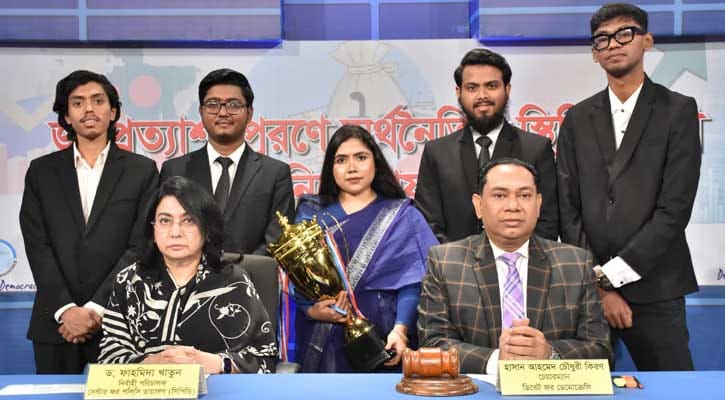
A prolonged war in the Middle East could place additional strain on Bangladesh’s already fragile economy, warned Fahmida Khatun, executive director of the Centre for Policy Dialogue (CPD).
Speaking as the chief guest at a shadow parliament debate competition titled “Economic Stability to Meet Public Expectations”in Dhaka on Saturday, she said the ongoing conflict could push up global oil prices, disrupt supply chains and threaten employment opportunities.
The event was organised by Debate for Democracy at the Bangladesh Film Development Corporation.
Fahmida said the current government has started its journey with a fragile economy and a prolonged conflict in the Middle East could intensify existing economic challenges.
In such a situation, she stressed the need to create a supportive environment for businesses to keep the economy moving.
She noted that most entrepreneurs want to contribute to the country’s development by increasing investment and creating jobs. However, during political transitions, acts of retaliation are sometimes observed, which may prevent fair treatment for all businesses.
“Making blanket allegations against businesspeople is not appropriate,” she said, adding that those willing to contribute to the economy should be given opportunities to operate.
She suggested that the authorities could consider reopening the bank accounts of businesses that have been closed, after proper verification. However, she emphasised that anyone involved in irregularities or crimes must be brought under the law.
Fahmida also said Bangladesh Bank is a specialised and crucial institution that serves as the guardian of the country’s financial system. In the past, politicisation of the central bank contributed to the rise of wilful loan defaulters, she added.
Chairing the programme, Hasan Ahmed Chowdhury Kiron, chairman of Debate for Democracy, said the new government has inherited a weak economy and restoring business confidence is essential for economic recovery.
He noted that blanket cases against businesspeople, obstacles to running businesses after returning to the country and freezing of bank accounts have created an unfavourable environment for trade and investment.
Kiron called for the withdrawal of what he described as harassment cases against entrepreneurs, saying business confidence must be restored to boost investment and employment.
He also commented on what he described as misinformation surrounding the appointment of Mostak Ahmed Rahman as governor of Bangladesh Bank. According to him, claims that the new governor approved Tk1,000 crore in liquidity support to National Bank Limited after assuming office are incorrect.
Kiron said the liquidity assistance had actually been approved during the tenure of former governor Ahsan H Mansur. At that time, Tk1,000 crore each was provided to National Bank and AB Bank Limited, while Premier Bank Limited received Tk5,000 crore in support.
He added that several other banks—including Export Import Bank of Bangladesh, First Security Islami Bank, Social Islami Bank Limited, Global Islami Bank and Union Bank Limited—also received liquidity support amounting to nearly Tk40,000 crore during the previous governor’s tenure.
According to Kiron, more than Tk51,000 crore in liquidity support had been provided to various banks during that period, and therefore it is too early to judge the performance of the current governor.
In the debate competition, debaters from Primeasia University defeated participants from Dhaka International University to win the title.
At the end of the programme, trophies, crests and certificates were distributed among the participating teams. Judges of the competition included academic Tajul Islam Chowdhury Tuhin and journalists Daulat Akter Mala, Zakir Hossain, Rizvi Newaz and Refayet Ullah Mirdha.