


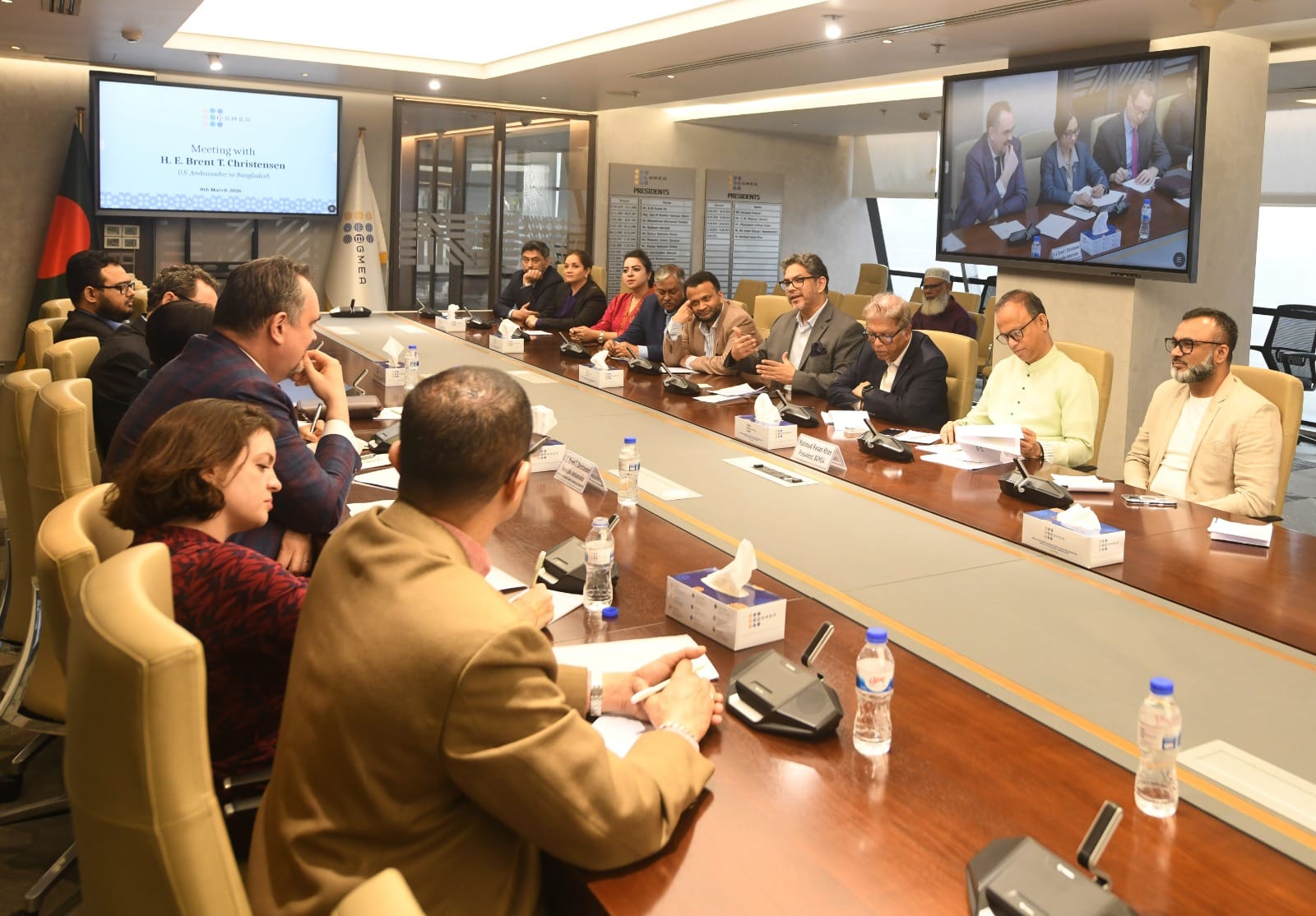
The United States ambassador to Bangladesh met leaders of the country’s powerful garment manufacturers’ body on Sunday to discuss bilateral trade, labour reforms and potential U.S. investment in Bangladesh’s energy sector.
Brent T. Christensen held talks with Mahmud Hasan Khan and board members of the Bangladesh Garment Manufacturers and Exporters Association (BGMEA) at the association’s complex in Uttara, Dhaka.
The meeting focused on expanding trade between Bangladesh and the United States, attracting American investment—particularly in energy—and addressing labour issues affecting the country’s export-oriented apparel sector.
Officials also discussed a possible mechanism for duty concessions on garments produced using U.S. cotton. BGMEA said such a move could deepen cooperation between the textile industries of the two countries.
Christensen said the matter is currently under review by the Office of the United States Trade Representative (USTR). He described the latest trade arrangement as positive for Bangladesh and said the initiative could lead to increased exports of U.S. cotton to the country.
BGMEA’s senior vice-president, Inamul Haq Khan, raised concerns about uncertainty for exporters caused by frequent tariff adjustments in recent months. Christensen said the situation followed a recent ruling by the Supreme Court of the United States and expressed hope that stability in tariff policies would soon be restored.
Energy investment was another key topic. Mahmud Hasan Khan said greater U.S. involvement in Bangladesh’s energy sector could help meet the growing demand created by the country’s expanding industrial base.
He suggested that investment in liquefied natural gas (LNG) infrastructure could help address short-term energy shortages, while U.S. technology and capital would be vital for boosting domestic gas exploration and production over the longer term.
Christensen said a stable and long-term energy policy in Bangladesh would encourage greater participation from American investors.
The two sides also discussed labour laws and a proposed new ordinance covering more than 140 reform points. The ambassador noted that labour standards have long been an important component of trade relations between the two countries.
BGMEA officials said consultations on the draft legislation are ongoing and that further clarification on several provisions would help ensure transparency and effective implementation.
The association also called for easing visa bond requirements for Bangladeshi garment entrepreneurs and introducing longer-term visas to facilitate business travel to the United States.
During the meeting, BGMEA representatives highlighted Bangladesh’s leadership in environmentally sustainable garment manufacturing.
They said the country hosts the world’s largest number of LEED-certified green garment factories recognised by the U.S. Green Building Council.
Christensen suggested deeper engagement by U.S. brands and buyers to support further progress in sustainable production.
Officials from the U.S. embassy and senior BGMEA representatives attended the meeting, with both sides expressing commitment to strengthening economic ties between Bangladesh and the United States.