


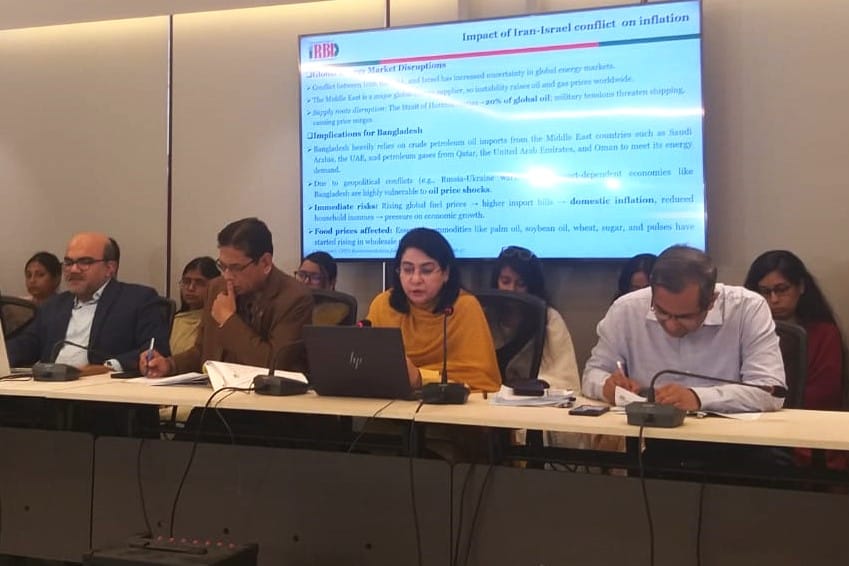
The government still has policy options to cushion domestic fuel prices despite the recent surge in global oil markets triggered by tensions involving Iran, the United States and Israel, the Centre for Policy Dialogue (CPD) said on Tuesday.
Speaking at a media briefing in Dhaka, CPD Distinguished Fellow Mustafizur Rahman said global crude oil prices had risen above $100 per barrel amid disruptions to oil and gas production and supply linked to the geopolitical tensions.
However, he noted that the extent to which international price increases are passed on to the domestic market depends on a number of policy instruments available to the government.
Rahman said that, aside from the profit margin of the state-run Bangladesh Petroleum Corporation (BPC), the government imposes around 20–25% in various taxes on fuel. When global prices rise, these taxes could be reduced to ease pressure on consumers.
He cited the removal of a 2% advance income tax on fuel imports during the tenure of the outgoing interim government as an example of such a policy measure.
Rahman made the remarks while responding to questions from journalists during a briefing on CPD’s recommendations for the national budget for the 2026–27 fiscal year, held at the organisation’s office in the Dhanmondi area of the capital.
CPD Executive Director Fahmida Khatun delivered the introductory remarks and presented the keynote paper, while Research Director Khondaker Golam Moazzem was also present.
Rahman said Bangladesh currently has several weeks’ supply of diesel, octane and other fuels in stock. However, he pointed out that the country does not yet have a permanent strategic petroleum reserve, unlike some neighbouring countries.
“A strategic reserve would help ensure market stability during crises,” he said, adding that panic buying could push demand beyond normal levels, making it difficult for any country to cope with sudden spikes in consumption.
He stressed the importance of reassuring the market and ensuring the steady availability of fuel to prevent panic-driven demand.
Rahman said the government is currently making spot purchases to manage the situation and is also moving to reactivate the diesel import arrangement with India through a cross-border pipeline. Bangladesh could also import fuel from alternative sources, including Malaysia, if required.
“The main objective is to ensure fuel availability,” he said, adding that the government should also avoid placing excessive pressure on the country’s foreign exchange reserves by purchasing fuel at elevated prices.
In this context, Rahman suggested that Bangladesh could consider taking loans from the Islamic Development Bank (IDB) to finance fuel imports if necessary.
He noted that preserving foreign exchange reserves is essential because key imports such as food and fertiliser depend on them. Alongside a short-term coordinated plan to address the current situation, he recommended establishing a strategic petroleum reserve in the medium term to stabilise the market and prevent panic buying in the future.
Khatun said the country is currently facing multiple domestic and international challenges, making it crucial for policymakers to adopt clear and strategic measures.
She added that restoring macroeconomic stability should be the government’s top priority, requiring efforts to control inflation, strengthen revenue discipline, increase investment and create employment.
Khatun also noted that the upcoming national budget for fiscal year 2026–27 will be the first under the newly elected Bangladesh Nationalist Party (BNP) government.
“This presents an important opportunity for the government to begin implementing its electoral commitments and demonstrate effective leadership in revenue management and public spending efficiency,” she said.
She added that, alongside addressing the current economic pressures, the government should continue reform initiatives aimed at strengthening the long-term foundations of the economy.