


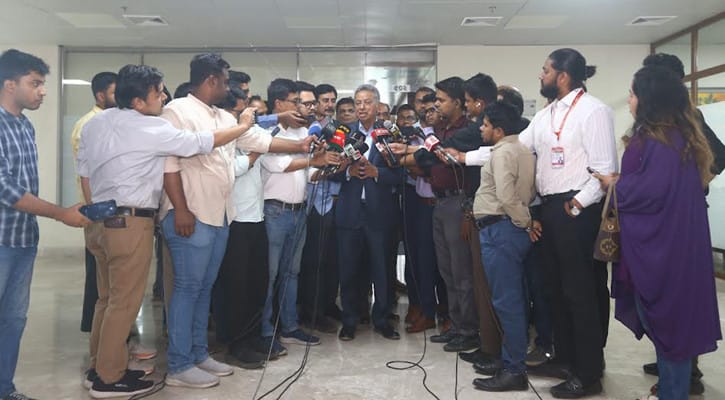
Finance Minister Amir Khosru Mahmud Chowdhury on Wednesday said the ongoing Middle East conflict is exerting fresh pressure on Bangladesh’s economy, forcing the government to absorb higher costs—particularly for fuel imports.
“The war in the Middle East is a major challenge for us. We are having to spend more, as we are buying fuel at higher prices,” he told reporters after a meeting at the National Board of Revenue (NBR) headquarters in Agargaon. The meeting reviewed the upcoming national budget and the broader economic outlook.
The minister said the government is currently grappling with three major economic challenges. “First, we inherited a fragile economy. Second, our tax-to-GDP ratio remains low. And third, the Middle East war has added a new layer of pressure,” he said, noting that discussions focused on ways to boost resource mobilisation to address these challenges.
Signalling a policy shift, Chowdhury said the government wants to move away from the practice of excessive money printing to support economic activity. “Without revitalising the economy, it will be difficult to raise the tax-to-GDP ratio,” he said.
He underscored that the government’s broader objective is to transition from a debt-driven model to an investment-led economy. “We are not looking to print money; rather, we aim to create an investment-friendly environment to revive the economy through sustainable means,” he added.
Emphasising the importance of investor confidence, the finance minister said frequent policy changes would be avoided. “Policies will be kept stable for a defined period so that investors can plan with certainty,” he said.
He also pointed to plans for significant deregulation to reduce legal and administrative bottlenecks, alongside efforts to restore discipline in the financial sector and the capital market.
On past investigations into tax evasion by large companies during the interim administration, Chowdhury said the government is reviewing the matter. “There are multiple issues under consideration. Everything is being reviewed,” he said.
Focus on inclusive growth in upcoming budget
Regarding the upcoming budget, the minister said priority will be given to integrating marginalised and low-income groups into the economic mainstream.
He said social safety net programmes—such as family cards and farmer cards—will continue, with allocations secured upfront before finalising the budget framework.
“The general public will not be excluded from development benefits on the pretext of budget constraints,” he said, assuring that support for vulnerable groups will remain a key pillar of fiscal planning.
Incentives planned to diversify exports beyond garments
Highlighting the need to reduce overdependence on a single sector, Chowdhury said the government is planning to extend incentives—similar to those enjoyed by the ready-made garments (RMG) industry—to other promising sectors.
“It is not possible to drive the economy forward relying solely on the garments sector. We need to develop new export-oriented industries,” he said.
To support diversification, the government is considering offering facilities such as bonded warehouse benefits, back-to-back letters of credit, and other trade-related incentives to emerging sectors.
The finance minister reiterated that strengthening the economy will depend on boosting investment rather than resorting to monetary expansion. He also stressed the need to bring disadvantaged groups under the budget framework to ensure equitable growth.
To attract both domestic and foreign investment, the government is working to reduce bureaucratic hurdles. “Investment must increase to generate employment. We are moving towards deregulation, and its impact will be visible soon,” he said.Officials expect that, if implemented effectively, these measures will help new sectors play a more significant role in Bangladesh’s export basket in the coming years.