


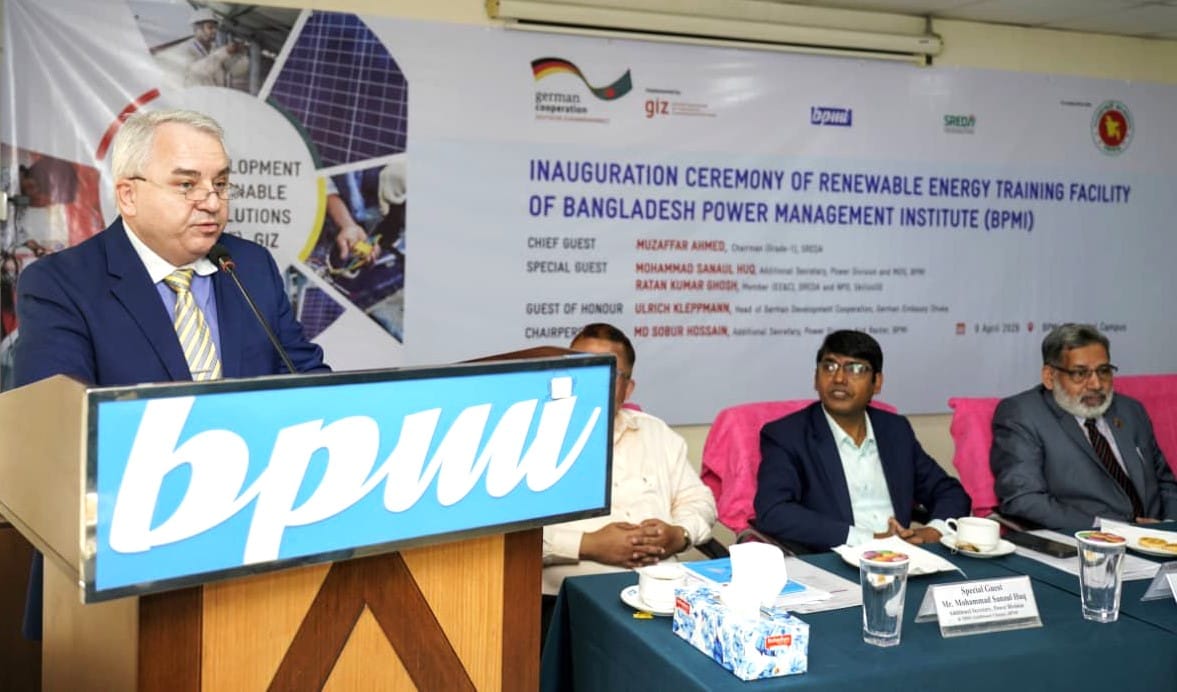
The Bangladesh Power Management Institute (BPMI) has inaugurated a state-of-the-art Renewable Energy Training Facility at its Purbachal campus, marking a significant step in the country’s transition towards a more sustainable and climate-resilient energy system.
The initiative, supported by German Development Cooperation through the Skills Development for Sustainable Energy Solutions (Skills4SE) project implemented by GIZ, aims to tackle a critical shortage of technical expertise that has been slowing Bangladesh’s green energy ambitions.
The new facility is expected to strengthen institutional capacity by providing industry-relevant training in solar and wind energy.
Bangladesh is working towards ambitious targets set out in its Renewable Energy Policy 2025, which seeks to generate 30% of electricity from renewable sources by 2040, alongside commitments under its Third Nationally Determined Contribution (NDC 3.0).
Officials say the centre will help align technical and vocational education with labour market needs, ensuring a skilled workforce capable of supporting and expanding modern renewable technologies.
The upgraded infrastructure includes specialised laboratories for renewable energy simulation and photovoltaics, as well as a dedicated weather station for assessing wind energy resources. Training programmes have also been modernised to cover advanced solar PV modelling and wind feasibility analysis.
As part of the project, 52 instructors have already received specialist training through Training of Trainers (ToT) programmes, aimed at ensuring the long-term delivery of high-quality technical education.
Speaking at the inauguration, BPMI Rector Md Sobur Hossain highlighted the strategic importance of the new facility, stating that enhanced resources would enable the institute to play a stronger role in supporting Bangladesh’s sustainable energy transition. He stressed that combining advanced technology with practical training is key to achieving both energy security and environmental objectives.
Ulrich Kleppmann, Head of German Development Cooperation at the German Embassy in Dhaka, said the initiative underlined the importance of investing in people as well as technology.
“A sustainable energy transition is not just about technology; it is fundamentally about people,” he said. “By developing industry-relevant skills, particularly among women and young professionals, we are helping to ensure that Bangladesh’s transition is inclusive and economically resilient.”
The event was attended by Muzaffar Ahmed, Chairman of the Sustainable and Renewable Energy Development Authority (SREDA), who served as chief guest.