


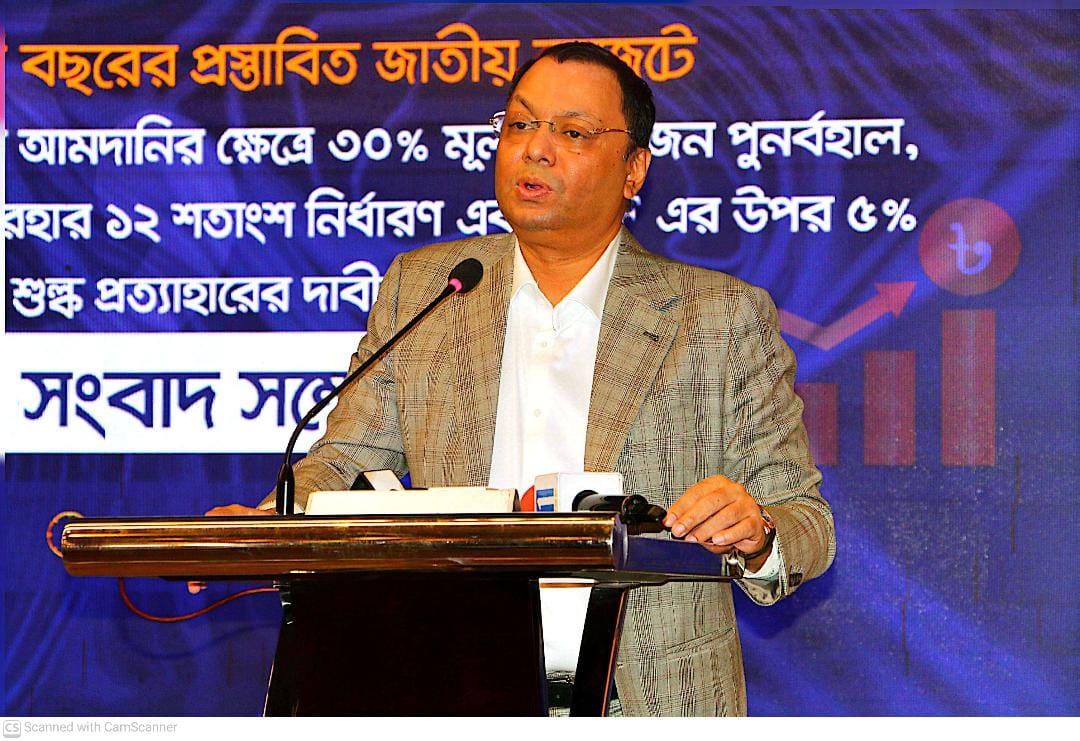
The Bangladesh Textile Mills Association (BTMA) on Saturday called for retaining the existing 30 percent value addition requirement for duty-free raw material imports under bank guarantees, warning that its proposed withdrawal in the national budget for FY2026-27 could further weaken the country’s struggling textile sector.
At a post-budget press conference in Dhaka, industry leaders said scrapping the condition would encourage misuse of bonded facilities, increase imports of foreign yarn and fabrics, and expose local manufacturers to intensified unfair competition.
“The textile sector is already under severe pressure. Removing the value addition requirement at this stage would accelerate the decline of domestic spinning and weaving industries,” BTMA President Showkat Aziz Russell told reporters at the Gulshan Club.
The government has proposed removing the 30 percent value addition condition for importing raw materials under bank guarantees without bond licences, saying the measure is aimed at supporting export diversification and facilitate export-oriented industries.
BTMA, however, argued that the move could have the opposite effect by discouraging local sourcing and undermining the domestic textile value chain at a time when Bangladesh is preparing for graduation from least developed country (LDC) status.
According texile millers, maintaining a strong local value addition base will be crucial to preserving export competitiveness and securing favourable market access after LDC graduation. It stressed that future export sustainability would require value addition levels of 40-50 percent or higher.
Other Demands
Alongside its call to retain the value addition requirement, BTMA placed three additional demands before the government.
The association sought an immediate cut in the corporate tax rate for primary textile manufacturers to 12 percent, bringing it in line with the rate enjoyed by RMG exporters.
BTMA said textile mills currently face an effective tax burden of around 27.5 percent, despite being an integral part of the country’s export-oriented apparel supply chain.
Describing the disparity as discriminatory, the association called for the reduced tax rate to remain in force until June 2030.
The trade body also urged the government to withdraw the proposed 5 percent import duty on Polyester Staple Fibre (PSF), a key raw material used in the production of synthetic yarn and fabrics.
BTMA noted that nearly 70 percent of global apparel demand now centres on man-made fibre products, while Bangladesh’s exports remain overwhelmingly cotton-based.
Imposing additional duties on PSF would increase production costs, weaken the competitiveness of local manufacturers and hamper efforts to diversify exports, it said.
The association’s demands also included the complete exemption of source tax on export cash incentives.
Although the proposed budget reduced the tax from 10 percent to 5 percent, BTMA said exporters continue to face acute liquidity constraints and require further relief to remain competitive.
Existing Mills Need Immediate Support
Industry leaders also questioned the effectiveness of the government’s recently announced Tk 60,000 crore support package aimed at reviving closed industrial units.
Rajib Haider, former BTMA director and a textile entrepreneur, said the immediate priority should be protecting operating mills rather than focusing solely on reopening shut down factories.
“Without urgent policy support, many of the mills that are still running today may also be forced to close,” he said.
Haider pointed to a sharp rise in borrowing costs, noting that lending rates have climbed from around 9 percent in previous years to as high as 15-16 percent.
“Competing in the global market while financing operations at such high interest rates has become increasingly difficult,” he said.
He also cited persistent challenges in opening letters of credit due to liquidity shortages and weak confidence in the banking sector.
Rising gas and electricity prices, coupled with energy supply uncertainties, have further eroded the competitiveness of domestic manufacturers, he added.
Surge in Yarn Imports
BTMA leaders expressed concern over the rapid growth of yarn imports, particularly from India, which they said is displacing local production.
According to figures presented at the briefing, Bangladesh imported yarn worth approximately Tk 26,000 crore in FY2024-25 despite having substantial domestic production capacity.
Since 2019, around 234 textile mills have shut down, while many surviving factories are operating at only 60-70 percent of their installed capacity.
Russell alleged that widespread leakage of bonded imports into the local market is exacerbating the crisis.
“Bond facilities have become both a blessing and a curse. A significant volume of fabrics imported for export production ultimately finds its way into the domestic market, creating severe distortions and unfair competition for local mills,” he said.
Haider said yarn imports from India increased by 104 percent between FY2022-23 and FY2024-25, adding that Bangladesh now accounts 46 percent of India’s total yarn exports.
He warned that continued erosion of domestic industrial capacity could lead to higher unemployment and broader economic challenges.
Calls for Industry-Friendly Policies
Speaking at the event, Bangladesh Garment Accessories and Packaging Manufacturers and Exporters Association (BGAPMEA) President Mohammad Shahriar criticised what he described as policy inconsistencies by the National Board of Revenue (NBR).
He said local manufacturers continue to miss out on significant export opportunities, particularly in the global shopping bag market, despite maintaining full compliance standards.
Shahriar urged policymakers to place greater emphasis on industry data and practical business experience when designing fiscal and trade policies.
BTMA leaders concluded that preserving Bangladesh’s textile manufacturing base is essential not only for sustaining export growth but also for protecting investment, employment and long-term industrial competitiveness in the post-LDC era.