


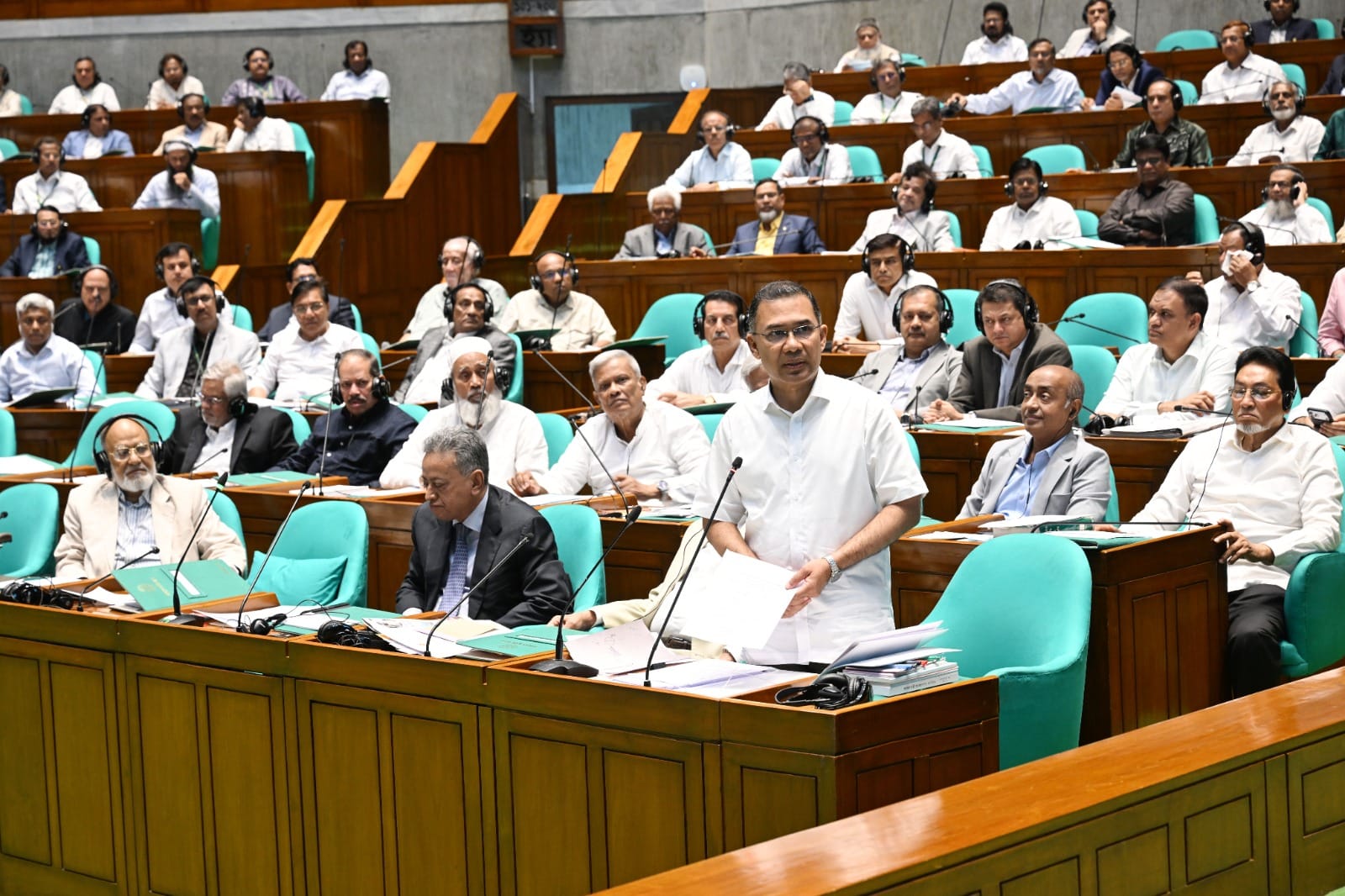
Prime Minister and Leader of the House Tarique Rahman on Monday proposed raising the tax-free income threshold beyond the levels set in the proposed national budget and called for scrapping the controversial provision allowing the legalisation of undisclosed income.
He also recommended withdrawing the proposed requirement of a Taxpayer Identification Number (TIN) for opening bank accounts, saying the measure had created confusion among the public.
The prime minister placed the proposals before Finance and Planning Minister Amir Khosru Mahmud Chowdhury while taking part in the general discussion on the proposed budget in the Jatiya Sangsad.
The House sat with Speaker Hafiz Uddin Ahmed in the chair.
Addressing lawmakers, Rahman said demands for changes to the budget usually came from the opposition, adding that although he was not “physically” on the opposition benches, he wanted to “stand mentally with them” while making his recommendations.
To ease the tax burden on individuals, the prime minister proposed increasing the tax-free income ceiling to Tk 400,000 for the 2026-27 and 2027-28 tax years, Tk 450,000 for 2028-29 and 2029-30, and Tk 500,000 for the 2030-31 tax year.
The proposed budget has set the respective thresholds at Tk 375,000, Tk 400,000 and Tk 450,000.
Referring to the proposed provision on voluntary disclosure of investments, Rahman said it had been introduced to reduce taxpayer harassment caused by the under-registration of land values.
However, he noted that the measure had sparked public concern, with many viewing it as a fresh opportunity to legalise black money.
“I would request the finance minister to withdraw the provision,” he said.
The prime minister also urged the government to drop the proposal requiring TIN certificates for opening bank accounts, registering partition deeds and completing property mutation, saying it had created unnecessary public confusion.
Rahman further proposed cutting the existing 10 percent tax on private universities to 5 percent.
He, however, said the tax benefit should be linked to greater investment in research, the establishment of language laboratories and expanded tuition waivers for meritorious students from low-income families.
His proposals were welcomed by both treasury and opposition lawmakers, who thumped their desks in approval.
The prime minister also sought broader tax incentives for members of ethnic minority communities living in both the Chattogram Hill Tracts and the plains.
He proposed extending tax exemptions to cover salary income alongside earnings from business, agriculture and other economic activities.
To support the country’s shrimp industry and boost exports, Rahman recommended exempting customs duty and value-added tax (VAT) on the import of feed additives, probiotics, vitamins, minerals and essential equipment.
He also called for lower or zero duties on a range of industrial raw materials, including honey used in pharmaceutical production, PET resin, PVC, cold-rolled sheets, oxides used in rolled products, copper for electrical wire manufacturing and unprocessed cashew nuts.
The prime minister proposed extending concessional import facilities for raw materials used by local LED lamp manufacturers and prefabricated building producers until June 30, 2030.
Noting that many Bangladeshi businesses advertise on social media platforms, OTT services, search engines and online marketplaces, Rahman said the existing 15 percent VAT often encouraged informal payment channels.
He proposed reducing the VAT to 5 percent to promote formal transactions and improve revenue collection.
Rahman also urged the finance minister to review the existing tax and VAT structure on gold, platinum, diamonds and silver jewellery.
He further proposed abolishing the 15 percent VAT on revenue sharing between the Bangladesh Telecommunication Regulatory Commission (BTRC) and telecom operators.
Among his other recommendations were exempting suppliers from the existing 10 percent VAT on all types of field supplies and reducing VAT on the local production of double-cabin pickup trucks and microbuses from 15 percent to 5 percent.
Later, Opposition Leader Shafikur Rahman requested the prime minister to recommend the withdrawal of all duties on bicycles.
Responding to the request, the leader of the House said he would ask the finance minister to examine the proposal and consider it if found feasible.