


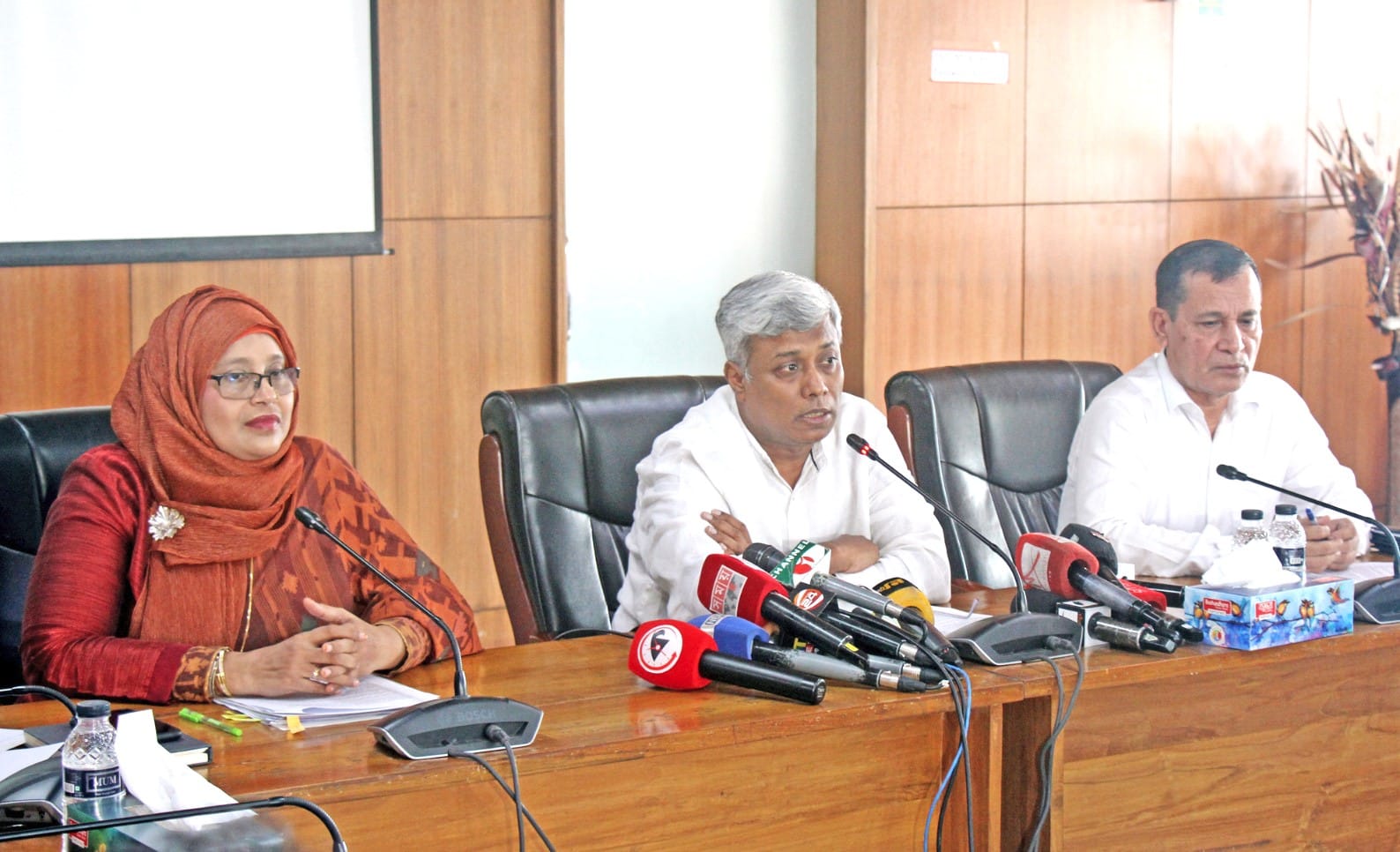
State Minister for Power, Anindya Islam Amit, has said the government is working to eliminate disparities in electricity supply between urban and rural areas by upgrading the country’s ageing power infrastructure and transmission network.
Speaking at a press conference on Monday at Bijoy Hall in the Power Division headquarters on Nawab Abdul Ghani Road, the minister acknowledged that long-standing infrastructure constraints had resulted in uneven electricity distribution across parts of the country.
“Although disparities remain due to historical infrastructure limitations, the government has launched a range of initiatives to address them gradually,” he told reporters.
The briefing was attended by senior officials, including Bangladesh Power Development Board (BPDB) Chairman Engineer Rezaul Karim, Rural Electrification Board (REB) Chairman Major General S.M. Zia-ul-Azim, and other officials from the Power Division.
The minister said the government aimed to close the urban-rural electricity supply gap through modernisation of the distribution system, strengthening of the national transmission network and improvements in customer services.
He also said Bangladesh was seeking to reduce its dependence on imported fuels by accelerating investment in renewable energy.
“The government is working towards developing the capacity to generate around 10,000 megawatts of electricity from renewable sources,” he said.
Addressing questions over power plant contracts signed under the Special Powers Act, Amit said the government could not simply cancel the agreements because they remain legally binding.
“Where possible, we are holding discussions with the relevant companies to review and revise contractual terms,” he said. “However, the contracts are not being terminated unilaterally.”
The press conference also addressed public concerns over electricity bills issued for June. A written statement from the Power Division, read by its Secretary Mirana Mahrukh, said that while higher electricity consumption during the hot season had increased bills for many households, the rise was not primarily the result of tariff increases.
The statement noted that residential consumers who use more electricity move into higher tariff bands, which can lead to larger bills. It also acknowledged that a small number of billing errors had been identified and said corrective action was being taken following investigations.
The Power Division said the government continues to subsidise the electricity sector to shield consumers from the full impact of rising costs, while also working to improve generation, transmission and distribution efficiency, reduce system losses and expand prepaid and smart metering.
Consumers with concerns about their bills have been urged to contact their local electricity distribution office, where meter inspections, bill reviews and complaint resolution services are available.
The statement also said that, in line with regulations set by the Bangladesh Energy Regulatory Commission (BERC), the monthly demand charge is calculated as 5% of the total electricity bill, replacing the previous practice of charging 2% of the connected load.
Responding to criticism over prepaid meters, the Power Division said customers who choose to pay the full installation cost incur no additional fees, while those opting for payment by instalments pay a monthly rental charge. It added that the government is considering waiving meter rental fees for consumers using government-funded prepaid meters.
Concluding the briefing, the Power Division urged journalists and social media content creators to verify information before publishing reports on electricity bills and metering, warning that misleading claims could create unnecessary public concern and undermine confidence in the power supply system.