


Bangladesh has formally requested India to return former home minister Asaduzzaman Khan Kamal, who was sentenced to death for crimes against humanity committed during the July Mass Uprising, says BSS report.
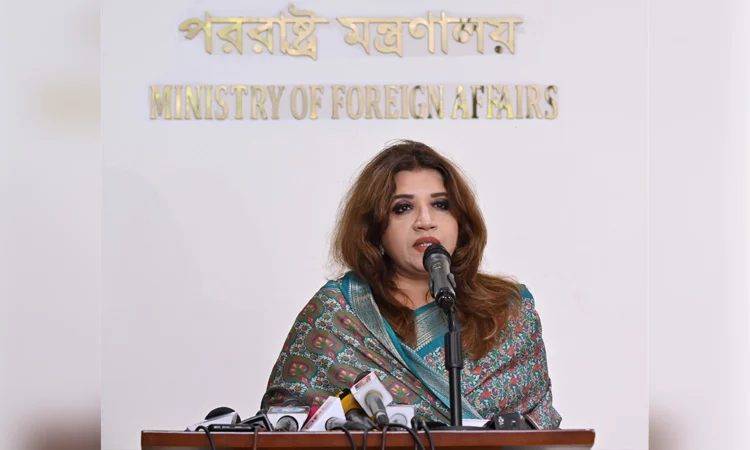
“We have sent a letter to India seeking the return of former home minister Asaduzzaman Khan Kamal. Separate letters have been sent seeking the return of those who have fled to India,” state minister for foreign affairs Shama Obaed said today.
The state minister made the remarks while talking to reporters after attending a seminar titled “Three Decades of BIMSTEC: Advancing Regional Cooperation for Shared Prosperity” at the Bangladesh Institute of International and Strategic Studies (BIISS) auditorium here.
She said the formal request seeking Kamal’s return was sent to the Indian government through the Ministry of Foreign Affairs.
Along with the request, Bangladesh also sent the Indian government a copy of the verdict handed down by the International Crimes Tribunal (ICT), which sentenced the former home minister to death in a case involving crimes against humanity committed during the July Mass Uprising.
Earlier, addressing the seminar as the chief guest, Shama reaffirmed Bangladesh’s strong commitment to BIMSTEC and to promoting a peaceful, resilient and prosperous Bay of Bengal region.
She emphasised the need to translate regional commitments into concrete actions through greater implementation, practical cooperation and strengthened institutional mechanisms.
The state minister also underscored Bangladesh’s commitment, as the current Chair of BIMSTEC, to advancing economic integration, connectivity, trade and investment, the Blue Economy and people-centric regional cooperation, while working closely with all member states to realise the regional grouping’s shared objectives.
She expressed confidence that the recommendations emerging from the seminar would help strengthen Bangladesh’s leadership during its BIMSTEC Chairmanship and contribute to the organisation’s future development.
BIMSTEC Secretary General Ambassador Indra Mani Pandey, who attended the seminar as special guest, highlighted the regional grouping’s ongoing projects and initiatives in areas including women’s development, climate adaptation, grid interconnection and technical capacity-building in the energy sector.
He also elaborated on BIMSTEC initiatives related to drug control, cyber, maritime and human security, counterterrorism and transnational crime, tourism, visa facilitation, trade and investment.
BIISS Director General Major General A S M Ridwanur Rahman delivered the welcome address, while BIISS Research Director Dr Mahfuz Kabir presented the keynote paper.
Professor Dr Rasheduzzaman of the Department of International Relations at the University of Dhaka and Professor Dr Kazi Maruful Islam, Director of the Centre on Budget and Policy at the same university, made panel presentations.
The session was chaired by Bangladesh Institute of Peace and Security Studies (BIPSS) President Major General A N M Muniruzzaman (Retd).
The keynote presentation and panel discussions examined BIMSTEC’s evolution over the past three decades and assessed opportunities and challenges facing the organisation in promoting regional cooperation.
The discussions highlighted the importance of strengthening institutional capacity, enhancing regional connectivity, expanding economic cooperation and fostering greater collaboration across BIMSTEC’s priority sectors.
Participants also underscored the need for practical, action-oriented initiatives to advance regional integration and contribute to peace, stability, resilience and sustainable development in the Bay of Bengal region.
Senior government officials, ambassadors and high commissioners, representatives of BIMSTEC member states and international organisations, academics, researchers, members of the armed forces, development partners, private sector stakeholders, media representatives and policy practitioners attended the seminar.