


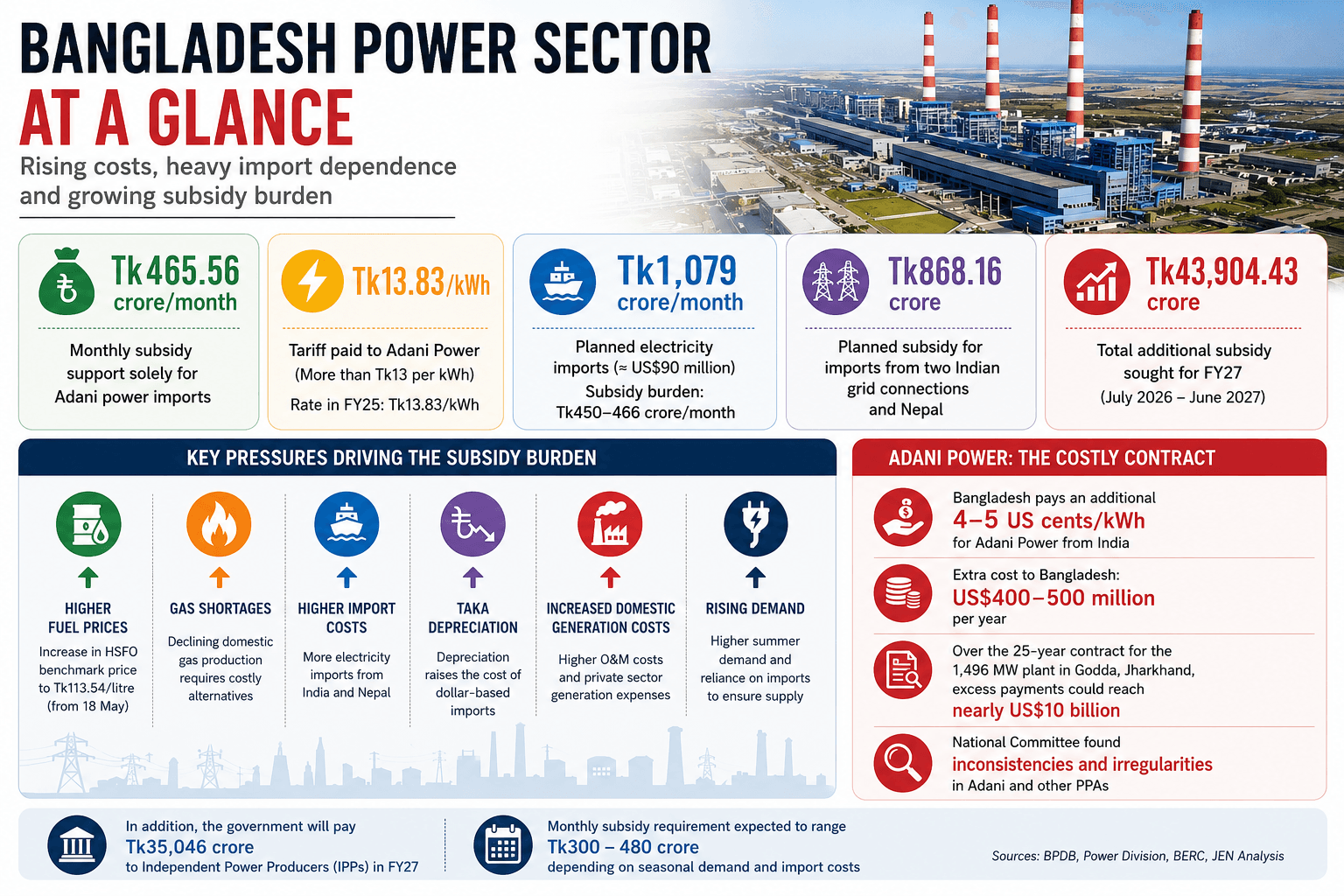
The state-owned Bangladesh Power Development Board (BPDB) has sought Tk5,586.69 crore in subsidy for electricity imports in fiscal year 2026-27, citing higher costs, particularly from power imported from India’s Adani Power, according to official data.
The amount means Bangladesh will require around Tk465.56 crore in monthly subsidy support solely for Adani power imports.
The Power Division recently submitted the subsidy requirement to the Finance Division, where the Adani power tariff was included in the calculation.
“We have a plan to import electricity worth Tk1,079 crore (US$90 million) per month. The subsidy burden is expected to remain around Tk450-466 crore during the same period,” BPDB Chairman Engr Md Rezaul Karim told Just Energy News in response to a query about subsidies for Adani power imports.
He said BPDB pays more than Tk13 per kilowatt-hour for electricity supplied by Adani Power. The rate was Tk13.83 per kilowatt-hour in the last fiscal year, according to BPDB data.
Meanwhile, Adani Power has continued submitting regular bills despite an ongoing dispute over coal pricing for the plant, officials from both sides confirmed.
The BPDB also plans to seek Tk868.16 crore in subsidy support for electricity imports from two Indian grid connections and Nepal, according to a letter sent to the Finance Division recently.
The Power Division has sought a total additional subsidy allocation of Tk43,904.43 crore for FY27, citing higher electricity import costs from India and Nepal, rising fuel prices and increased domestic generation expenses in private power sector.
According to the official proposal, BPDB requires the revised subsidy allocation for the period from July 2026 to June 2027 to ensure uninterrupted power supply.
The request follows the Bangladesh Energy Regulatory Commission’s (BERC) decision to increase bulk and retail electricity tariffs in May, after which authorities recalculated the subsidy requirement. Before the tariff adjustment, the Power Division had sought around Tk59,144.77 crore in subsidy for the current fiscal year.
The proposal said the power sector is facing increasing financial pressure due to higher electricity imports from neighbouring countries, rising domestic generation costs, increased natural gas prices, greater dependence on liquid fuels amid gas shortages and depreciation of the taka against the US dollar.
It also noted that BERC increased the benchmark price of high-sulphur fuel oil (HSFO) to Tk113.54 per litre from 18 May, adding further pressure on generation costs.
Power imports have become an increasingly important part of Bangladesh’s electricity supply mix. The revised subsidy proposal includes electricity imported from India and Nepal, generation from the 163MW Tripura power plant and rental power plants.
According to the revised estimate, the government will need to provide Tk43,904.43 crore in subsidy during FY27. In addition, the government will pay Tk35,046 crore to independent power producers (IPPs).
The monthly subsidy requirement is expected to range between Tk300 crore and Tk480 crore, depending on seasonal demand and import costs.
The proposal said electricity generated by IPPs, state-owned power plants and imported sources is sold to distribution utilities at regulated bulk tariffs, forcing BPDB to absorb the gap between procurement costs and regulated selling prices through government subsidies.
Officials said electricity demand is expected to rise during the summer months, while persistent domestic gas shortages will require continued imports of electricity and fossil fuels to maintain reliable supply.
Early of the current year, the interim government formed National Committee has said Bangladesh has been paying an additional 4–5 US cents per kilowatt-hour for electricity supplied by India’s Adani Power, costing the country an estimated $400 million–$500 million a year.
According to the committee, the excess payments could amount to nearly $10billion over the 25-year term of the contract for the 1,496-megawatt coal-fired plant built by Adani in Godda, in India’s Jharkhand state.
“We prepared the report based on the facts and findings and submitted it on the power purchase agreements (PPAs) of a series of power plants, including Adani,” Justice Moinul Hossain, hwo is head of the committee told Just Energy News.
He added that the committee found inconsistencies and irregularities in the signing of the PPAs with Adani and other power producers.
Besides, Energy Expert Prof M Tamim also warned that idle generation capacity creates additional financial pressure because the government still has to pay capacity charges to power plants that are not producing electricity.
“Moreover, if we lack the necessary fuel and our installed capacity remains idle, we still have to pay capacity payments for power plants that are not producing electricity. This results in a substantial financial loss for the country,” he said.