


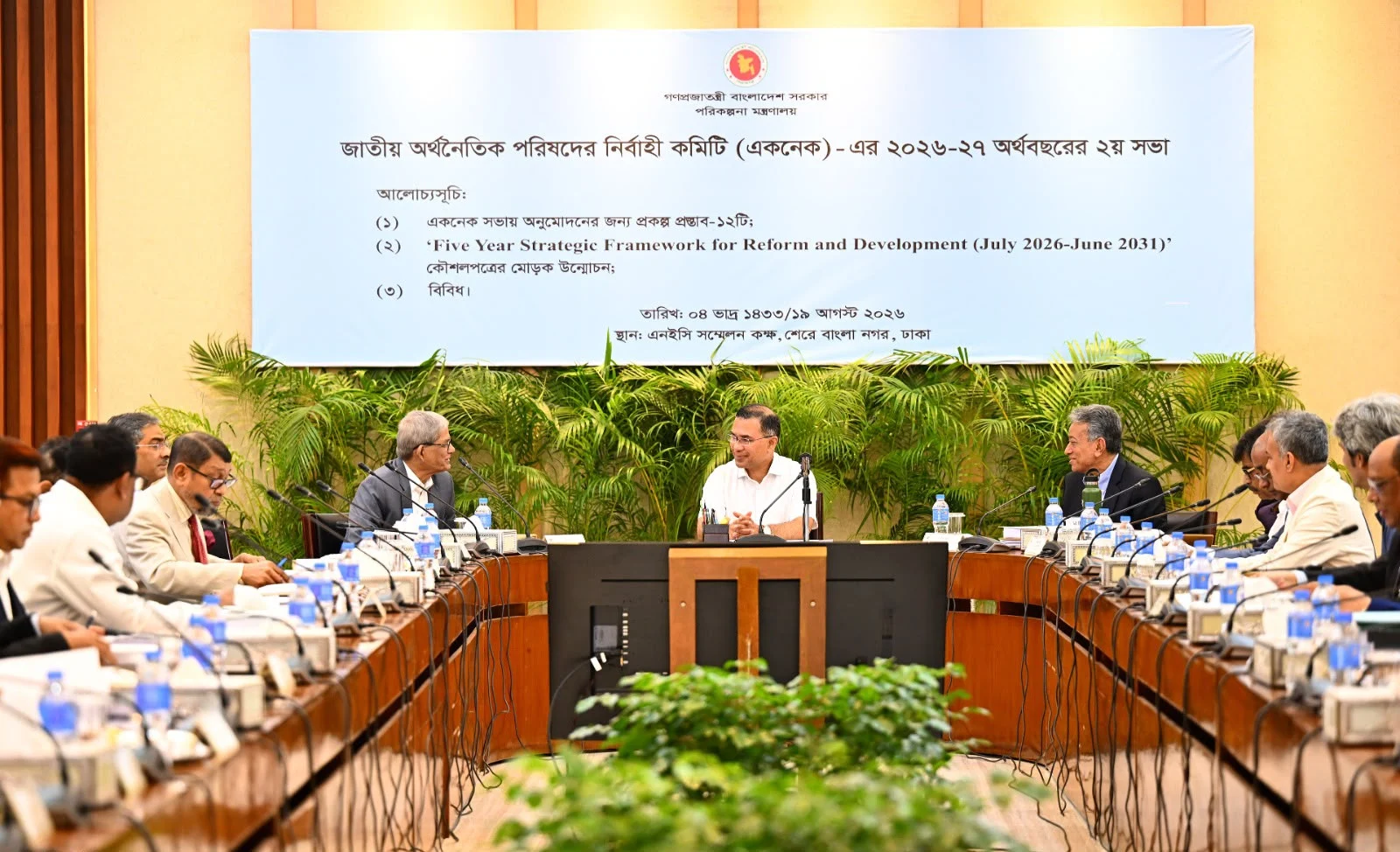
The Executive Committee of the National Economic Council (ECNEC) on Wednesday approved 10 projects involving Tk 9,333.58 crore, with the rehabilitation and strengthening of rural roads across the country accounting for more than half of the total allocation.
The Tk 4,963.67 crore rural road project will cover all 64 districts and all upazilas across the country’s eight divisions, with around 5,223 kilometres of roads and 7,000 metres of bridges and culverts to be rehabilitated.
Of the total project cost, Tk 8,488.71 crore will come from government funds and Tk 936.38 crore from project loans.
The approvals came at the second ECNEC meeting of the current fiscal year, chaired by Prime Minister and ECNEC Chairman Tarique Rahman at the NEC Conference Room in Sher-e-Bangla Nagar.
Planning State Minister Md Zonayed Abdur Rahim Saki briefed reporters after the meeting.
Focus on road maintenance
Saki said the rural roads had been selected after assessing their conditions and identifying locations where people were facing serious communication difficulties.
The prime minister instructed authorities to use modern technologies to make the roads more durable. Rubber-bitumen technology will initially be tested on 100km of roads during the first year, with wider application depending on the results.
Saki stressed that maintenance must be incorporated into road projects, describing road maintenance as one of the weakest areas of infrastructure management.
The project mainly covers the repair of existing bridges and culverts, while new bridge construction will be undertaken separately, he said.
Health gets major allocations
The ECNEC approved Tk 1,154.83 crore for replacing and reconstructing unusable structures at Dhaka Medical College.
The project, to be implemented entirely with government funds from September 2026 to August 2030, will replace several unusable buildings, including student hostels and other non-residential structures.
The committee also approved the second revision of a project to construct 19 modern hostel buildings at 10 medical colleges, with an additional cost of Tk 201.70 crore.
Smart bridge maintenance
A Tk 115.73 crore project was approved to introduce smart maintenance technology for bridges under the Roads and Highways Department.
With support from the Korea International Cooperation Agency (KOICA), the project will initially introduce technology to monitor the condition of four bridges.
The system will allow authorities to centrally track changes in bridge conditions and identify potential deterioration early, enabling preventive maintenance.
The prime minister and ECNEC also discussed whether the system could eventually cover major bridges, tunnels and other major structures.
Saki said the project would also focus on technology transfer and training Bangladeshi engineers to build long-term institutional capacity.
Water, power and defence projects
The ECNEC approved Tk 298.65 crore for protecting Lalmonirhat Sadar upazila from erosion along the right bank of the Dharla River.
It also approved Tk 558.83 crore for strengthening the coastal embankment at Bashbaria Ferry Ghat in Sitakunda, Chattogram, and the stretch from the ferry ghat to Kumira Ghat.
Two power-sector projects were approved.
The second revision of a project to build a 100MW solar power plant at Madarganj in Jamalpur received approval with an additional cost of Tk 101.82 crore.
The committee also approved the first revision of a project to expand and strengthen electrical infrastructure in the DESCO area of Dhaka, involving an additional Tk 627.23 crore.
The government has set a target of generating up to 10,000MW of solar power during its five-year tenure, Saki said, adding that solar power has been given the highest priority under the renewable energy strategy.
The ECNEC also approved a Tk 1,311.53 crore project for infrastructure development at Ramu Cantonment.
More than 8,000 soldiers currently lack adequate accommodation there, Saki said.
The project will be financed entirely by the government. The prime minister instructed authorities to preserve the natural terrain of the hilly area and design buildings according to the existing elevation rather than cutting and levelling the hills.
The committee also approved the third revision of a project to strengthen the capacity of the Department of Livestock Services, with the revised cost reduced by Tk 0.45 crore.
Govt moves to prevent project duplication
Saki said two projects were not approved because of concerns over duplication with existing projects.
The Planning Commission is now working to shift from a piecemeal approach to a programme-based cluster system, under which similar projects, such as road maintenance schemes, would be grouped together.
The aim is to identify overlaps, avoid duplication and address gaps in development programmes.
The Planning Commission has already held discussions with around 41 ministries and divisions on the issue, Saki said.
The government is also working to make project implementation more time-bound and budget-bound.
In some cases, it takes one-and-a-half to four years for a project to move from the initial concept through DPP preparation and approval to issuance of a work order, he said.
A revised project implementation framework has been prepared and is awaiting presentation to the prime minister.
A project monitoring dashboard has also been developed to track the status of every project. The Prime Minister’s Office, Finance Ministry, Planning Ministry and relevant ministries will have access to the system.
Statistical reform
Saki said the government was also working to modernise the national statistical system so that reliable, updated and representative data could be generated to properly assess the impact of government initiatives.
On the country’s development outlook through 2031, he said the government’s five-year strategic framework seeks to take Bangladesh from “fragility to prosperity”.
The first two years will focus on economic recovery, followed by three years of transition, while the overall five-year period will focus on reconstruction with acceleration.
The energy and power sector remains one of the major challenges inherited by the government, Saki said.
The government is working to increase domestic gas production, expand renewable energy and build emergency fuel reserves, he added.
The meeting was also informed that the Planning Minister had already approved nine projects costing less than Tk 50 crore.
The ECNEC-approved projects cover rural roads, health, riverbank and coastal protection, renewable energy, electricity infrastructure, bridge maintenance, livestock and defence infrastructure.