


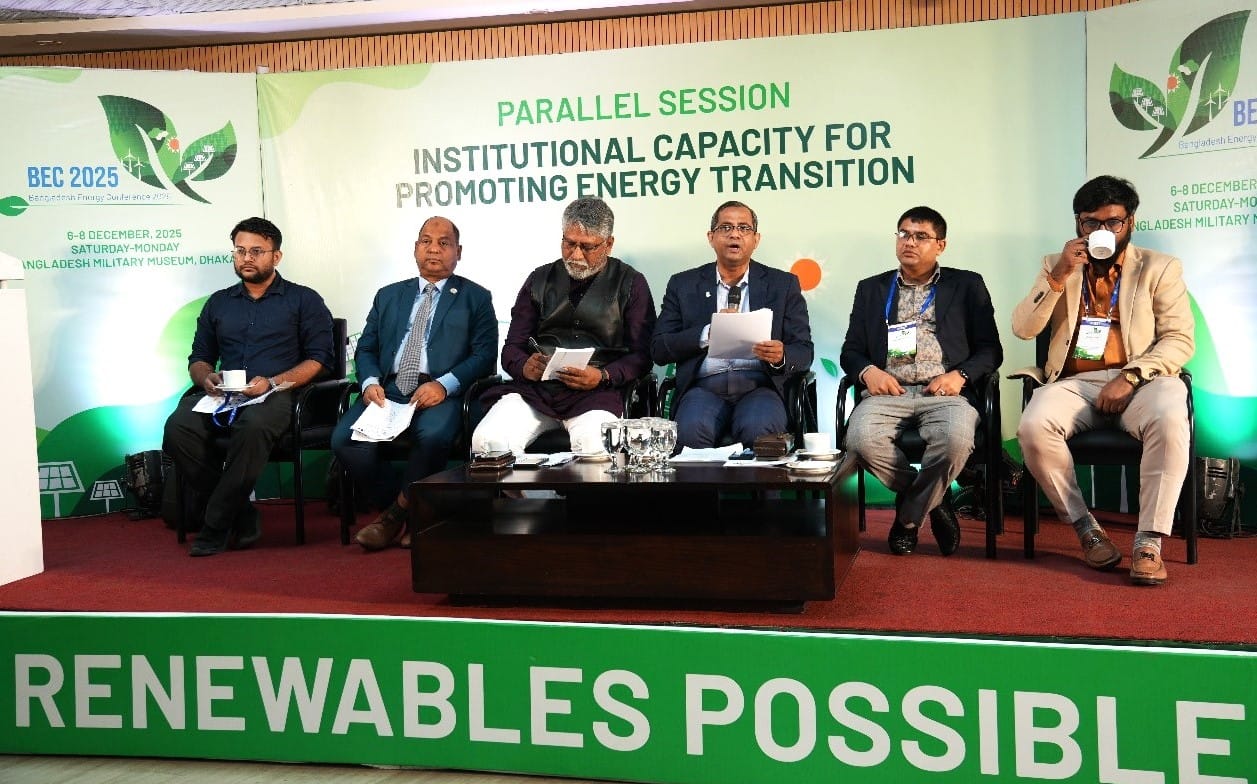
The Asian Development Bank’s (ADB) decades-long emphasis on fossil fuel financing is intensifying Bangladesh’s energy, economic and environmental vulnerabilities, according to a new civil society analysis presented at the Bangladesh Energy Conference 2025.
Experts warned that ADB’s continued reliance on gas-based power is locking Bangladesh into an expensive, fuel-dependent and unstable energy system, while renewable energy remains significantly underfunded despite rising global consensus in favor of low-cost, climate-resilient solutions.
The findings came from a report titled “MDBs in the Energy Sector of Bangladesh,” presented by Sarmin Akter Bristy, Fossil Fuel Campaigner at the NGO Forum on ADB.
The session was moderated by the Forum’s Executive Director Rayyan Hassan.
Hassan warned that ADB’s fossil-heavy financing model is deepening the country’s structural energy risks.
“ADB’s one-sided, gas-focused portfolio heightens Bangladesh’s exposure to fuel shortages, mounting debt and escalating climate threats,” he said.
Renewables: Huge Potential, But Blocked by Policy Barriers
A separate session titled “Problems and Potentials of RE Application in Bangladesh” revealed that policy bottlenecks continue to limit renewable energy expansion despite the sector’s strong potential.
Anwar Hossain, Executive Director of Earth, noted that industrial solar has expanded faster than rooftop solar — but mostly for compliance.
“Nearly 90% of home-based rooftop solar systems are non-functional, installed only to meet regulatory requirements. If these systems actually produced power, they could meaningfully support the national grid,” he said.
Mostofa Al Mahmud, President of BSREA, said high upfront solar costs demand strong financial incentives — incentives that remain absent.
“A meeting to reduce tariffs on solar panels was held months ago, yet no progress followed. Invisible forces are resisting renewable energy,” he added.
Energy finance researcher Sheikh Ruhul Amin warned that Bangladesh’s renewable targets are not aligned with financing realities.
“Major funders, including ADB, do not consider the 20–30% renewables target bankable. Unrealistic targets create financial risks. Bangladesh must set credible, investible goals,” he said.
Idle Gas Plants, Rising Debt: ‘Costliest Form of Energy Insecurity’
The report highlights significant financial losses from ADB-financed plants that cannot operate due to fuel shortages or missing gas pipelines.
Two large plants—the Rupsha 800 MW and Reliance Meghnaghat 715 MW—are fully built but sitting idle because of inadequate gas supply.
Despite generating no electricity, Bangladesh must pay heavy capacity charges under OCR loan provisions.
“These plants represent the costliest form of energy insecurity — assets ready to generate but starved of fuel,” Bristy said.