


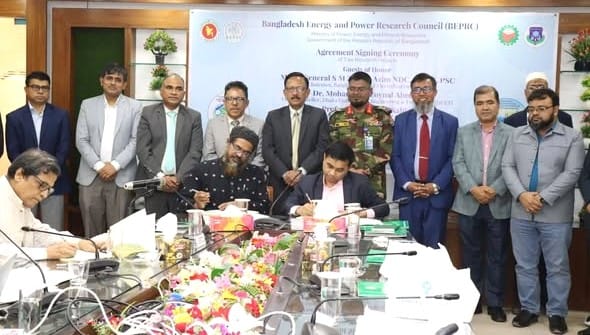
Artificial intelligence–based electricity cost modelling could significantly improve efficiency and transparency in Bangladesh’s power sector, speakers said at a contract-signing ceremony in Dhaka on Sunday.
The Bangladesh Energy and Power Research Council (BEPRC) signed agreements for two major applied research projects focused on renewable energy expansion, cost transparency and the development of the country’s blue economy.
Addressing the event, Consumers Association of Bangladesh energy adviser Professor M Shamsul Alam said weak governance and corruption in the power and energy sectors had contributed to a sharp rise in subsidy burdens.
“Bangladesh’s GDP growth has fallen to 4.5 percent, while foreign exchange reserves stand at around US$21 billion. Large-scale irregularities in the power and energy sectors have pushed subsidies even higher,” he said.
Professor Alam added that AI-based electricity cost modelling would help curb corruption, ensure data accuracy and support more justified power purchase agreements.
The ceremony was chaired by BEPRC chairman and senior secretary Mohammad Wahid Hossain, who said the government had spent approximately Tk 2.05 lakh crore on power subsidies over the past two decades.
“BEPRC is building a research-friendly ecosystem in the power and energy sectors to help reduce the long-term subsidy burden,” he said.
Bangladesh Rural Electrification Board (BREB) chairman Major General SM Zia-ul-Azim, attending as guest of honour, praised BEPRC’s initiatives, saying they would strengthen national self-reliance in energy research and development.
The first project, titled “Sustainable Electricity Generation from Tidal Lagoons in Coastal Bangladesh: A Demonstration toward Climate-Resilient Infrastructure,” will be implemented by the Department of Electrical and Electronic Engineering at Dhaka University of Engineering and Technology (DUET).
The 36-month project, with a budget of Tk 38 million, will establish a pilot tidal lagoon spanning about five acres in Rampal upazila of Bagerhat district.
The project will monitor electricity generation, tidal patterns and environmental impacts using ultra-low-head turbines and an IoT-based SCADA system.
It aims to develop a scalable renewable energy model for coastal regions, supporting climate resilience and blue economy development. Professor Dr Izardar Sabbir Hossain of DUET will serve as the principal investigator.
The second project, “Web-Based Remote Monitoring, Electricity Cost Modelling and Decision Support System Powered by Artificial Intelligence,” will be carried out by the Department of Electrical and Electronic Engineering at Daffodil International University.
Also spanning 36 months, it has an estimated cost of Tk 30.8 million.
The project will develop AI-driven tools for real-time power plant monitoring, electricity cost analysis and decision support. Pilot activities will be conducted at gas-, oil- and coal-based power plants in collaboration with the Bangladesh Power Development Board. CAB adviser Professor Dr M Shamsul Alam who is also Dean of Engineering at Daffodil International University, will lead the research.
Guests at the signing ceremony included DUET Vice-Chancellor Professor Dr Mohammad Zainal Abedin and Daffodil International University Vice-Chancellor Professor Dr M R Kabir.
Officials said the projects would play a crucial role in reducing power generation costs, enhancing transparency and promoting sustainable energy from blue economy resources. Over the past year, BEPRC has signed five new research contracts and launched several initiatives, including plans for a national energy and power research laboratory and a centralised data centre.