


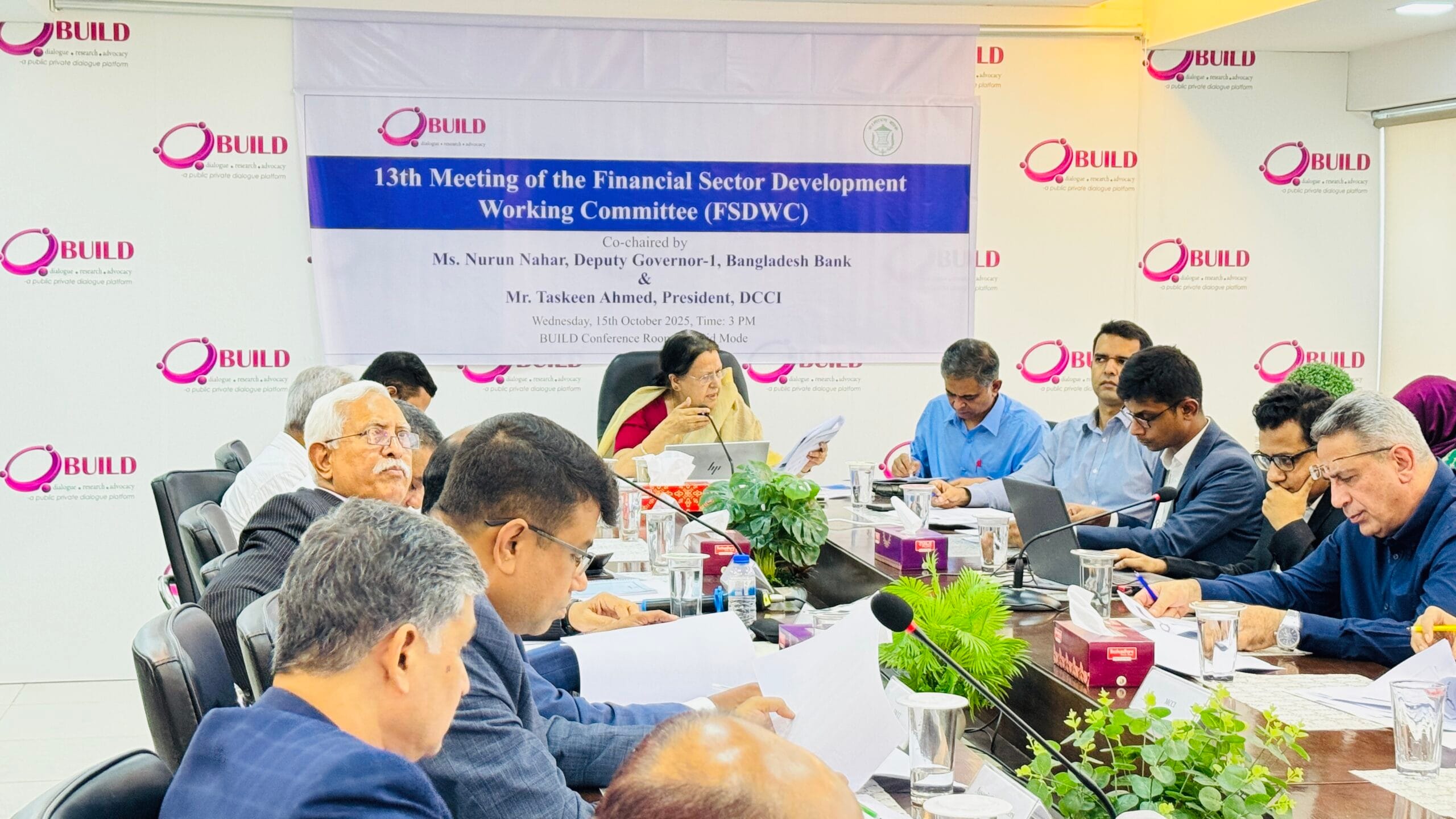
The Bangladesh Bank is in the process of aligning its Credit Guarantee Scheme (CGS) with the CMSME Master Circular, which will be finalized soon, said Nurun Nahar, Deputy Governor of Bangladesh Bank.
She made the announcement while chairing the 13th Financial Sector Development Working Committee (FSDWC) meeting on “CMSME Financing Master Circular 2025 – An Analysis”, organised by Business Initiative Leading Development (BUILD) at its conference room on Wednesday.
Nahar acknowledged that while the circular may have some shortcomings, these will be addressed over time. She reiterated that the central bank is committed to helping the CMSME (Cottage, Micro, Small, and Medium Enterprises) sector flourish, emphasizing that the ambitious 27% credit target is intended to push the sector toward growth.
“No policy can be fully perfect, but we are open to improvements as we move forward,” she said, adding that the Bangladesh Bank is designing policies to ensure benefits for all stakeholders.
In her keynote presentation, Ferdaus Ara Begum, CEO of BUILD, revealed that in the first quarter of 2025, the small business segment received the highest number of loans, while medium enterprises secured the largest average disbursement. The trading sector dominated CMSME credit with 59%, compared to 24% for manufacturing, while the share of women-owned enterprises declined as businesses became more formalized.
She also noted that informal entrepreneurs can now access loans of up to Tk 5 lakh using Unique Business Identification (UBID), Digital Business Identification (DBID), or Personal Retail Account (PRA) instead of trade licenses. While credit limits have increased since 2019, the service sector still receives more preference than manufacturing.
BUILD recommended revisiting the CMSME credit target, developing clearer guidelines for peer and group financing, raising the manufacturing credit ceiling, and aligning the CGS with central bank policies to make CMSME financing more inclusive.
Ali Zaman, President of the SME Owners Association, called for simplification of SME lending formats and proposed that loans for SMEs and women entrepreneurs be offered as cash-credit or overdraft facilities to ensure greater flexibility in meeting working-capital needs.
Bibhuti Bhushan Biswas, Senior General Manager of PKSF, said PKSF’s involvement in credit disbursement would help the Bangladesh Bank achieve its CMSME targets.
Suman Chandra Saha, Deputy General Manager of the SME Foundation, emphasized the need for a unified SME database and requested government support for establishing district-level offices to strengthen cluster development efforts.
Mansurul Karim, Regional Director of BSCIC, mentioned that 10% of BSCIC industrial plots have been reserved for women entrepreneurs.
SM Alomgir Hossain, Head of Small Business at BRAC Bank, highlighted that although regulations permit the use of assets other than land as collateral, banks have yet to widely adopt this flexibility—especially in manufacturing, where capital investment is higher.
The President of the Institute of Chartered Accountants of Bangladesh (ICAB) stressed the need to overcome the “default culture” to strengthen financial discipline.
Women entrepreneurs present at the meeting urged that loan rejection causes be communicated to applicants, enabling them to correct issues and reapply through other institutions.
Representatives from the Finance Division, Ministry of Finance, Ministry of Commerce, RJSC, Ministry of Industries, FBCCI, MCCI, banks, and several private sector bodies also attended the meeting and shared their insights and recommendations.