


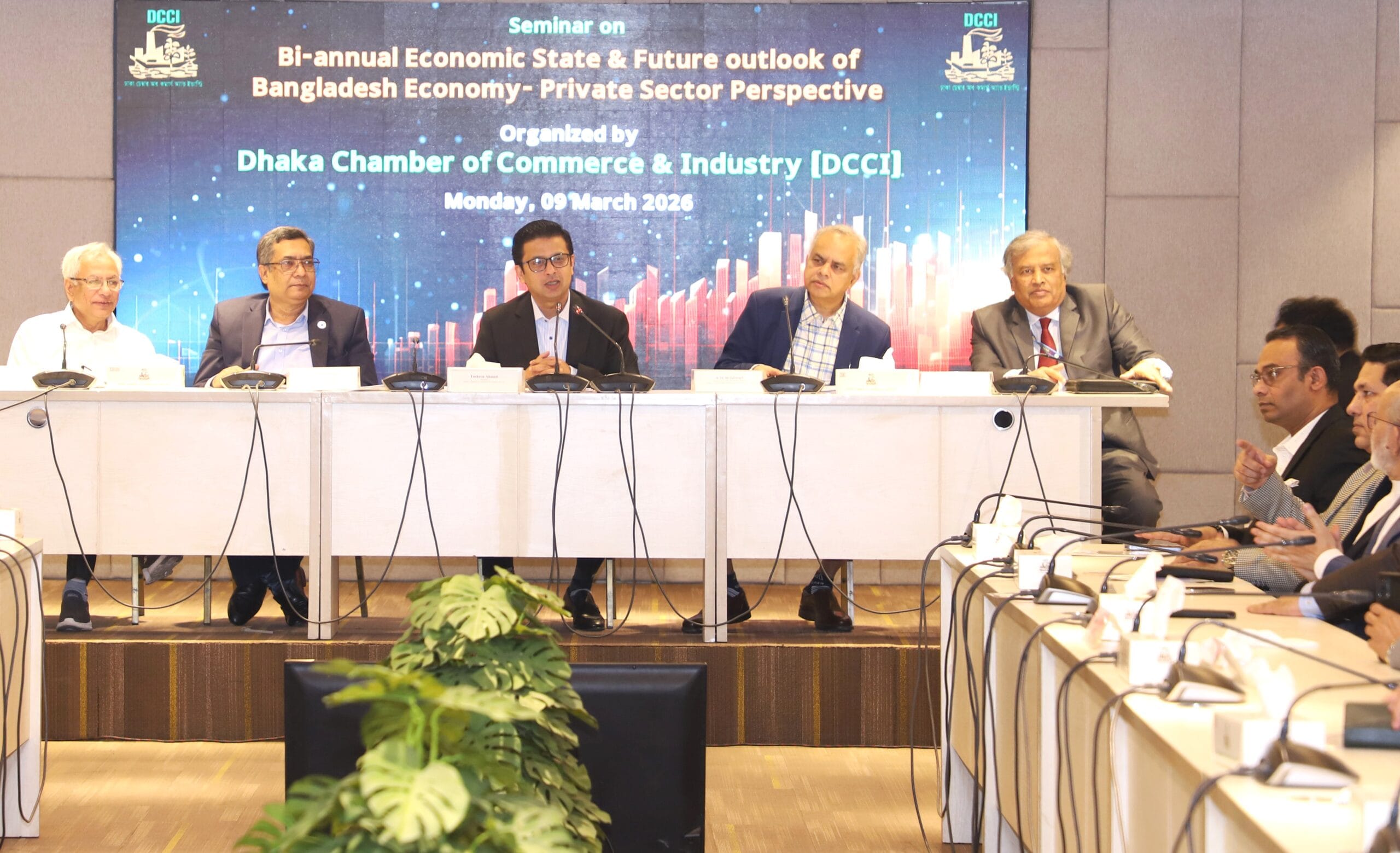
Business leaders here have raised concerns about the country’s economic outlook, citing global geopolitical tensions, persistent inflation and weakening investment as key challenges facing the private sector.
The remarks were made during a seminar titled “Bi-annual Economic State & Future Outlook of Bangladesh Economy – Private Sector Perspective” organised by the Dhaka Chamber of Commerce & Industry in Dhaka on Monday.
Speaking at the event, Taskeen Ahmed, president of the chamber, said the progress of the private sector had been “less than satisfactory” due to a range of domestic and global pressures.
These include disruptions to international trade linked to the ongoing tensions involving Iran, the United States and Israel, as well as new US tariffs, inflation, uncertainty over industrial energy supply and deteriorating law and order conditions.
Ahmed said the Middle East conflict posed a serious threat to global supply chains, particularly for Bangladesh, where a large portion of industrial energy imports originate from the region. He warned that the new US tariff policy could also negatively affect global trade and investment flows.
The chamber chief urged the government to consider delaying the country’s planned graduation from Least Developed Country status by three years in order to maintain competitiveness in global markets.
Bangladesh is currently scheduled to graduate from the category this year, which would eventually end several trade preferences enjoyed by its exports.
Ahmed also called for reforms including automated revenue management systems, expansion of the tax base through direct taxation, reduced government borrowing from domestic banks and improved efficiency in public spending. He said easing bureaucratic procedures and strengthening law and order were essential to boost both domestic and foreign investment.
The seminar’s chief guest, Zonayed Abdur Rahim Saki, Bangladesh’s state minister for planning, joined virtually and said the government was working on policies aligned with the financial commitments outlined in its election manifesto. He added that authorities were closely monitoring the Middle East crisis and preparing measures to mitigate its economic impact.
Saki said the government aimed to “democratise the economy” by ensuring the benefits of development reach all citizens, while prioritising employment generation, environmental protection and the development of a skilled workforce. He also acknowledged that the country had yet to sufficiently expand its tax base, contributing to increased reliance on borrowing.
Dr Monzur Hossain of the Bangladesh Planning Commission said economic stability must be restored if Bangladesh is to achieve its goal of becoming a $1 trillion economy by 2030.
He stressed the need to prioritise manufacturing and develop alternative financing mechanisms beyond the banking sector to support small and medium-sized enterprises.
Meanwhile, Dr Mohammad Akhtar Hossain, chief economist at Bangladesh Bank, said inflation currently stood at about 9%, warning that the Middle East crisis could create further instability. He suggested that tighter monetary policy might be required to contain price pressures, noting that excessive liquidity and lower interest rates could destabilise the economy.
Other speakers also highlighted structural challenges. Dr Zaidi Sattar of the Policy Research Institute of Bangladesh called for a reduction in excessive reliance on tariffs and a comprehensive reform of the tax structure.
Dr A K Enamul Haque, director-general of the Bangladesh Institute of Development Studies, warned that declining profitability in rice farming could discourage farmers and affect future production. He also pointed to supply chain weaknesses and financing difficulties for cottage, micro, small and medium enterprises.
During the discussion, Dr Mohammad Abu Eusuf of the Research and Policy Integration for Development stressed the need to rebuild business confidence and restore trust among bank depositors, while coordinating fiscal and monetary policies to tackle inflation.
Representatives from Bangladesh’s garment industry also highlighted trade risks. Faisal Samad of the Bangladesh Garment Manufacturers and Exporters Association said the ready-made garments sector – one of the country’s main economic drivers – remained vulnerable in the US and EU markets due to the absence of free trade agreements.
The seminar concluded with an open discussion session attended by policymakers, business leaders and researchers. Officials from the chamber said the event aimed to provide a platform for dialogue between the government and private sector on the country’s economic outlook.