


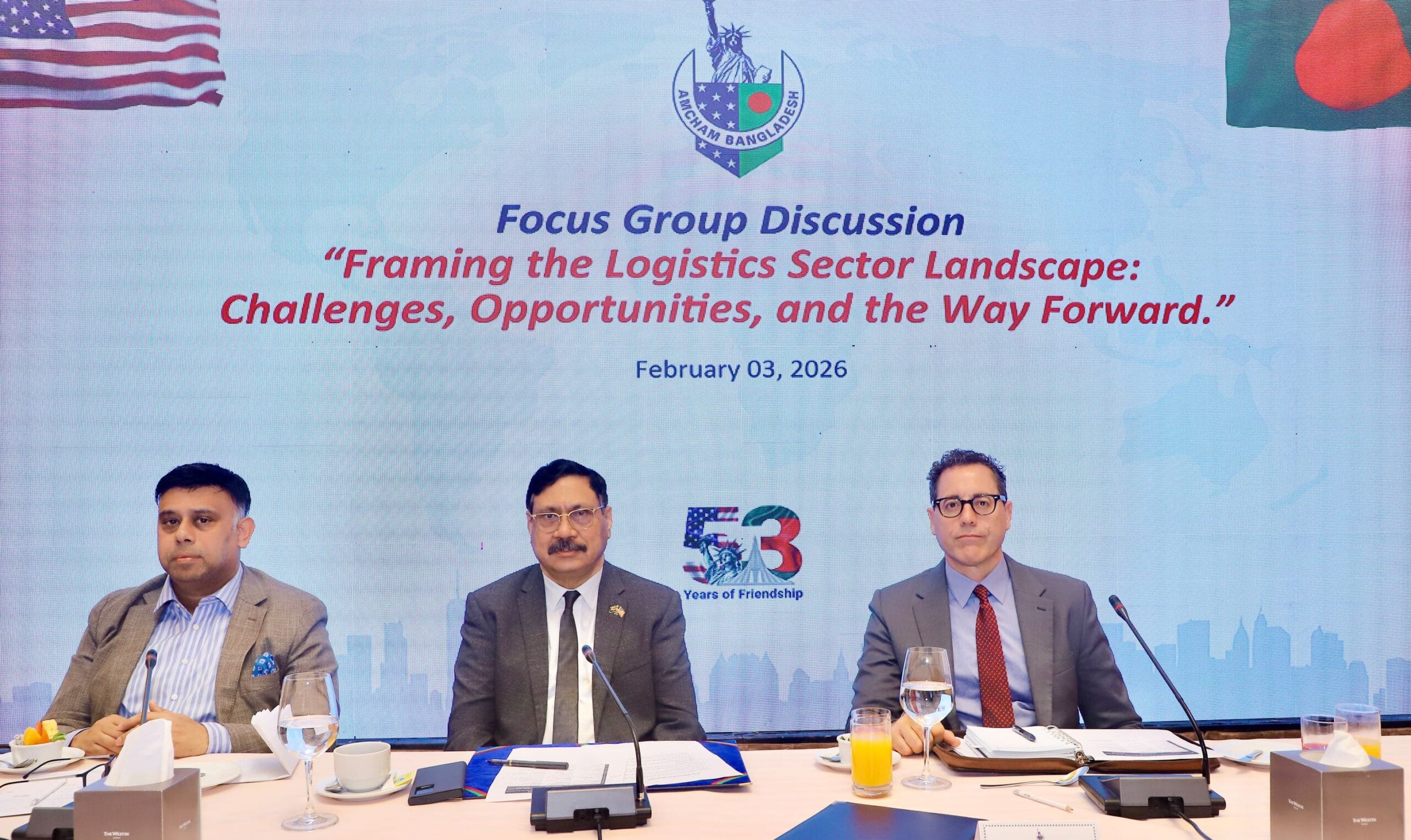
Bangladesh must accelerate logistics reform to remain competitive as global supply chains evolve, business leaders and policy experts said at a recent discussion, warning that capacity gaps and slow implementation could undermine trade growth ahead of the country’s graduation from least developed country (LDC) status.
Syed Ershad Ahmed, President of the American Chamber of Commerce in Bangladesh (AmCham), said logistics underpins supply chains, economic activity and everyday life, but remains poorly understood domestically despite gradual progress.
Drawing on more than 30 years of experience, he said Bangladesh continues to lag behind regional peers as global logistics is reshaped by artificial intelligence, automation, decarbonisation, geopolitical shifts and the push for more resilient supply chains. Bridging knowledge and capacity gaps, he argued, is critical to sustaining trade and attracting investment.
Dr M. Masrur Reaz, Chairman of Policy Exchange Bangladesh, said logistics competitiveness was central to reducing trade costs, improving delivery times and boosting efficiency. Referring to disruptions caused by the recent Chattogram port labour strike, he said weaknesses in logistics can have economy-wide consequences.
He noted that infrastructure and port capacity expansion would be essential to support a projected GDP of USD 760 billion by 2030, adding that a 1 per cent reduction in logistics costs could increase exports by about 7 per cent as Bangladesh approaches LDC graduation.
Dr Reaz also pointed to implementation gaps in the National Logistics Policy, citing government monopolies in rail and air cargo, weak coordination among ministries and the lack of a central logistics authority.
He warned of structural risks stemming from heavy dependence on the Dhaka–Chattogram corridor, which carries around 70 per cent of national trade, and called for greater private and foreign investment, particularly in rail logistics and cold chains. Major projects such as the Matarbari Deep Sea Port, Bay Container Terminal and a third terminal at Hazrat Shahjalal International Airport were highlighted as opportunities to build long-term capacity.
Mahbubul Anam, Managing Director of CF Global, said inefficiencies in air logistics and express courier services were constraining time-sensitive trade, especially as e-commerce demand rises.
He cited logistics costs at Dhaka airport being 20–25 per cent higher than road transport and stressed the need for stronger public–private coordination, better infrastructure planning and adequate equipment. He also noted the absence of direct cargo flights to the United States, despite clearance facilities already in place for the European Union.
From a policy perspective, Nusrat Nahid Babi, Senior Transport Specialist for South Asia at the World Bank, said reform momentum since 2022 must be reinforced by the new government through clear priorities and political consensus.
She outlined a phased agenda focused on policy simplification, multimodal connectivity, skills development, supply-chain digitalisation and investment. Immediate priorities include operationalising the National Logistics Policy and establishing a Logistics Division under the Prime Minister’s Office, followed by compliance with the WTO Trade Facilitation Agreement and expanded public–private partnerships.
Md Moinul Huq, Citi Country Officer for Bangladesh at Citibank N.A., said customs authorities need to operationalise provisions of the Customs Act 2023, particularly around electronic documentation and payments. He also called for reduced reliance on letters of credit and more flexible trade settlement mechanisms to improve competitiveness.
Participants also raised concerns over Bangladesh’s heavy dependence on ready-made garment exports, limited new infrastructure development and weak implementation of electronic documentation despite enabling policies. The discussion concluded with calls for wider adoption of multimodal transport—especially improved rail links to Chattogram Port—stronger industry–academia collaboration on skills, expansion of cold-chain and agribusiness logistics, and greater use of AI-enabled cargo visibility systems.
The American Chamber of Commerce in Bangladesh (AmCham) organised focus group discussion on the country’s logistics sector on 3 February 2026 in Dhaka, bringing together industry leaders, policymakers and development partners to assess challenges and future priorities.
The discussion, titled “Framing the Logistics Sector Landscape: Challenges, Opportunities, and the Way Forward”, took place at a local hotel and was attended by AmCham members from across the logistics ecosystem. Participants included representatives from the ready-made garments sector, freight forwarding companies, inland container depots, shipping lines, airlines and courier services.
Officials from the US Embassy in Dhaka were also present, including Paul Frost, Commercial Counsellor, and Erin Covert, Agricultural Attaché.