


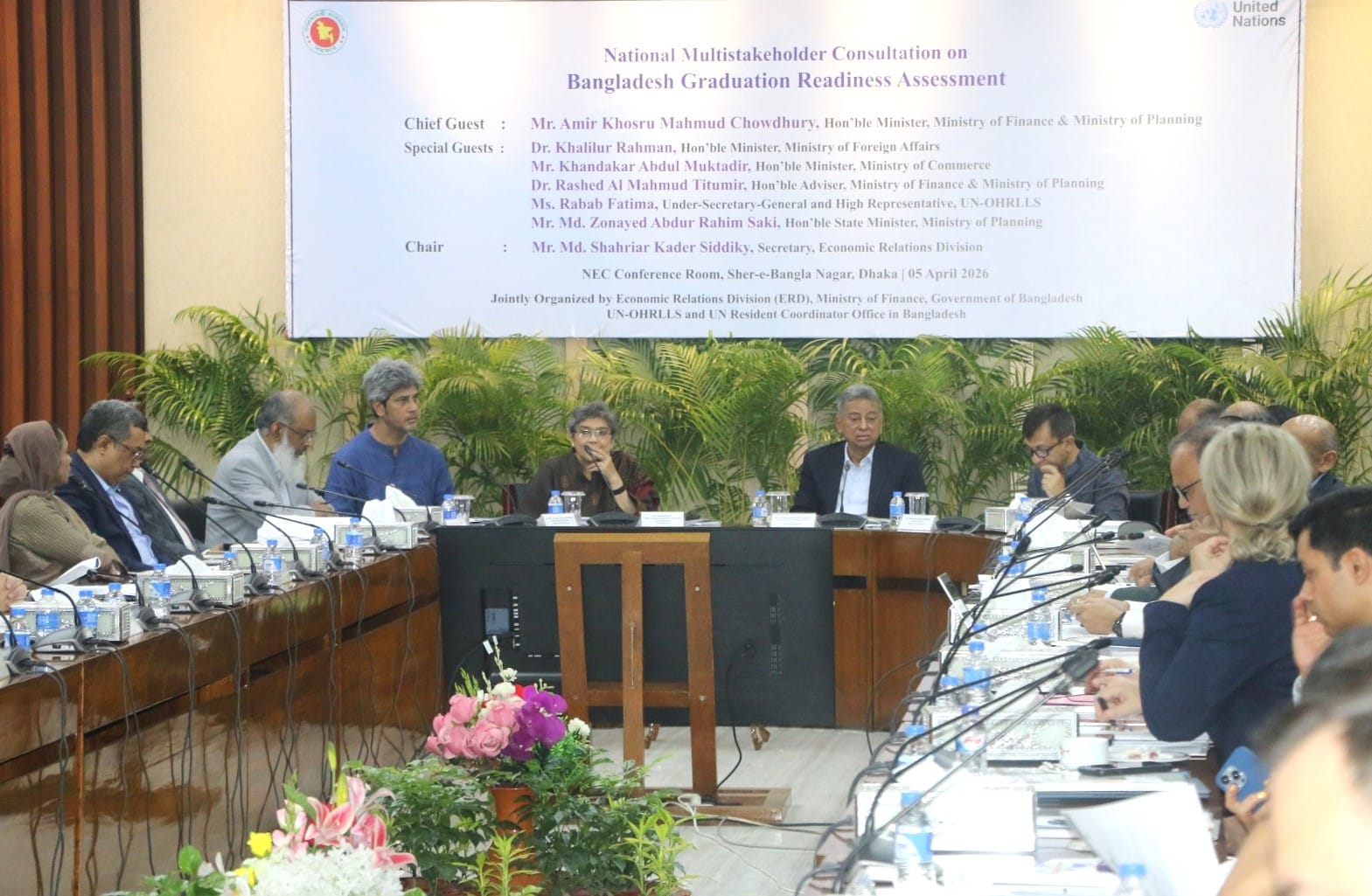
Finance and Planning Minister Amir Khosru Mahmud Chowdhury has signalled the government may require additional time to navigate the economic challenges linked to its impending graduation from the UN’s Least Developed Country (LDC) category, warning that current macroeconomic pressures could complicate the transition.
Amir Khosru Mahmud Chowdhury told a national consultation in Dhaka that stabilising the country’s fragile economy remains the government’s “utmost priority”, as policymakers grapple with slowing indicators and structural vulnerabilities.
“We are simply fighting to salvage the economy,” he said, describing a difficult inheritance marked by declining macroeconomic performance and capital shortages, particularly in the domestic capital market.
Bangladesh is set to graduate from the LDC category — a milestone that will end preferential trade benefits and concessional financing — but officials and stakeholders have raised concerns about the country’s readiness amid mounting global and domestic shocks.
The consultation, jointly organised by the Economic Relations Division, the United Nations Office of the High Representative for the Least Developed Countries, Landlocked Developing Countries and Small Island Developing States, and the UN Resident Coordinator Office in Bangladesh, reviewed a recent assessment of Bangladesh’s preparedness for graduation.
The study, commissioned at the government’s request, drew on extensive consultations with public institutions, businesses, civil society groups and development partners. It highlighted a range of risks that could intensify during the transition period.
Among these are climate vulnerability, the ongoing Rohingya refugee crisis, lingering effects of the Covid-19 pandemic, global supply disruptions linked to the Russia-Ukraine war, and rising inflation and balance-of-payments pressures. Recent geopolitical tensions in the Middle East were also flagged as emerging concerns.
Presenting the findings, economists warned that “pre-existing graduation vulnerabilities could become far more pronounced” under current economic conditions, adding that the convergence of political and macroeconomic challenges raises questions over whether more preparatory time is needed.
Bangladesh has formally requested a three-year extension to its graduation timeline. According to Rabab Fatima, the request is under review by the UN’s Committee for Development Policy under its enhanced monitoring mechanism, with a final recommendation to be submitted to the UN Economic and Social Council before any decision by the General Assembly.
Other ministers at the event outlined policy priorities to restore economic momentum. Commerce minister Khandakar Abdul Muktadir stressed the need for prudent debt management and broadening the tax base, while economic adviser Rashed Al Mahmud Titumir called for structural transformation, diversification and productivity gains to support long-term growth ambitions.
Officials insisted the request for additional time should not be seen as a retreat from Bangladesh’s graduation goal, but rather a “strategic step” to ensure a smooth and sustainable transition.
Private sector representatives and civil society groups echoed that position, urging policymakers to secure a longer preparatory period to safeguard export competitiveness and economic stability once LDC-specific support measures are phased out.
Bangladesh is currently on track to graduate later this decade, a move widely seen as a symbol of development progress — but one that carries significant economic adjustments at a time of heightened global uncertainty.