


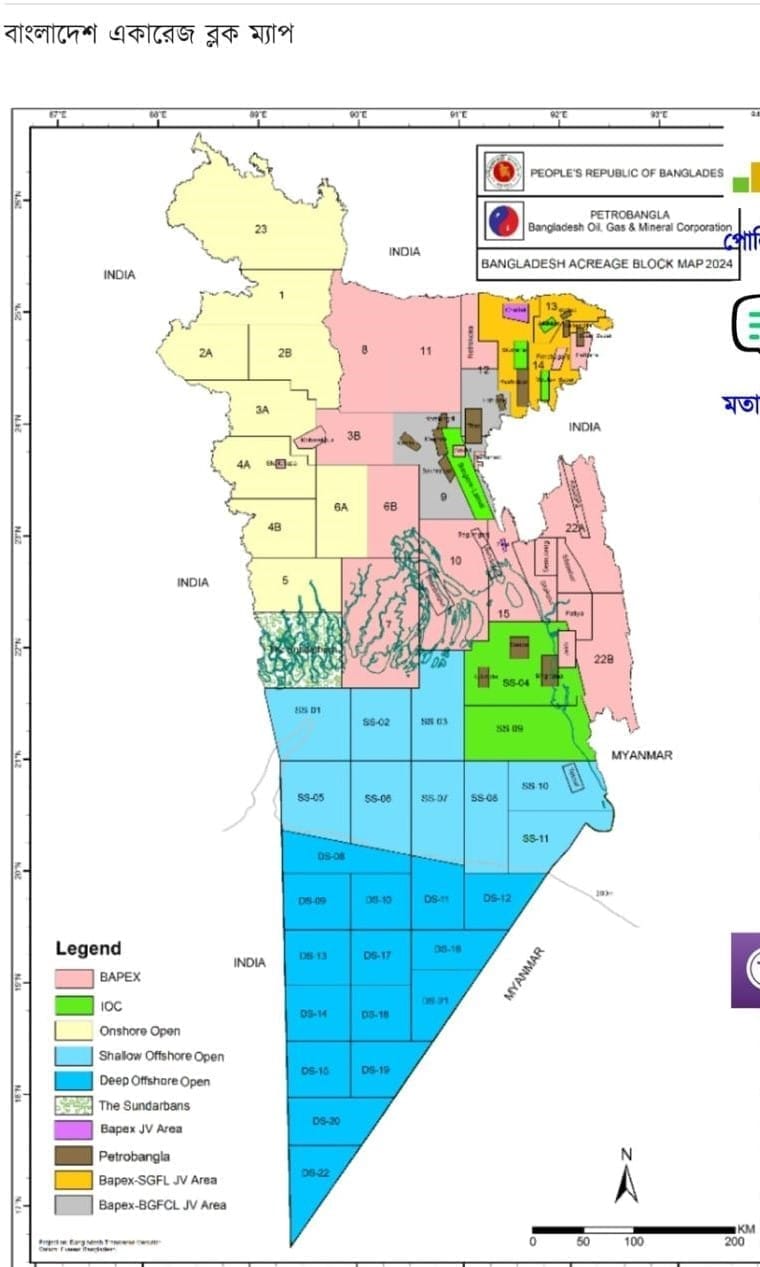
Bangladesh’s new BNP-led government plans to invite international bids for 47 onshore and offshore hydrocarbon exploration blocks within its first 180 days in office, as the country seeks to ease mounting pressure on natural gas supplies.
The Bangladesh Oil, Gas, Mineral Corporation(Petrobangla) will offer 21 onshore and 26 offshore blocks under a revised production-sharing framework designed to attract international oil companies (IOCs), officials said.
“We are going to launch the bidding within 180 days of the government,” EMRD secretary Mohammad Saiful Islam told Just Energy News on Sunday.
The move comes amid heightened concern over fuel security after several long-term LNG suppliers declared force majeure on seven cargoes scheduled for April, following disruptions linked to the blockade of the Strait of Hormuz during the Iran–Israel conflict.
Petrobangla chairman Md Erfanul Haque said the government still plans to import 31 LNG cargoes this year, although one shipment has already been cancelled and several deliveries may need to be replaced through the more expensive spot market.
Revised fiscal terms
Officials said the government has already completed preparatory work for the bidding round after the Ministry of Law vetted the draft Offshore Model Production Sharing Contract (MPSC) 2026 shortly before the national election in February.
The new model contract introduces several changes aimed at improving investor confidence, including reforms to gas pricing, pipeline cost recovery, work obligations and contributions to the Workers’ Welfare Fund.
Gas prices will now be linked to Brent crude oil rather than the earlier high-sulphur fuel oil benchmark.
Under the proposal, gas produced from deep-water blocks would be priced at 11% of Brent’s three-month average, based on a price floor of $70 and a ceiling of $100 per barrel. Shallow-water gas would receive 10.5% of Brent, while onshore projects would be priced at 8% in plains areas and 8.5% in hilly regions.
The draft also introduces a negotiable pipeline tariff mechanism and reduces the mandatory contribution to the Workers’ Welfare Fund from 5% of profits to 1.5%.
Officials said the government would not include blocks in the Chattogram Hill Tracts in the upcoming round.
Learning from previous attempt
The new framework marks a significant shift from the 2023 model contract, which offered a flat 10% of Brent but failed to attract investors amid political uncertainty. Only seven bid documents were purchased and none were submitted.
Earlier arrangements also capped gas prices at $5.60 per MMBtu for shallow-water blocks and $7.26 for deep-water developments.
The revised terms draw partly on recommendations made in 2022 by consultancy Wood Mackenzie to align Bangladesh’s fiscal regime more closely with international standards.
The draft also replaces the LIBOR benchmark with the Secured Overnight Financing Rate (SOFR) for financial calculations.
Supply pressures
Bangladesh’s energy system remains heavily dependent on fossil fuels, with domestic gas output declining in recent years while demand from industry and power generation continues to rise.
Energy analyst and former Bangladesh University of Engineering and Technology (BUET) professor Ijaz Hossain said nearly all of the country’s energy supply still comes from fossil fuels and import dependence has grown sharply.
“Today, around 97–98% of our total energy supply is fossil-fuel based, while about 60% of power and energy is import-dependent,” he said at a Just Energy News dialogue.
Hossain urged the government to accelerate exploration in onshore areas such as Bhola and open deep-water offshore blocks quickly.
He also suggested increasing exploratory drilling through the issuance of gas bonds and creating a dedicated Petrobangla subsidiary to partner with international firms with advanced reservoir and drilling expertise.
According to his analysis, around 10% of gas supplied in Bangladesh is lost through theft and system inefficiencies.
“When roughly a third of the gas supply comes from imported LNG, these losses translate into billions of dollars in foreign exchange every year,” he said, adding that reducing leakage could significantly ease pressure on the country’s dollar reserves.
Energy experts broadly welcomed the planned bidding round but cautioned that investor response will depend on regulatory clarity, stable policy conditions and political certainty.