


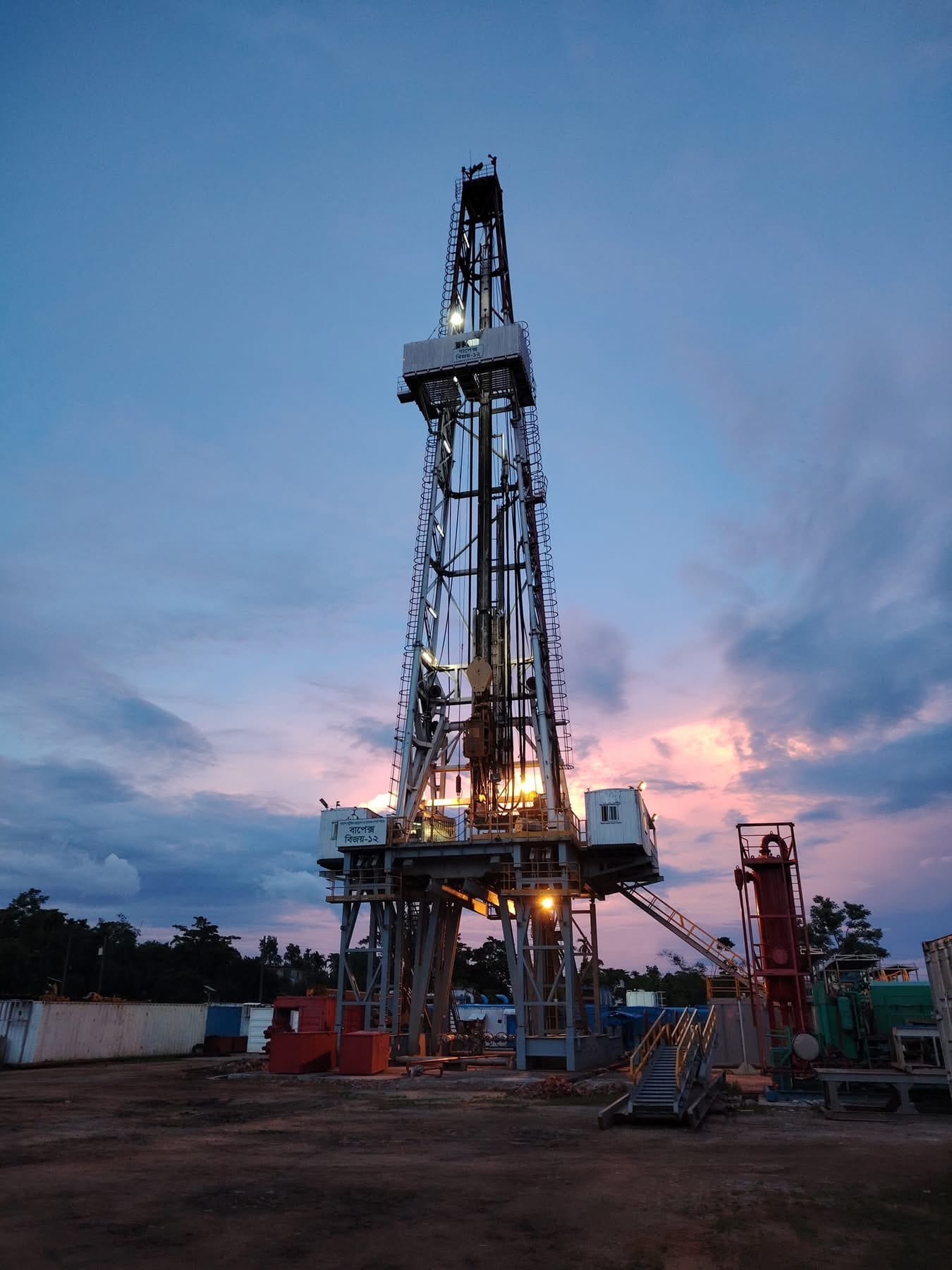
Bangladesh will launch an accelerated 180-day energy drive aimed at increasing domestic gas supply and reducing reliance on costly imports, as mounting energy pressures strain public finances and foreign exchange reserves.
Under the draft plan, the government expects to add about 90 million cubic feet per day (mmcfd) of gas to the national grid within six months.
Authorities also intend to revive production from several abandoned wells, signalling a renewed push to utilise idle domestic resources.
The Energy and Mineral Resources Division (EMRD) has received proposals to drill seven exploration wells, seven development wells and two workover wells in the short term.
At the same time, preparations are underway to finalise the Production Sharing Contract (PSC) Model 2026, a reform initiative aimed at attracting foreign investment in onshore and offshore exploration.
Seismic surveys have been prioritised alongside drilling activities. The government plans to complete 2,000 line-kilometres of 2D seismic surveys within six months.
Offshore data acquisition covering 500 line-km in Blocks 7 and 9 is also planned. New 3D seismic surveys are scheduled in Rangpur, Lalmonirhat, Gaibandha, Joypurhat and Panchagarh.
The initiatives will be implemented by Petrobangla and the Energy and Mineral Resources Division.
Mounting supply pressure
The fast-track programme comes as domestic gas production continues to decline. Output has fallen from more than 2,100 mmcfd in 2023 to below 1,900 mmcfd in 2025, an average annual decline of roughly 150 mmcfd.
The widening supply gap has forced greater dependence on imported liquefied natural gas (LNG). In 2025 alone, Bangladesh spent approximately $6.9 billion on LNG imports, intensifying pressure on already fragile foreign exchange reserves.
Energy analysts attribute the surge in import costs to volatile global LNG prices and years of underinvestment in domestic exploration.
Fiscal and infrastructure constraints
Fuel subsidies are adding to fiscal strain. In the 2025-26 fiscal year, the government allocated around Tk6,000 crore for energy subsidies.
Under commitments tied to a programme with the International Monetary Fund, Bangladesh has pledged to gradually phase out fuel subsidies by 2030, a move that could necessitate further tariff adjustments.
The deteriorating outlook was presented last week by Energy and Mineral Resources Division Secretary Mohammad Saiful Islam to Power Minister Iqbal Hasan Mahmud Tuku and the state minister for power and energy.
Infrastructure limitations also constrain supply. Bangladesh currently imports LNG through two floating storage and regasification units (FSRUs) and one land-based terminal, but regasification capacity and transmission bottlenecks limit the volume that can be delivered to the grid.
System losses, including technical losses and leakages, stand at about 6.38%, resulting in significant wastage. Officials estimate the financial cost of these losses at approximately Tk4,094 crore annually.
Long-term risks
Energy experts warn that without accelerated upstream exploration and expanded regasification and pipeline capacity, Bangladesh’s dependence on LNG will continue to rise, exposing the economy to global price volatility and exchange rate risks.
“We are drafting a 180-day plan to immediately increase gas supply to the national grid,” EMRD Secretary Mohammad Saiful Islam told Just Energy News. He expressed concern over the frequent depletion of national gas reserves from local gas fields.
As of June 2025, remaining domestic gas reserves were estimated at 7.96 trillion cubic feet, underscoring the urgency of new discoveries to meet growing demand.