


Bangladesh’s external debt has risen sharply from $23.5bn in 2009 to nearly $112bn in 2025 — an increase of 377% — intensifying scrutiny of high-cost infrastructure and power contracts, including agreements with Adani Power.
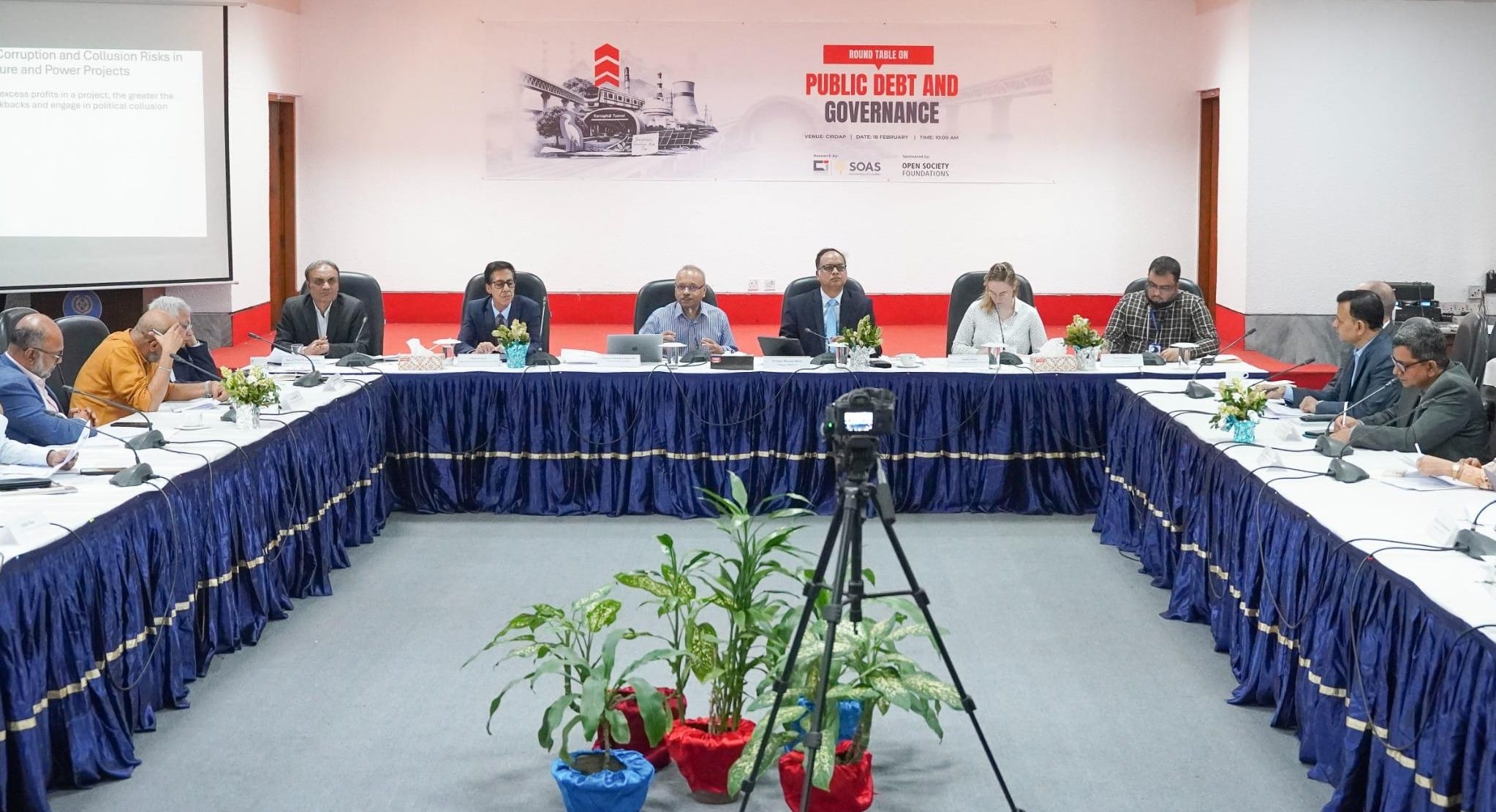
The findings were presented at a roundtable titled Public Debt and Governance, held in Dhaka on 18 February and organised by Change Initiative, a research-based think tank. The discussion focused on project governance, contractual efficiency and corruption risks in large-scale infrastructure schemes.
According to the research, one in every five taka of government revenue is now spent on interest payments alone, before any repayment of principal. Analysts warned that nearly $5bn in annual subsidies are required to sustain what they described as overpriced power contracts, many structured under “take-or-pay” terms requiring payments regardless of electricity usage.
The study reviewed 42 mega-projects undertaken between 2009 and 2025 across the transport, power, aviation and port sectors. It found that 29 projects experienced an average cost escalation of 70.3%. It further estimated that between 23% and 40% of project value may have been lost to collusion, inflated expenses and inefficiencies.
Researchers cautioned that Bangladesh’s debt-to-GDP ratio, currently estimated at 42% on a corrected basis, could rise to between 65% and 70% by 2030 if governance weaknesses persist. External debt relative to foreign exchange earnings has reached 192%, signalling growing solvency pressures.
High-value power projects were identified as particularly vulnerable to political collusion. Fixed capacity charges in the power sector are projected to reach Tk 38,000 crore in 2025, regardless of whether electricity is dispatched.
Professor Mushtaq H Khan of SOAS University of London, presenting comparative findings from Sri Lanka’s 2022 financial crisis, warned that governance failures in energy and infrastructure can rapidly translate into sovereign risk. He argued that effective competition — rather than additional top-down regulation — is essential to curb collusive contracting.
The report comes as Bangladesh faces mounting payment obligations to private power producers and sizeable external loan repayments, raising questions over the long-term sustainability of expensive cross-border energy agreements, including the Adani power purchase deal.
Speakers at the roundtable stressed that reforming procurement processes, strengthening institutional oversight and expanding competitive renewable energy projects will be critical to avoiding what researchers described as a potential “debt risk trap” in the years ahead.
Among those attending, Owais Parray, Country Economic Adviser at the United Nations Development Programme (UNDP), said: “Rising debt reflects growing demands for infrastructure and social protection. The risk is disconnecting policy from finance; we must bridge this gap through integrated planning and stronger institutional capability to ensure borrowing translates into real, sustainable development.”
Emma Wind, Governance Adviser at the UK’s Foreign, Commonwealth & Development Office (FCDO), said: “As Bangladesh nears LDC graduation, power sector reform is a financial necessity. By using IMF governance diagnostics and donor expertise to strengthen the procurement process, we can ensure a financially stable, energy-secure future that benefits both the nation and its global development partners.”
Md Jahangir Alam Molla, Director of the Bangladesh Power Development Board (BPDB), said repealing special acts and introducing competitive bidding had reduced solar tariffs from 10 cents to between 5 and 8 cents per unit. He added that prioritising land availability and fuel diversification remained central to reform efforts.
Mostafaa Al Mahmud, President of the Bangladesh Solar and Renewable Energy Association (BSREA), said: “With solar under five cents, we must stop wasting billions of dollars on imports. Scaling renewables through grid-adjacent land is no longer an option; it is an essential survival strategy for Bangladesh.”
Kawsar Chowdhury, co-chair of the Bangladesh America Alliance, said: “With a $5bn subsidy and 9,500MW of excess capacity, we face an existential crisis. To reduce costs and corruption, competitive solar power projects on government land, such as on top of canals, are essential.”
Md Shamim Jahangir, editor of Just Energy News, suggested that donor agencies should also be held accountable, alleging that they had supported infrastructure projects — such as the Rooppur Nuclear Power Plant and the Meghnaghat power project developed by JERA — which he said had contributed to mounting debt concerns.