


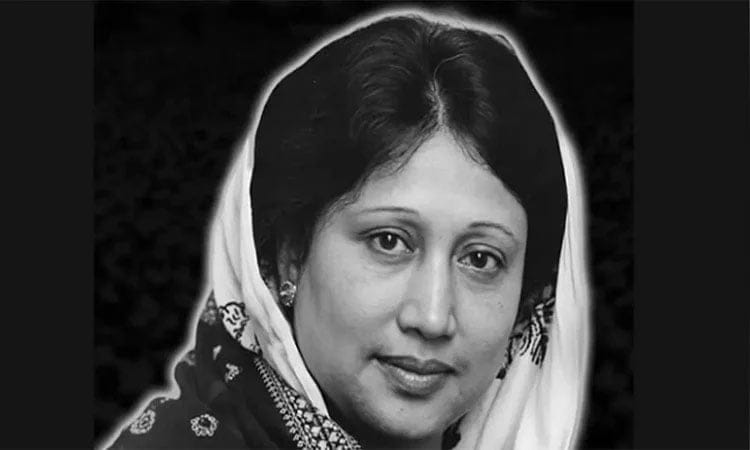
Former Prime Minister of Bangladesh and BNP Chairperson Begum Khaleda Zia passed away on Tuesday morning at the age of 80, marking the end of an era in the country’s politics.
She breathed her last at 6:00am at Evercare Hospital in Dhaka, where she had been receiving treatment for multiple age-related complications.
The death was confirmed by BNP Standing Committee member Salahuddin Ahmed, who said the party’s Acting Chairman Tarique Rahman informed senior leaders of his mother’s passing. BNP also confirmed the news through official posts on its verified social media platforms, offering prayers for her departed soul.
Prolonged Illness and Final Days
Begum Khaleda Zia had long been suffering from a range of serious health conditions, including heart disease, diabetes, arthritis, liver cirrhosis and kidney complications. She was admitted to Evercare Hospital on November 23 after her condition deteriorated due to respiratory distress. A high-level medical board comprising local and foreign specialists oversaw her treatment. Although there were plans to take her abroad for advanced care, her fragile condition made travel impossible.
Family members, including her elder son and BNP Acting Chairman Tarique Rahman, were by her side during her final hours.
Three Days of National Mourning, Public Holiday Declared
Following her death, the government announced three days of national mourning beginning Wednesday. A general holiday has also been declared for Wednesday in honor of the former prime minister. National flags will be flown at half-mast, and special prayers will be offered across the country.
From early morning, thousands of BNP leaders, activists, supporters and ordinary citizens gathered outside Evercare Hospital to pay tribute. The area witnessed an atmosphere of grief, silence and prayer as people mourned one of the most influential political figures in Bangladesh’s history.
Funeral and Burial Plans
According to BNP Standing Committee member Salahuddin Ahmed, Khaleda Zia’s namaz-e-janaza is likely to be held on Wednesday at Manik Mia Avenue in Dhaka after Zohr prayers. She is expected to be laid to rest beside her late husband, former President Ziaur Rahman, at Zia Udyan in Sher-e-Bangla Nagar.
Journey and Legacy
Born on August 15, 1945, in Dinajpur, Khaleda Zia entered politics following the assassination of her husband, President Ziaur Rahman, in 1981. She joined the Bangladesh Nationalist Party in 1982 and rose swiftly through the ranks, becoming party chairperson in 1984.
She served as Bangladesh’s prime minister three times—first in 1991, then from 1996, and again from 2001 to 2006. Khaleda Zia holds the distinction of being Bangladesh’s first female prime minister and one of the earliest elected female leaders in the Muslim world. Notably, she never lost an election, winning multiple parliamentary seats across different constituencies.
Her tenure was marked by economic liberalisation, the expansion of education for girls, and a firm stance against authoritarian rule. She played a decisive role in the mass movement that led to the fall of military ruler Hussain Muhammad Ershad.
Condolences from Chief Adviser Prof Yunus
Chief Adviser of Bangladesh’s interim government, Professor Muhammad Yunus, expressed deep sorrow, describing Khaleda Zia as a “guardian of the nation” and a defining figure in Bangladesh’s democratic struggle.
In a condolence message, Yunus said the country had lost a towering political leader whose uncompromising leadership inspired generations. He recalled her role in restoring democracy, promoting multi-party politics, and advancing women’s education through landmark initiatives such as free schooling and stipends for girls.
International Reactions
The United States extended its deepest condolences through the US Embassy in Dhaka, noting Khaleda Zia’s pivotal role in shaping Bangladesh’s modern history and contributing to the country’s development.
Indian Prime Minister Narendra Modi expressed profound grief, calling her an important political figure in Bangladesh’s history. He highlighted her contributions as the country’s first woman prime minister and her role in strengthening India-Bangladesh relations.
Pakistan’s Prime Minister Shehbaz Sharif, President Asif Ali Zardari, and Deputy Prime Minister Ishaq Dar also conveyed heartfelt condolences. In their messages, they described Khaleda Zia as a committed friend of Pakistan and praised her lifelong service to the people of Bangladesh.
A Defining Chapter Closes
Begum Khaleda Zia’s death closes a defining chapter in Bangladesh’s political history. Revered by supporters as a symbol of resistance and democracy, and acknowledged even by rivals for her impact, she leaves behind a legacy that shaped the nation’s political landscape for more than four decades.