


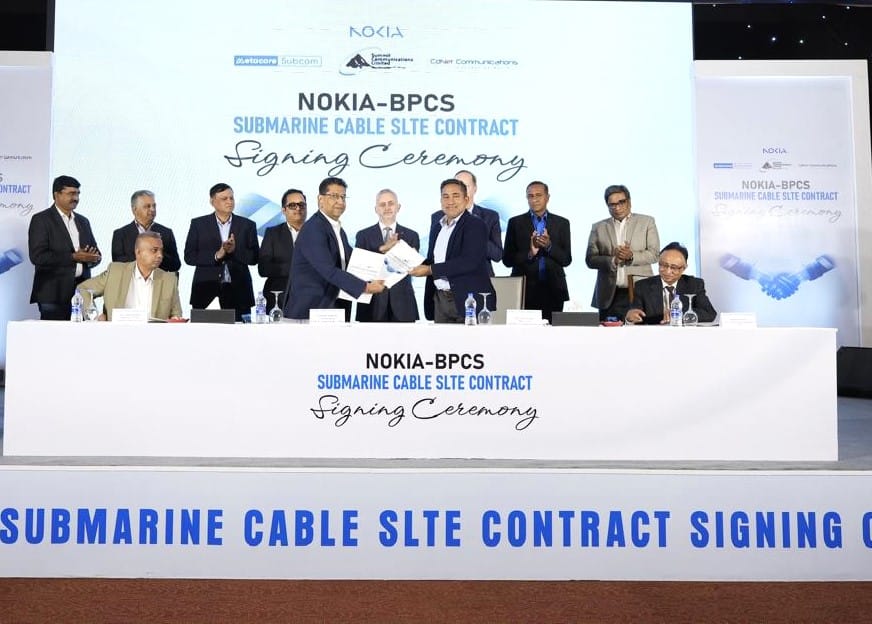
The Bangladesh Private Cable System (BPCS) Consortium has signed an agreement with Nokia for the supply of Submarine Line Terminal Equipment (SLTE), marking a major milestone in the country’s first private-sector submarine cable project.
The agreement was signed at a gala ceremony held on Sunday night at a city hotel in the capital. Industry insiders view the deal as a significant step forward in advancing Bangladesh’s privately owned submarine cable infrastructure.
On behalf of the BPCS Consortium, the agreement was signed by Md Aminul Hakim, Chief Executive Officer of Metacore Subcom Ltd; Arif Al Islam, Managing Director and Chief Executive Officer of Summit Communications Ltd; and Md Moshiur Rahman, Chief Executive Officer of CdNet Communications Ltd. Representing Nokia were Prashant Malkani, Head of Sales Unit at Nokia India, and Suman Prasad, Senior Sales Account Director at Nokia.
Also present from Nokia were Jibitesh Nayal, Head of Emerging Business; Rahul Derwani, Marketing Manager; Mohammad R. Islam, Account Manager; and Christopher Samuel, Head of Sales, Nokia Bangladesh.
The ceremony was attended by European Union Ambassador Michael Miller, Finnish diplomat to India Antti Herlevi, and representatives of the Japanese Embassy, including Daisuke Sugao and Mami Kobayashi.
Consortium members said Bangladesh currently uses around 9,000 Gbps of bandwidth. Demand is projected to rise to about 20,000 Gbps by mid-2027 and nearly 50,000 Gbps by 2030. To meet this growing demand, the three private-sector submarine cables have become essential, they said.
Entrepreneurs have already invested around Tk 6 billion in the project. A further investment of Tk 12 billion is planned to commission a three-pair submarine cable by June 2026.
Consortium officials noted that more than 60 per cent of Bangladesh’s international bandwidth currently comes from India via International Terrestrial Cables (ITC), resulting in a significant outflow of foreign currency each year. Once the new three-pair Singapore–Cox’s Bazar submarine cable becomes operational, dependence on India will be reduced, moving the country closer to bandwidth self-sufficiency.
They added that Nokia’s technology allows equipment to operate with lower power consumption and requires less physical space, reducing data centre footprint and overall operational costs. This is expected to simplify network management and lower expenses, ultimately helping reduce internet costs for end users.
Nokia’s SLTE will be deployed at both ends of the cable, which, according to the consortium, will ensure a high level of cybersecurity.