


Bangladesh’s sustained push to improve energy efficiency has delivered major economic dividends, cutting fossil fuel imports worth USD 3.3 billion in just one year, according to a new report by the Institute for Energy Economics and Financial Analysis (IEEFA).
The study, Bangladesh’s energy efficiency goals within reach, finds that the country improved energy efficiency by 13.64% between FY2014-15 and FY2023-24—an average annual gain of 1.52%. In FY2023-24 alone, efficiency gains helped avoid the consumption of about 7 million tonnes of oil equivalent (Mtoe) of fossil fuels, sharply reducing import bills.
“Energy efficiency increased by 13.64% against a national target of 20% by 2030,” said Shafiqul Alam, Lead Energy Analyst for Bangladesh at IEEFA South Asia. “These gains translated into avoided fossil fuel imports of around USD 3.34 billion in FY2023-24.”
The report notes that while early progress after the launch of the Energy Efficiency and Conservation Master Plan in 2016 was uneven, momentum strengthened after FY2020-21, when global energy price shocks and supply disruptions made efficiency and energy security urgent priorities. Subsequent regulations, low-cost financing and support programmes have since put Bangladesh on track to meet—and potentially exceed—its efficiency targets ahead of schedule.
At the current pace, Bangladesh is likely to achieve its 2030 energy efficiency goal a year early. The country is also on course to meet its updated Nationally Determined Contribution (NDC) target of a 19.2% efficiency improvement by 2035 ahead of time, the study says.
Households and industry, which together account for about two-thirds of national energy consumption, offer the greatest scope for further gains. The widespread shift from incandescent and compact fluorescent lamps to LED lighting has already delivered significant savings, alongside growing adoption of energy-efficient air conditioners.
“Clear energy efficiency labels are essential to accelerate the uptake of efficient appliances in a market where consumers often lack information on performance standards,” Alam said.
In industry, the report highlights large potential savings from upgrading motors and motor-driven systems, improving captive power generation, and shifting from gas-fired to electric boilers. In buildings, stricter enforcement of standards, energy labels and passive design features could significantly reduce cooling demand.
The report also calls for policy support to make efficient technologies more affordable, noting that high import duties—around 62% on LED components and elevated tariffs on inverter compressors—remain a barrier for price-sensitive consumers.
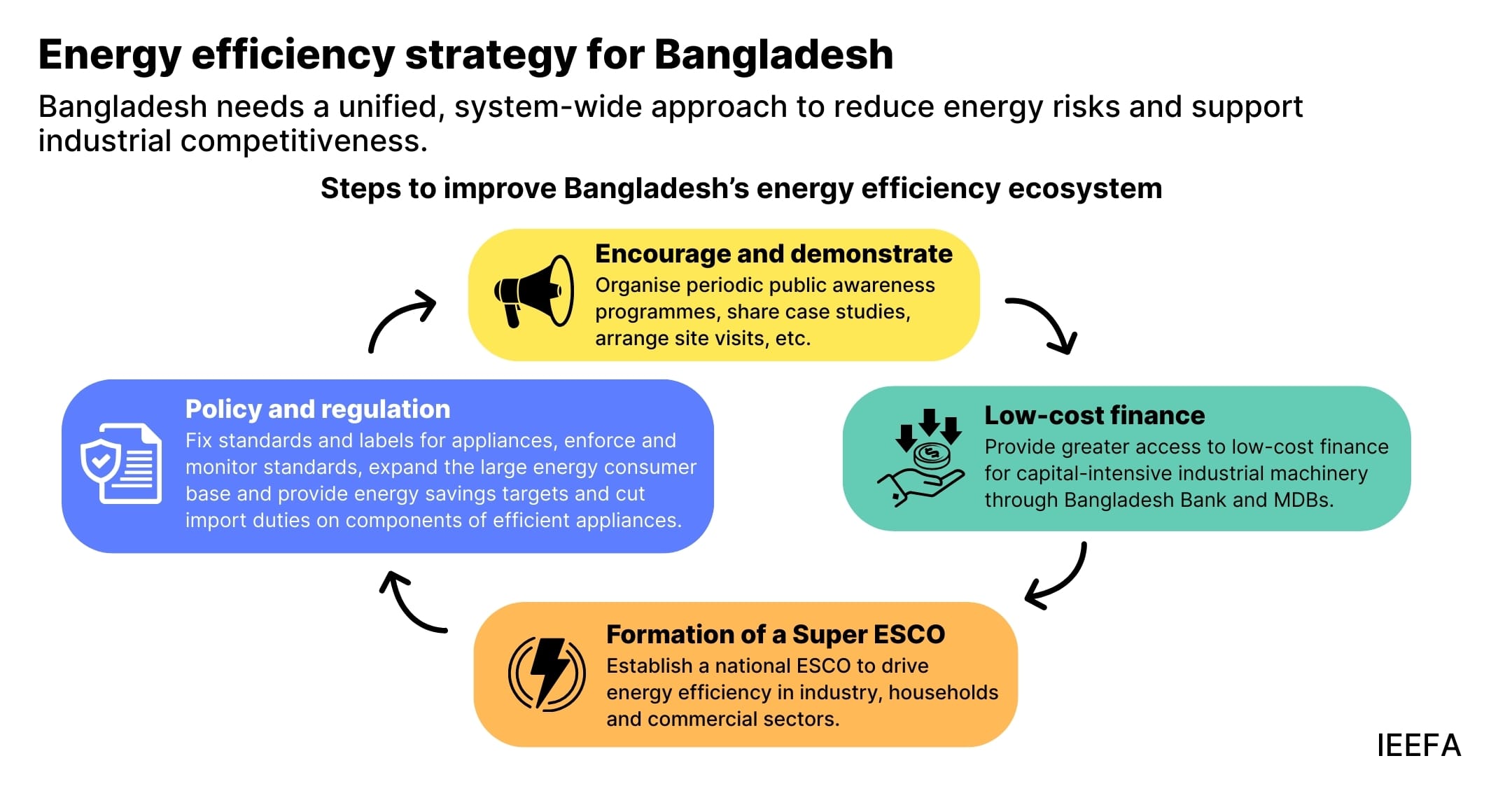
Among its recommendations, IEEFA urges the government to expand public awareness campaigns, set energy-saving targets for large consumers, enforce the National Building Code 2020, and establish a “super” energy service company (ESCO) to scale up efficiency projects. Greater access to low-cost finance, supported by multilateral development banks, is also seen as critical.
“Energy efficiency goes beyond reducing bills,” Alam said. “It can rapidly transform the national energy system—but only through a coordinated approach involving regulators, consumers, financiers and technology providers.”