


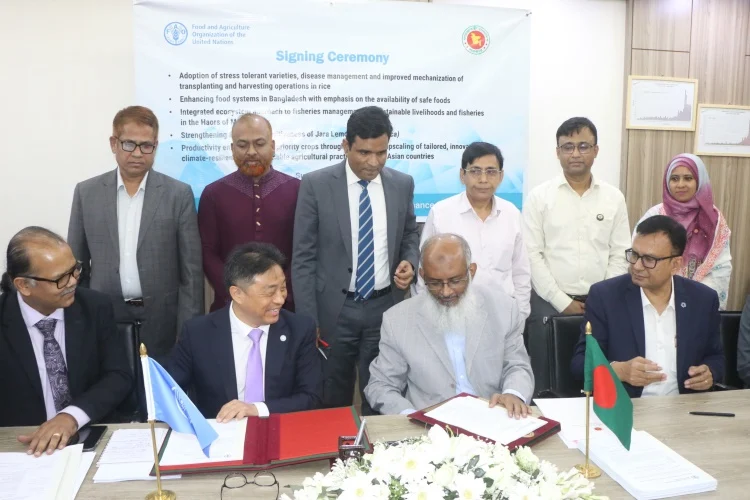
The Food and Agriculture Organization of the United Nations (FAO) and the Bangladesh government on Sunday signed five technical assistance projects aimed at strengthening agriculture, food systems and rural livelihoods.
The agreements were signed at the Economic Relations Division (ERD) of the Ministry of Finance, according to a press release.
Four of the projects will be financed under FAO’s Technical Cooperation Programme (TCP), while another project will be funded through FAO’s Flexible Voluntary Contribution (FVC) pooled funding instrument.
The projects focus on areas including stress-tolerant rice varieties, safe food systems, fisheries management in haor areas, export competitiveness of Jara lemon, and climate-resilient agricultural practices.
Speaking at the event, AKM Sohel, additional secretary and UN Wing chief at ERD, said Bangladesh has so far implemented 420 FAO-supported projects worth about $426 million in grants.
He said these initiatives have played an important role in strengthening the country’s food security. He also urged FAO to support Bangladesh in developing large-scale climate-smart agriculture projects to attract climate financing from sources such as the Green Climate Fund (GCF) and the Global Environment Facility (GEF).
Jiaoqun Shi, FAO representative in Bangladesh, said the projects reflect strong collaboration between FAO and the government.
He expressed hope that the funds would help mobilise larger investments to build more efficient, inclusive, resilient and sustainable agrifood systems in the country.
ERD Secretary Md Shahriar Kader Siddiky reaffirmed the government’s commitment to working closely with FAO. He also called for greater focus on climate-sensitive agricultural initiatives, innovative financing models, food quarantine facilities, and the development of agro-product value chains for domestic and international markets.
Key projects
One project, with a budget of $250,000, will promote the adoption of stress-tolerant rice varieties, disease management and improved mechanisation to reduce yield losses and lower production costs. The project will be implemented with the Bangladesh Rice Research Institute (BRRI).
Another $270,000 project will support the development of safe and sustainable food systems by strengthening policy implementation, financing strategies and monitoring mechanisms. The initiative will support institutions such as the Food Planning and Monitoring Unit (FPMU) and the Bangladesh Food Safety Authority (BFSA).
A third project, funded with $250,000, will promote an ecosystem-based approach to fisheries management in the haor areas of Moulvibazar. Implemented with the Department of Fisheries (DoF), the project aims to restore aquatic ecosystems, protect fish biodiversity and improve livelihoods of local communities.
Another initiative, with $275,000 funding, will work to strengthen the export competitiveness of Jara Lemon (Citrus medica). Implemented with the Bangladesh Agricultural Research Institute (BARI), it will help develop a sustainable value chain while creating income opportunities for farmers, women and youth.
The fifth project, worth $216,000, will focus on improving the productivity of key cropping systems, including Boro rice, T Aman rice, fallow land and rapeseed-mustard, through the adoption of climate-resilient and sustainable farming practices in collaboration with BRRI.