


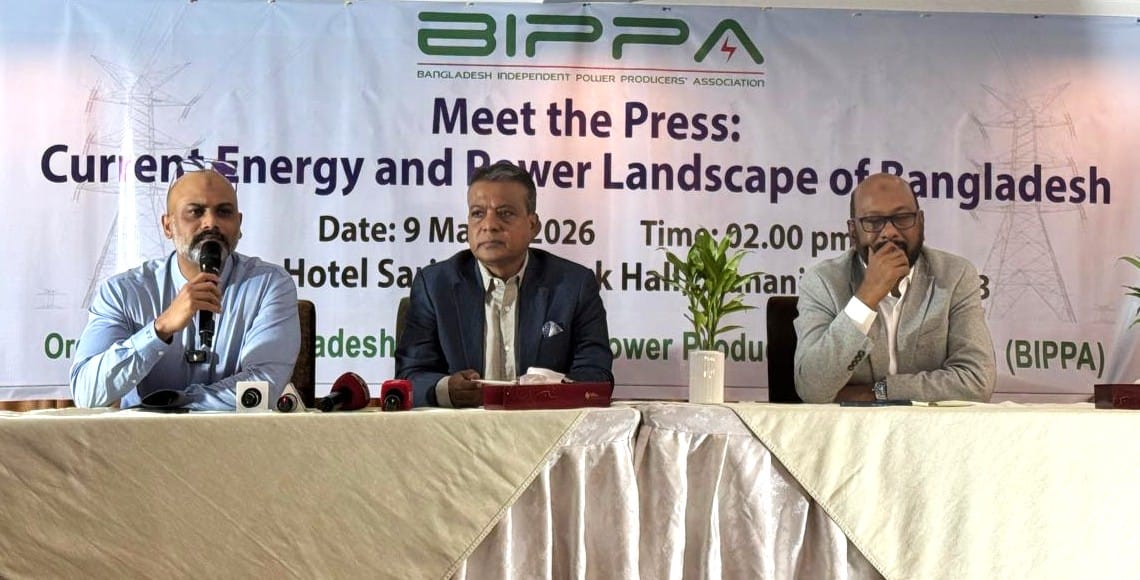
The country’s HFO-based power plants can play a critical role in cost-effective electricity generation to address the ongoing global energy crisis stemming from the Iran war and meet peak demand during the upcoming summer, private power producers say.
At a meet-the-press event in the capital on Monday, leaders of the Bangladesh Independent Power Producers’ Association (BIPPA) warned that the ongoing conflict could trigger a sharp rise in LNG prices.
They said LNG prices could jump from the current $15 to around $40 per MMbtu, similar to that after the start of the Ukraine war, which would significantly increase power generation costs.
“Temperature is forecast to rise during April and May because of the El Niño effect, while the Iran war may create a global LNG supply shortage. Fuel oil does not see as much price volatility as LNG. So producing power from HFO can be a cost-effective solution,” said Imran Karim, former president of BIPPA, while presenting a paper.
According to BIPPA’s forecast, Bangladesh may require nearly 4,000MW of electricity from privately run HFO-based power plants to meet peak demand in 2026, amid declining domestic gas supply and limitations in LNG imports due to a shortage of floating storage and regasification units (FSRUs).
The association also recommended a temporary waiver or reduction of the 34 percent import duty on HFO to align it with the regional average of 0–11 percent to reduce generation costs.
BIPPA leaders urged the government to clear around Tk12,000–Tk13,000 crore in overdue payments to private power producers.
Imran Karim said arrears for oil-based power plants have accumulated for eight to ten months, with total dues reaching nearly Tk14,000 crore.
“If the government faces financial constraints, it can issue bonds. Without either cash or bonds, it will be difficult to continue supplying electricity,” he said.
He added that private power producers are no longer in a position to keep plants running by borrowing money.
Karim also said the country’s actual power generation capacity is significantly lower than the officially stated 28,484MW due to fuel shortages and other constraints.
He explained that about 6,694MW of capacity remains idle because of gas shortages, while 1,626MW is unavailable due to routine maintenance. Solar power generation of around 769MW is not available at night, and about 768MW from diesel plants is rarely used. After accounting for these factors, the effective generation capacity stands at around 18,626MW.
“Even if everything runs smoothly, the maximum supply may reach around 18,000MW. With higher temperatures expected this summer, managing demand will be challenging,” he said, adding that all available power plants may need to be utilised to stabilise supply.
BIPPA president KM Rezaul Hasanat said around 23 percent of power plants remain idle due to gas shortages, creating a serious challenge for the power sector.
“There is no immediate prospect of increasing gas supply, so the issue needs urgent attention,” he said.
Responding to a question about a committee report suggesting renegotiation of tariffs for some previously signed power contracts, BIPPA leaders said discussions could take place if any company had received undue benefits.
“If any company has enjoyed unjustified advantages, there can certainly be discussions, even if it involves our companies. But the process must be reasonable,” Karim said.
BIPPA vice-president Faisal Ahmed Chowdhury said private power producers want to work as partners of the government in ensuring energy security.
He added that the private power sector has helped develop skilled local manpower in the industry.
“Earlier we had to bring engineers from abroad. Now local engineers are capable of solving most technical problems,” he said.