


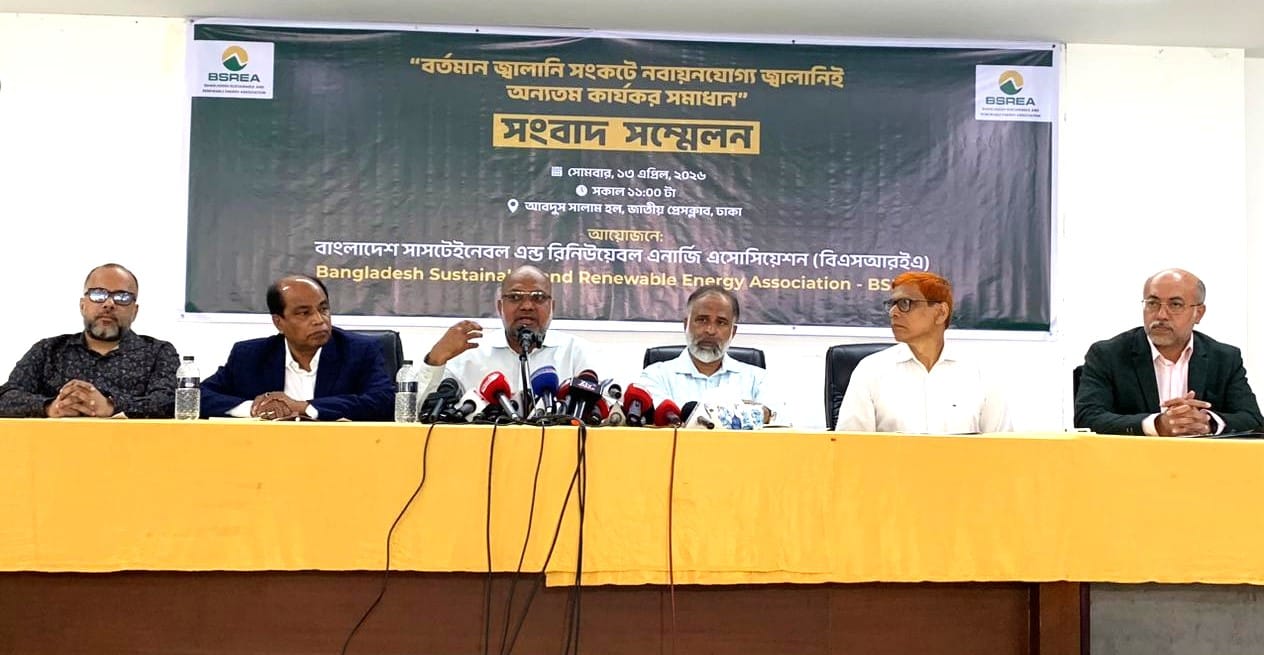
The Bangladesh Sustainable and Renewable Energy Association (BSREA) has called on the government to prioritise renewable energy as it grapples with a deepening power crisis, warning that steep import duties on equipment are slowing the sector’s growth.
Speaking at a press conference in Dhaka on Monday, BSREA leaders said taxes of up to 50–60% on renewable energy components are discouraging investment at a time when the country urgently needs alternatives to costly imported fuels.
Bangladesh is facing mounting pressure in its energy sector due to its heavy reliance on imports, rising global fuel prices and strain on foreign currency reserves.
The government is currently paying more than Tk 200 crore a day in subsidies to keep electricity generation running, largely due to the high cost of liquefied natural gas (LNG), coal and oil.
BSREA president Mostafa Al Mahmud said renewable energy—particularly solar—remains the cheapest and most environmentally sustainable long-term option, but lacks sufficient policy backing. He argued that high import duties on equipment, along with similar charges on lithium-ion batteries and energy storage systems, are creating significant barriers to expansion.
By contrast, he said, conventional energy sectors continue to benefit from subsidies and policy support, creating what he described as a “clear imbalance” in the energy framework.
The association pointed to examples from countries including India, Vietnam and China, where tax breaks, reduced import duties and easier access to finance have accelerated renewable energy adoption.
Global market volatility is adding to Bangladesh’s challenges. Rising geopolitical tensions, including those involving the United States and Iran, have pushed Brent crude prices to around $115–120 per barrel, while concerns persist over the security of key shipping routes such as the Strait of Hormuz.
With more than 60% of its energy demand met through imports, Bangladesh remains highly exposed to both price shocks and supply disruptions. Around 70% of its LNG imports come from Qatar, raising concerns about overdependence on a single supplier.
According to BSREA, the power sector requires more than 2,500 million cubic feet of gas per day, but current supply has dropped to between 850 and 900 MMCFD. This shortfall could lead to a deficit of up to 1,800 megawatts of electricity generation. Meanwhile, the country’s strategic fuel reserves are sufficient for just 35 to 40 days—well below levels seen in many developed economies.
The impact is already being felt in industry, particularly in the vital garments sector, where gas shortages and rolling blackouts have cut productivity by as much as 30–40%, potentially affecting export earnings and foreign exchange reserves.
BSREA warned that the crisis reflects deeper structural weaknesses rather than a short-term disruption, and called for a rapid shift towards renewable energy to ensure long-term stability.
Among its recommendations are cuts to import duties and taxes on renewable energy equipment, zero-duty access for lithium-ion batteries, low-interest long-term financing, and the fast-tracking of delayed solar projects.
It also urged the government to relaunch rooftop solar schemes, simplify net metering systems, expand solar-powered irrigation and introduce tax incentives for clean energy investment.
With the right policy support, the association said, renewable energy could play a central role in strengthening Bangladesh’s energy security in the years ahead.