


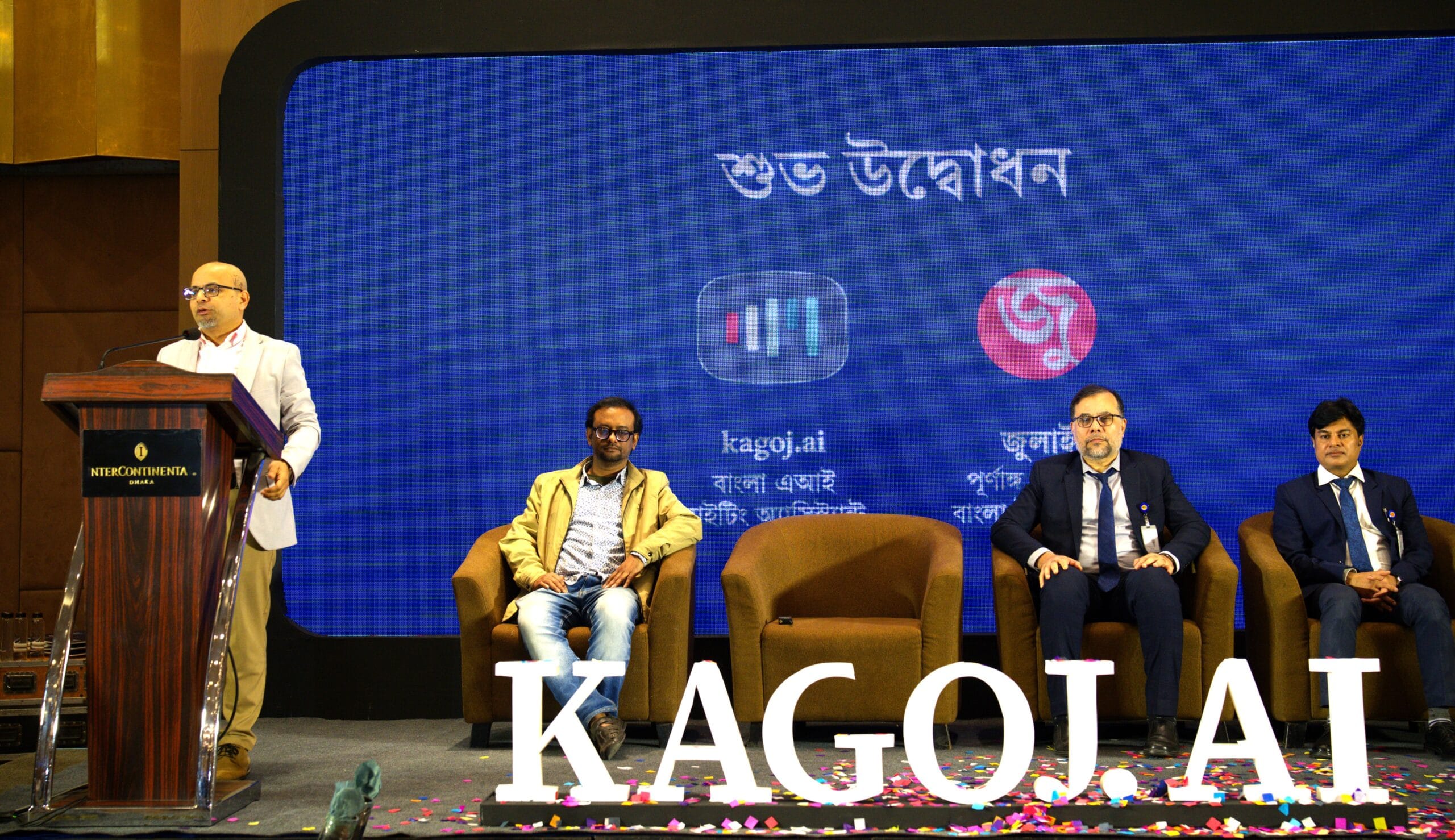
An artificial intelligence (AI)–based Bangla language platform, Kagoj.ai, and a new Bangla font, Julai, were launched on Monday to strengthen the use of Bangla in digital governance, publishing and content creation.
The two technology products were unveiled at a ceremony held at the Ruposhi Bangla Grand Ballroom of Hotel InterContinental in the capital under the initiative of the Information and Communication Technology (ICT) Division.
Faiz Ahmed Taiyeb, Special Assistant to the Chief Adviser, attended the programme as chief guest, while ICT Division Secretary Sheesh Haider Chowdhury, NDC, presided over the event. EBLICT Project Director Md Mahbub Karim delivered the welcome address.
Speaking on the occasion, Faiz Ahmed Taiyeb said most books in existing libraries remain non-searchable, leaving vast amounts of knowledge inaccessible in the digital era.
Converting printed materials into digital text is both time-consuming and labour-intensive, he said, adding that Kagoj.ai aims to address this challenge through Bangla Optical Character Recognition (OCR) technology.
He said the platform also incorporates speech-to-text and text-to-speech technologies to reduce the time and effort required for writing and documentation.
Referring to past limitations, he noted that Bangla typing had long been constrained by person-centric dependency on the Bijoy font, while the progress initiated by Avro is now being further advanced through the introduction of the Julai font.
According to him, the Julai Bangla font has been designed with compatibility between Bangla and English character heights and appropriate line spacing, making it suitable for official and publishing use.
He added that 18 mobile phone manufacturers with factories in Bangladesh are expected to integrate this ecosystem into their devices within the next six months to one year.
Faiz Ahmed Taiyeb also said the project has already collected around 10,000 minutes of spoken data from nearly 40 indigenous languages spoken in Bangladesh.
Similar datasets will be developed for languages such as Chakma to enable their use in speech-to-text and text-to-speech systems. He added that open APIs and security-checking mechanisms would facilitate wider institutional use of the platform.
In his presidential address, ICT Division Secretary Sheesh Haider Chowdhury said Kagoj.ai and the Julai font had added “two new feathers” to the achievements of the ICT Ministry.
Noting that Bangladesh is home to more than 40 languages, some spoken by only a few people, he said the initiative would play an important role in preserving linguistic diversity and building a self-reliant digital ecosystem for Bangla.
Other speakers included Bangla Academy Director General Dr Mohammad Azam, Additional Secretary of the Posts and Telecommunications Division Zahirul Islam, and Project Director Md Mahbub Karim.
Officials said Kagoj.ai would enable the use of AI in Bangla-based writing, official documentation, language processing and content creation, marking a major milestone in the digital advancement of the Bangla language.
No such comprehensive AI platform for Bangla had been launched previously, they added.
The Julai Bangla font, developed for official and institutional use, is expected to address long-standing limitations in computer-based Bangla writing.
Government and private-sector officials, technology experts and invited guests attended the programme.
Both services have been developed under the project “Enrichment of the Bangla Language in Information Technology through Research and Development,” implemented by the Bangladesh Computer Council under the ICT Division.