


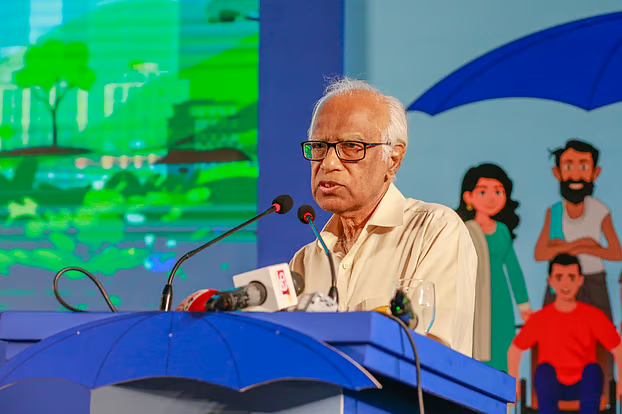
Bangladesh must strengthen democratic accountability, improve administrative responsibility and adopt a long-term, equitable development model to ensure sustained progress, Planning Adviser and eminent economist Dr Wahiduddin Mahmud said on Sunday.
Delivering the keynote speech at the Annual BIDS Conference on Development 2025, organised by the Bangladesh Institute of Development Studies (BIDS) at Parjatan Bhaban in Agargaon, he said these pillars are essential for establishing a functional democratic order capable of supporting long-term economic growth.
‘Democracy alone is not enough’
“Democracy by itself cannot guarantee development, as seen in many emerging economies,” Dr Wahiduddin said. “A strong accountability mechanism across public administration, coupled with values, social behaviour and moral responsibility, is vital.”
Dr Wahiduddin outlined three priorities for the country’s current trajectory: transitioning to an effective and representative democracy; ensuring this system supports sustainable economic development; and pursuing development that reduces social and economic disparities.
Nearly 55 years after independence, Bangladesh is still working to establish a fully functional democratic system, “something that should have been achieved long ago,” he said.
Political culture must evolve
Dr Wahiduddin cautioned that institutions alone cannot deliver meaningful democracy without a corresponding change in political culture.
“A parliament elected by the people, a government accountable to that parliament, and independent oversight institutions are basic prerequisites,” he said. “But the real test lies in political conduct — and that does not change overnight.”
He linked political patronage to youth unemployment, weak education systems and high dropout rates, arguing that many young people turn to cadre-based politics due to a lack of economic alternatives.
“Blaming politics alone will not solve the problem,” he said.
Administrative reform critical for economic progress
On the economic front, he warned that democratic governance will not lead to development if administrative inefficiency and informal networks between business and bureaucracy remain intact.
“New rules and regulations may help, but their effectiveness depends entirely on the behavioural environment — the incentives, the culture of trust and the social norms within which markets operate,” he said.
Drawing lessons from East Asia, he noted that countries such as China and Vietnam achieved rapid growth through strong internal accountability, discipline and trust within the administrative system.
“Accountability must be matched with responsibility,” he emphasised.
Call for transparent national statistics
Dr Wahiduddin stressed the need to modernise and digitalise Bangladesh’s statistical systems. Making BBS datasets digitally accessible would allow researchers and journalists to independently verify national data, he said.
However, he noted that transparency alone cannot solve deeper governance challenges.
“If political demand for illicit gains exists, no regulation can fully prevent wrongdoing,” he said.
Building a just and discrimination-free society
Addressing broader social goals, he said that reducing inequality and building a discrimination-free society requires political clarity and ideological commitment.
“Debates on redistribution, social protection, market–state relations and inequality are inherently ideological,” he said. “Political parties must clearly articulate their positions in their manifestos.”
Two guiding principles for policymakers
He concluded by stressing two guiding principles for policymakers: no country can prosper without ensuring the minimum livelihood needs of all citizens, and achieving this requires both the right economic structure and genuine political commitment.
“Without political commitment, corruption simply changes its source,” he said. “With accountability and responsibility, sustainable equitable development is within reach.”