


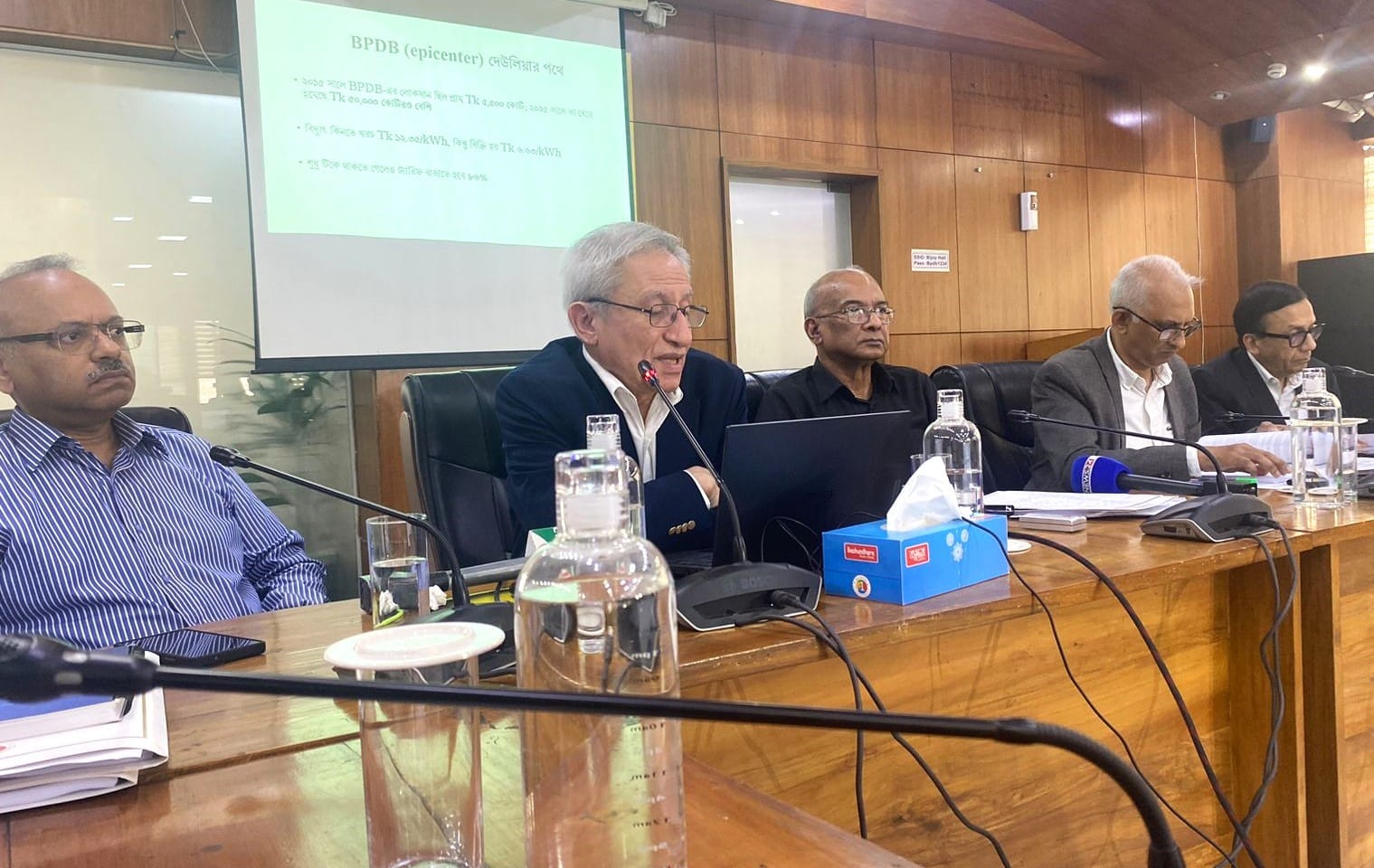
Fixed capacity payments to private producers for unutilized electricity surged 20 times during FY2011-FY2024, shooting up the Bangladesh Power Development Board’s annual loss to over Tk50,000 crore, finds a report of the National Review Committee (NRC) unveiled Sunday.
The NRC has found that 7,700-9,500MW of Bangladesh’s unutilized power generation capacity installed during the Awami League government was either demand-redundant or structurally constrained by fuel and grid limitations, and their annual fiscal cost is $0.9-$1.5 billion.
At the heart of the fiscal stress was the faulty Power Purchase Agreements (PPAs) signed with the private companies under the Quick Enhancement of Electricity and Energy Supply (Special Provision) Act, 2010 that allowed unsolicited power deals at much higher rates sidelining the public procurement rules. The interim government repealed the law in November 2024.
As a result, power price for HFO-based private power plants were found to be 40-45 percent higher than market price, for gas-based plant 45 percent higher while that of solar power 70-80 percent higher.
The NRC report shows that payment to Independent Power Producers (IPPs) jumped more than eleven folds against four-fold increase in power generation. Unnecessary capacity and overestimated power prices are the result of systematic governance and contractual failures.
Convenor of the review committee Judge (Retd) Moinul Islam Chowdhury the report finds massive corruption, fraud, collusion illegalities in the process of the power purchase agreements.
“We’ve found evidence in support of those corruptions, fraud, collusion and so on and so forth the repealed Act of 2010 for all practical purposes introduced cronyism and kleptocracy in the power sector of Bangladesh,” Chowdhury said while unveiling the final report at a press conference at Bidyut Bhaban in the capital on Sunday.
“Unsolicited deals were done arbitrarily in non-transparent and hush-hush manner. As a result the power sector is in a vulnerable state,” he added.
The Quick Enhancement of Electricity and Energy Supply (QEEES) Act, 2010 was enacted as an emergency measure to address Bangladesh’s acute power shortage at the time.
Under the Act, the government was granted extraordinary powers, including exemption from competitive tendering procedures, limited scope for judicial review, and relaxed regulatory oversight.
Although the QEEES Act was originally conceived as a temporary arrangement, it has remained in force for more than 14 years.
Over time, the law evolved into the dominant contractual framework governing major projects in the power sector, shaping procurement practices and investment decisions long after the initial emergency conditions had subsided.
“The current situation of the power sector actually tells what happened during the last 15 years. The epicenter of the current fiscal stress was the BPDB,” commented Dr Zahid Hussain, an economist and also an NRC member.
“In only nine years since 2015, BPDB’s losses skyrocketed from just Tk5,500 crore to Tk 50,000 crore, which is equal to the cost of a metro rail,” he added.
Under the cover of emergency laws, procurement and contracting processes gradually take the form of state capture, where policymaking and contract design become skewed in favor of a limited number of vested interests through transaction-based relationships, Dr Zahid said to explain the impact of that law.
Competitive bidding was often bypassed in practice, reducing transparency in project selection and procurement.
Over the years, tariff determination has also shifted away from market-based price discovery. Instead, tariffs have frequently been set through transaction-driven negotiations, raising concerns about cost efficiency and value for money.
At the same time, the oversight role of the Bangladesh Energy Regulatory Commission (BERC) has gradually been marginalised, further weakening independent regulatory scrutiny in the sector.
In many power sector contracts under this framework effectively guarantee annuity-like cash flows for 20 to 25 years, ensuring steady and predictable returns for project sponsors, Dr Zahid noted.
These agreements are structured to shield investors from key commercial risks, including demand uncertainty, fuel price volatility and foreign exchange fluctuations.
Under such arrangements, the burden of rising fuel costs, currency depreciation or even low electricity offtake is transferred to the state.
In addition, “Change of Law” and “Political Event” clauses shift a significant share of policy and political risks onto the government.
Dr Zahid argued that this model has resulted in an imbalance in risk-sharing, where profits are largely privatised while risks are socialised, ultimately placing the financial burden on the public and the broader economy.
Who benefited from the Special Law
Those who have benefited most from the contracts include large private Independent Power Producers (IPPs), many of which have secured multiple agreements over time and across different technologies, allowing them to build diversified and long-term revenue streams within the power sector.
A group of selected local and foreign sponsors has also gained significantly, benefiting from sovereign guarantees as well as protection under international arbitration mechanisms. These safeguards have reduced their exposure to commercial and political risks, making the contracts particularly attractive to investors.
As contracts have increasingly become concentrated in the hands of a small number of sponsors, their bargaining power has strengthened over time.
This concentration has enabled a limited group of players to exert greater influence over contract terms, pricing structures and risk allocation, further entrenching their advantages within the sector.
The NRC findings suggest that while electricity generation assets and decision-making are often anchored abroad, the bulk of the financial, fuel and operational risks remain concentrated in Bangladesh.
This imbalance has left the country exposed to long-term liabilities, even as returns are secured elsewhere.
Specific cases of concern
In the case of SS Power, a single sponsor secured approval for two large power plants under one contractual framework.
At Meghnaghat, projects backed by Summit Group moved forward despite clear indications that domestic gas reserves were nearing depletion. Multiple large plants were approved at the same location, increasing reliance on uncertain fuel supply and future imports.
The Reliance–JERA project has drawn scrutiny for relocating a power plant that had effectively become stranded in India and bringing it into operation in Bangladesh, transferring technological and commercial risks to the host country.
Meanwhile, the Payra coal power project highlights infrastructure mismatches, as a large coal-based plant was developed in an area where port facilities have struggled to operate efficiently.
The report finds that Adani Power has supplied electricity to Bangladesh at significantly higher prices than other recent power import sources, such as Sembcorp and PTC.
According to the analysis, the power purchase price from Adani has been 4–5 US cents per kilowatt-hour higher than what would be considered a reasonable benchmark.
In the domestic generation segment, Summit Meghnaghat II, a gas-based power plant, has recorded a unit cost nearly double the average cost of gas-fired power plants in recent years.
The Summit Barisal heavy fuel oil (HFO) plant has also been identified as relatively expensive compared with other HFO-based plants operating in the system.
Similarly, SS Power, a coal-fired project, is assessed as the most expensive option among comparable coal-based alternatives available to Bangladesh.
The report concludes that these high-cost contracts show signs of political patronage and close sponsor–bureaucratic partnerships, suggesting that commercial considerations may have been subordinated to political influence in key power sector decisions.
At the macroeconomic level, the report warns of serious risks to the overall economy. If tariffs were set to fully recover costs, industrial electricity prices in Bangladesh would become around 80–90 percent higher than those faced by industries in Vietnam, China, Pakistan and India.
Such a sharp cost disadvantage could undermine competitiveness and pose a severe risk of deindustrialisation, threatening investment, exports and employment.
Recommendations
The report calls for full transparency in the power sector, urging the disclosure of all power purchase agreements (PPAs), along with their amendments and detailed payment information.
Making such data publicly available is seen as essential to restoring trust, improving oversight and enabling informed public scrutiny.
It recommends the reinstatement of competitive procurement as the cornerstone of future power sector development. Competitive bidding should be established as the default method for all new projects, supported by effective, transparent and rule-based procurement processes to ensure value for money.
For future contracts, the report stresses the need for risk reallocation, with reforms in contract design to ensure a fair and balanced distribution of risks and liabilities between the government and private sponsors. This would help prevent the socialisation of losses while profits remain private.
The recommendations also include the creation of an independent energy oversight authority to strengthen accountability and reduce political and administrative interference in project approvals and tariff decisions.
On accountability and contract enforcement, the report argues that agreements should be cancelled where evidence of corruption meets international standards.
In other cases, anti-corruption investigations should continue to gather credible evidence. Finally, the report advocates good-faith renegotiation of legacy PPAs that impose the heaviest financial burden on the system, with the aim of easing fiscal pressure while safeguarding energy security.