


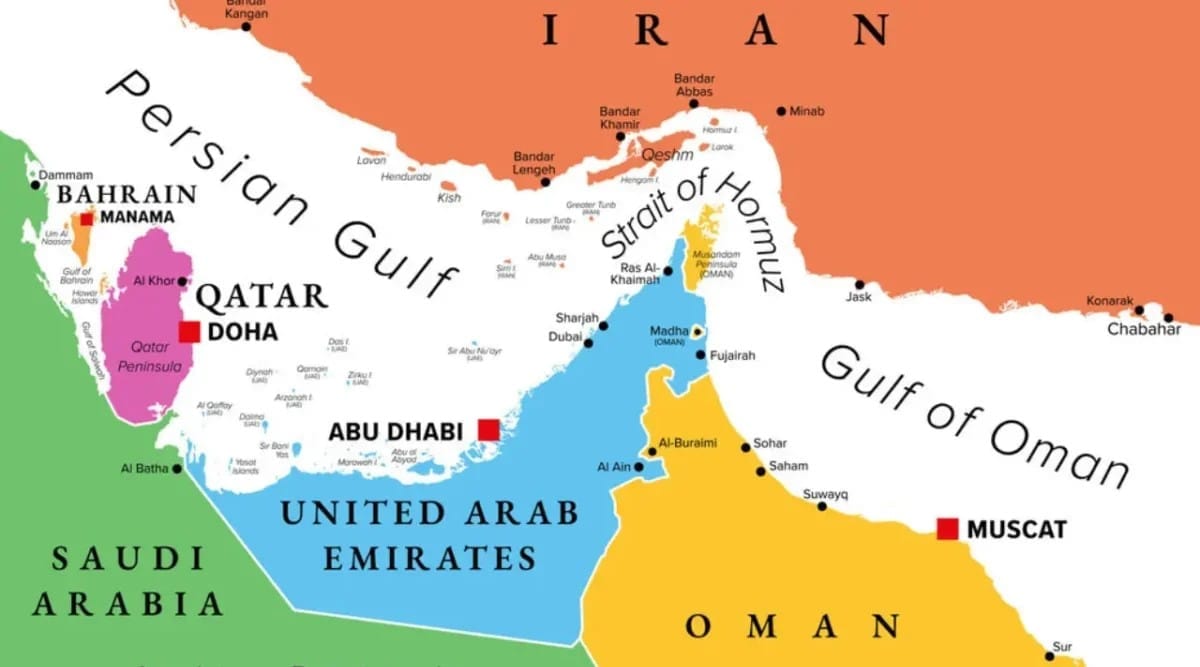
Qatar has suspended liquefied natural gas (LNG) production at key facilities following drone strikes blamed on Iran, triggering concerns over global supply disruptions and a potential energy crunch in Bangladesh and other Asian markets, reports Al Jazeera report.
State-owned QatarEnergy halted operations at affected sites after two drones hit installations in Mesaieed Industrial City and the Ras Laffan industrial complex, home to one of the world’s largest LNG processing hubs, according to Qatar’s defence ministry.
No casualties were reported, but the company suspended LNG and related production on safety grounds.
Force majeure declared, global market tightens
Sources cited by Reuters and Bloomberg said QatarEnergy has declared “force majeure,” allowing it to suspend contractual supply obligations due to circumstances beyond its control.
The disruption comes at a time of heightened geopolitical tension in the Gulf. Iran’s Revolutionary Guard has reportedly restricted passage through the Strait of Hormuz, a critical global energy route.
According to Turkey’s Anadolu Agency, tanker movement through the strait has dropped by 86 percent, with around 700 vessels stranded at both ends, further tightening supply chains.
Bangladesh and Asia face biggest risks
Analysts warn that Asia—particularly Bangladesh, India and Pakistan—will bear the brunt of the disruption, as the region depends heavily on LNG imports from Qatar.
Rachel Ziemba, senior fellow at the Center for a New American Security, said the attacks highlight growing pressure on Gulf energy infrastructure and will have the most immediate impact on Asian markets.
Bangladesh is already facing a significant gas supply shortfall. Daily demand stands at about 3.8 billion cubic feet, against supply of roughly 2.65 billion cubic feet. Of this, around 950 million cubic feet comes from imported LNG.
With summer approaching, Bangladesh had planned to increase LNG imports to over 1 billion cubic feet per day. Any disruption could worsen power shortages, reduce electricity generation and trigger load-shedding, while also lowering pipeline gas pressure for households.
State-run Petrobangla had planned to import 115 LNG cargoes this year, including 40 from Qatar and 16 from Oman under long-term contracts.
Prices surge amid supply uncertainty
Qatar accounts for roughly 20 percent of global LNG exports, and the halt in production has already rattled markets.
Benchmark wholesale gas prices in Europe jumped nearly 50 percent on Monday, while LNG spot prices in Asia rose about 39 percent following the announcement.
Energy expert Maximilian Sönin of Stanford University said the situation would likely create short-term volatility rather than a full-blown crisis.
“If infrastructure damage remains limited, the market will face instability in the near term, but not necessarily a crisis like Europe experienced in 2022,” he said, referring to the energy shock following Russia’s invasion of Ukraine.
Wider global implications
Although China—the world’s largest gas importer—sources much of its LNG from Australia, reduced Qatari supply will still ripple across global markets, including Europe.
About 82 percent of Qatar’s LNG exports go to Asia, but constrained supply will force competition across regions, pushing prices higher worldwide.
A spokesperson for the European Commission told Reuters that the EU’s gas coordination group will meet this week to assess the situation and ensure supply security.
Analysts say prolonged disruption in Qatar could deepen global energy insecurity, with immediate consequences for import-dependent economies like Bangladesh.