


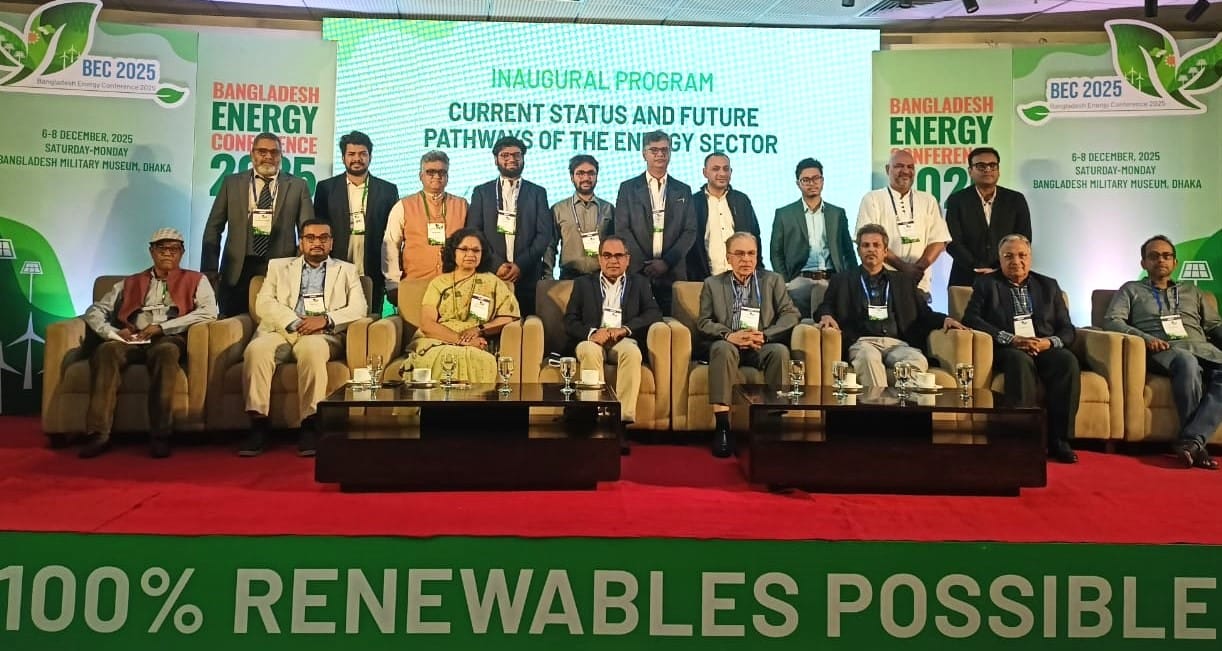
Energy experts and civil society leaders have called on the government to urgently revise the Integrated Energy and Power Master Plan (IEPMP), stressing that Bangladesh must adopt a far more ambitious—and realistically achievable—share of renewable energy to ensure long-term energy security and sustainability.
The call was made on Saturday at the opening session of the 3rd Bangladesh Energy Conference 2025, held at the Bangladesh Military Museum in Dhaka.
Action-Driven Renewable Energy Roadmap Needed
Speaking as chief guest, Syeda Rizwana Hasan, Adviser to the Ministry of Environment, Forest and Climate Change, said the interim government has taken promising initiatives, but warned that real progress depends on implementation rather than announcements.
“We previously set high renewable targets, yet actual generation remained minimal. What we need now is a realistic, achievable roadmap,” she said.
She highlighted the government’s ongoing programme to install solar systems on government building rooftops, noting that the project is making “rapid and encouraging progress.”
Energy Transition Must Be a Political Priority
The three-day conference brings together policymakers, energy researchers, academics and civil society representatives to discuss Bangladesh’s energy transition and sustainable development pathway.
Professor Kazi Maruful Islam, Coordinator of the Bangladesh Working Group on Ecology and Development (BWGED), said energy policy must be central to political priorities, especially ahead of the next national elections.
“Energy policy cannot be isolated from political commitments,” he said.
Experts Cite Overreliance on Foreign Consultants
Several speakers pointed out structural barriers slowing down renewable energy growth.
CPD Research Director Dr Khandakar Golam Moazzem said Bangladesh must reduce dependence on foreign consultants and strengthen domestic institutions.
“Local ownership of the transition is a national imperative,” he said, calling for investment in skilled manpower and technical capacity.
Reallocating Subsidies
Shahriar Ahmed Chowdhury, Chairman of the Centre for Renewable Energy Services Limited, noted that Bangladesh spends nearly $4 billion in annual electricity subsidies.
“Even half of that, if channelled into renewable energy, could transform the sector,” he said, adding that several existing policies remain “unfriendly to renewable energy.”
Policy-Level Irregularities Highlighted
Transparency International Bangladesh (TIB) Executive Director Iftekharuzzaman criticised longstanding governance failures in the sector.
“Policy-level crimes and malpractice have historically plagued the energy sector,” he said, adding that masterplans drafted by foreign agencies such as Jica have often overlooked Bangladesh’s renewable energy priorities.
Call for Just, Inclusive Energy Transition
Advocate Shimonuzzaman of LEAD Bangladesh and Banshree Mitra Niyogi of Manusher Jonno Foundation stressed the importance of transparency, accountability and inclusion in energy planning.
They urged policymakers to ensure that marginalised communities, including women, are placed at the centre of the energy transition.
Urgency for Sustainable Strategy
While experts welcomed recent steps—including a halt on new fossil fuel power plant approvals and tax incentives for renewable projects—they warned that rising LNG imports are putting additional pressure on foreign exchange reserves.
This trend, they said, underscores the need for a long-term sustainable energy strategy rather than increased reliance on costly imports.
The 3rd Bangladesh Energy Conference 2025, organised by BWGED in collaboration with 16 partner organisations, will continue until 8 December.