


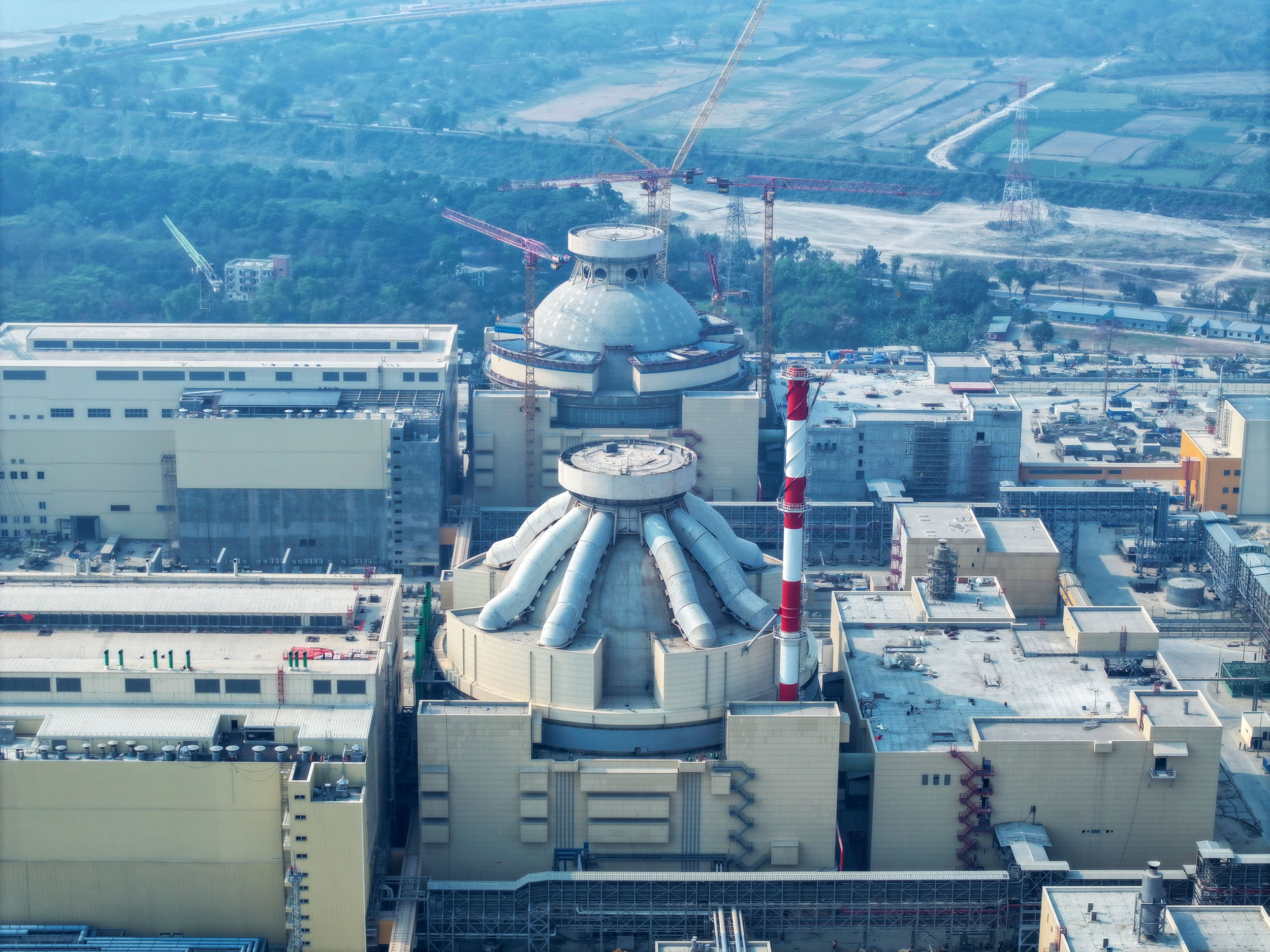
Bangladesh’s only nuclear power project (PP), the Rooppur Nuclear Power Plant, is set to face a 23% cost hike and a further delay of at least two and a half years, as the interim government moves to approve a major revision proposal ahead of the national elections.
The Tk1.13 lakh crore mega project — largely financed by the Russian government and approved in December 2016 — missed its original completion deadline in December last year, making a time extension necessary to finish the remaining work.
The project is also facing significant cost escalation, as the original estimates were prepared nine years ago when the taka was much stronger against the US dollar than it is today.
Against this backdrop, the Planning Commission is set to place the first revision proposal before the Executive Committee of the National Economic Council (Ecnec) at its meeting scheduled for Sunday.
The proposal seeks approval for a Tk26,181 crore cost increase, raising the total project cost to Tk1.40 lakh crore, along with a new completion deadline of June 2028, Planning Commission sources said.
Although the revised Development Project Proforma (DPP) was submitted to the commission much earlier, the proposal underwent prolonged scrutiny under the interim government.
Sunday’s Ecnec meeting is likely to be the last under the Muhammad Yunus-led interim government before the February 12 national elections.
“Fluctuations in foreign exchange rates during various phases of the project were not properly factored into the original cost estimates, resulting in an inaccurate projection of the total cost in taka,” a senior Planning Commission official said on condition of anonymity due to the project’s sensitivity.
“Without a reliable estimate of total expenditure, it is not possible to determine the unit cost of electricity generation or conduct a meaningful cost-benefit analysis. That is why the proposed cost revision has been recommended for Ecnec approval,” the official added.
Russia’s Exim Bank is providing a loan of US$11.38 billion — nearly Tk91,000 crore at the 2016 exchange rate — for the construction of the plant.
When the DPP was prepared, the exchange rate was estimated at Tk80 per US dollar. So far, $8.29 billion has been utilised at an average exchange rate of Tk95.28 per dollar. The remaining $3.09 billion is yet to be disbursed and has been calculated at an exchange rate of Tk122.4 per dollar.
Taking these exchange rate changes into account, Planning Ministry officials said the recommendation for the cost hike has been finalised.
Additional expenditure has also been proposed to rationalise the costs of various infrastructure components. The Bangladesh Atomic Energy Commission (BAEC) is implementing the project in Rooppur, Pabna.
At a recent meeting of the Planning Commission’s Project Evaluation Committee, the project director said costs had increased as new requirements emerged over the nine-year implementation period.
He noted that the project now requires specialised technological support, a full-operation service contract, and spare parts, as commissioning of the first unit of the 2,400MW plant — comprising two 1,200MW units — has already begun.
The government also has to bear additional costs for constructing new accommodation facilities for foreign officials of the Russian contractor, in line with an intergovernmental agreement between Bangladesh and Russia.
According to BAEC officials, physical construction and equipment installation for Unit 1 are at the final stage, but commercial operation is being delayed to ensure safety. Meanwhile, the Power Grid Company of Bangladesh completed a 400kV transmission line for the first unit in June last year, making the power evacuation system ready.
Overall, the project has achieved about 95% progress, while the second unit has reached nearly 90% physical and financial completion, officials said.
Project implementation has also been disrupted by escalating geopolitical tensions following the Russia-Ukraine war and the subsequent Western sanctions on Russia, which affected equipment supply chains.
Local officials further pointed to Bangladesh’s limited institutional capacity to oversee a project of this scale.
Energy experts have warned that repeated delays and cost overruns could undermine the project’s economic efficiency.